
Communication Systems
Get insights from 65 questions on Communication Systems, answered by students, alumni, and experts. You may also ask and answer any question you like about Communication Systems
- 65
Questions
- 0
Discussions
- 0
Active Users
- 0
Followers
Have a question about Communication Systems? Ask our experts
Keep it short & simple. Type complete word. Avoid abusive language.
The TV transmission tower at a particular station has a height of 125 m. For doubling the coverage of its range, the height of the tower should be increased by
The TV transmission tower at a particular station has a height of 125 m. For doubling the coverage of its range, the height of the tower should be increased by
According to question, we can write
Increment in height of tower = h2 – h1 = 500 – 125 = 375 m
 Upvote

A signal containing multiple frequencies is shown in figure A. It is passed through 2 different filters and then outputs are shown in figure B & C.
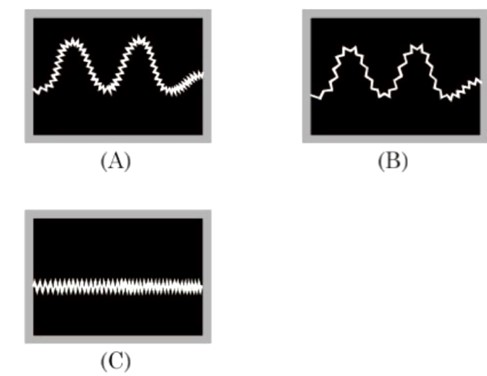
A signal containing multiple frequencies is shown in figure A. It is passed through 2 different filters and then outputs are shown in figure B & C.
Low pass filter will allow low frequency signal to pass while high pass filter allow high frequency to pass through
Upvote A wave of frequency of 10 kHz and amplitude 20 volts is being used to modulate amplitude of carrier wave of frequency 1000 kHz and peak voltage 40 volts. Choose correct option regarding carrier modulated wave.
<!-- [if !supportLineBreakNewLine]-->
<!--[endif]-->
A wave of frequency of 10 kHz and amplitude 20 volts is being used to modulate amplitude of carrier wave of frequency 1000 kHz and peak voltage 40 volts. Choose correct option regarding carrier modulated wave.
<!-- [if !supportLineBreakNewLine]-->
<!--[endif]-->
µ = A? /A? = 0.5 {A? = 20 volt, A? = 40 volt}
m (t) = A? sin ω? t {ω? = 2π×10? }
c (t) = A? sin ω? t {ω? = 2π×10×10³}
C? (t) = (A? + A? sin ω? t) sin ω? t ⇒ A? {1+ µsin ω? t} sin ω? t
Upvote For VHF signal broadcasting. km2 of maximum service area will be covered by an antenna tower of height 30m, if the receiving antenna is placed at ground. Let radius of the earth be 6400km. (Round off to the Nearest Integer) (Take π as 3.14)
For VHF signal broadcasting. km2 of maximum service area will be covered by an antenna tower of height 30m, if the receiving antenna is placed at ground. Let radius of the earth be 6400km. (Round off to the Nearest Integer) (Take π as 3.14)
Kindly consider the following figure
Upvote The amplitude of upper and lower side bands of A.M. wave where a carrier signal with frequency 11.21 MHz, peak voltage 15 V is amplitude modulate by a 7.7 kHz sine wave of 5 V amplitude are (a/10) V and ( b/10 ) V respectively. Then the value of a/b is _______.
The amplitude of upper and lower side bands of A.M. wave where a carrier signal with frequency 11.21 MHz, peak voltage 15 V is amplitude modulate by a 7.7 kHz sine wave of 5 V amplitude are (a/10) V and ( b/10 ) V respectively. Then the value of a/b is _______.
Amplitude of sidebands = µAc/2
Here µ = Am/Ac = 5/15 = 1/3
Amplitude = (1/3) (15)/2 = 2.5 V
a/10 = 2.5 => a = 25
b/10 = 2.5 => b = 25
a/b = 1
Upvote If the highest frequency modulating a carrier is 5 kHz, then the number of AM broadcast stations accommodated in a 90 kHz bandwidth are……….
If the highest frequency modulating a carrier is 5 kHz, then the number of AM broadcast stations accommodated in a 90 kHz bandwidth are……….
Band Width = 2 × n × the highest modulation frequency
Upvote A signal of 0.1 kW is transmitted in a cable. The attenuation of cable is -5dB per km and cable length is 20km. The power received at receiver is 10-xW. The value of x is…………………
[Given in dB = 10 log10 <!-- [if gte mso 9]><xml>
A signal of 0.1 kW is transmitted in a cable. The attenuation of cable is -5dB per km and cable length is 20km. The power received at receiver is 10-xW. The value of x is…………………
[Given in dB = 10 log10 <!-- [if gte mso 9]><xml>
Sound level is given in dB = 10 log
As sound level decreases 5 dB every km,
So, in 20 km sound level will decrease by 20 × 5 = 100 dB.
x = 8
Upvote Given below are two statements:
Statement I : A speech signal of 2 kHz is used to modulate a carrier signal of 1 MHz. The bandwidth.
Statement II : The side band frequencies are 1002 kHz and 998 kHz.
In the light of the above statements, choose the correct answer from the options given below:
Given below are two statements:
Statement I : A speech signal of 2 kHz is used to modulate a carrier signal of 1 MHz. The bandwidth.
Statement II : The side band frequencies are 1002 kHz and 998 kHz.
In the light of the above statements, choose the correct answer from the options given below:
Side band frequencies are 1 MHz 1 kHz
Upvote