Physics

Get insights from 5.6k questions on Physics, answered by students, alumni, and experts. You may also ask and answer any question you like about Physics

Follow Ask Question
5.6k

Questions

0

Discussions

24

Active Users

0

Followers

New answer posted

a year ago

0 Follower 4 Views

V
Vishal Baghel

Contributor-Level 10

λ R e d > λ v i o l e t

β = λ D d ⇒ Fringe width

If the source of light used in a Young's double slit experiment is changed from red to violet : consecutive fringe lines will come closer.

New answer posted

a year ago

0 Follower 3 Views

V
Vishal Baghel

Contributor-Level 10

(A) Source of microwave frequency   => Magnetron

(B) Source of infrared frequency                =>Vibration of atoms and molecules

(C) Source of Gamma rays                           => Radioactive decay of nucleus

(D) Source of x-rays                                      => inner shell electrons.
 

New answer posted

a year ago

0 Follower 9 Views

V
Vishal Baghel

Contributor-Level 10

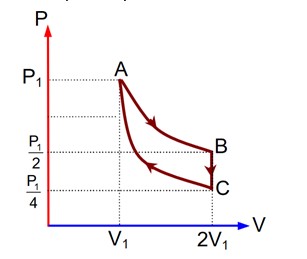
n = 1 mole

W A B = n R T l n v 2 v 1 = 1 * R T l n 2 v 1 v 1 = R T l n 2

W B C = 0

W C A = P 1 V 1 − P 2 V 2 γ − 1 = P 1 4 * 2 V 1 − P 1 * V 1 γ

⇒ W C A = − R T 2 ( γ − 1 )

∴ W t o t a l = R T [ l n 2 − 1 2 ( γ − 1 ) ]

New answer posted

a year ago

0 Follower 2 Views

V
Vishal Baghel

Contributor-Level 10

Let x = A sin ω t  & v = A ω c o s ω t

∴ v = ω A 2 − x 2

v 2 = ω 2 x 2 − ω 2 A 2

v 2 ω 2 A 2 + x 2 A 2 = 1

New answer posted

a year ago

0 Follower 2 Views

V
Vishal Baghel

Contributor-Level 10

V = 1.24 * 106 volt

λ m i n = ?

λ m i n = h c e V = 1 2 4 2 n m e ( 1 . 2 4 * 1 0 6 ) = 1 0 0 0 * 1 0 − 9 1 0 6 ⇒ λ m i n = 1 0 − 3 n m

New answer posted

a year ago

0 Follower 13 Views

V
Vishal Baghel

Contributor-Level 10

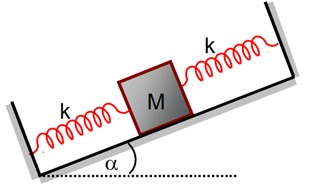
Here, K e q = 2 k

T = 2 π m 2 k

∴ f = 1 2 π 2 k m

New answer posted

a year ago

0 Follower 5 Views

V
Vishal Baghel

Contributor-Level 10

Δ E = h v → ( 1 n 2 2 − 1 n 1 2 )

(1) n1 = 3, n2 = 2

    ( 1 2 2 − 1 3 2 ) = 9 − 4 3 6 = 5 3 6         

(2) n1 = 4, n2 = 3

( 1 3 2 − 1 4 2 ) = 1 6 − 9 1 4 4 = 7 1 4 4        

(3) n1 = 2, n2 = 1

( 1 1 2 − 1 2 2 ) = 4 − 1 4 = 3 4  

(4) n1 = 5, n2 = 4

( 1 4 2 − 1 5 2 ) = 2 5 − 1 6 4 0 0 = 9 4 0 0

New answer posted

a year ago

0 Follower 6 Views

V
Vishal Baghel

Contributor-Level 10

F n e t = 2 k e e ( d 2 + x 2 ) s i n θ = ( 2 k e 2 ( d 2 + 2 ) ) θ

[for small displacement i.e, x is small so|, sin ≈ ≈   tan ]

= 2 k e 2 ( d 2 + x 2 ) . x d = 2 . 1 4 π ε 0 q 2 x d 3   [q = e]

= q 2 2 π ε 0 d 3 x = m ω 2 x

∴ ω = q 2 2 π ε 0 d 3 m

New answer posted

a year ago

0 Follower 4 Views

V
Vishal Baghel

Contributor-Level 10

F = − α x 2 ⇒ m v d v d x = − α x 2

⇒ ∫ v 0 0 v d v = − α m ∫ 0 x x 2 d x ⇒ 0 2 2 − v 0 2 2 = − α 3 m x 3

⇒ − v 0 2 2 = − α 3 m x 3 ⇒ x = ( 3 v 0 2 m 2 α ) 1 / 3

New answer posted

a year ago

0 Follower 4 Views

V
Vishal Baghel

Contributor-Level 10

A tristor is formed by doping a semi conductor water from one side by N-type dopant (high concentration while comparatively lower concentration on other side thus forming NPN tristor & vice-versa.

So, statement (I) is false & statement (II) is true.

Get authentic answers from experts, students and alumni that you won't find anywhere else

Sign Up on Shiksha

On Shiksha, get access to

  • 67k Colleges
  • 1.2k Exams
  • 718k Reviews
  • 1850k Answers

Share Your College Life Experience

×
×

This website uses Cookies and related technologies for the site to function correctly and securely, improve & personalise your browsing experience, analyse traffic, and support our marketing efforts and serve the Core Purpose. By continuing to browse the site, you agree to Privacy Policy and Cookie Policy.