Physics

Get insights from 5.6k questions on Physics, answered by students, alumni, and experts. You may also ask and answer any question you like about Physics

Follow Ask Question
5.6k

Questions

0

Discussions

24

Active Users

0

Followers

New answer posted

a year ago

0 Follower 8 Views

A
alok kumar singh

Contributor-Level 10

According to transformer ratio,

V S V P = N S N P = 2 : 1

New answer posted

a year ago

0 Follower 11 Views

A
alok kumar singh

Contributor-Level 10

Excess force  = T * 2 π R

= 7 1 0 0 * 2 * 3 . 1 4 * 4 . 5 1 0 0

= 1 9 7 . 8 2 * 1 0 − 4

=19.8*10−3 N

=19.8mN

New answer posted

a year ago

0 Follower 26 Views

A
alok kumar singh

Contributor-Level 10

Energy difference Δ E = h c λ

∴ λ ∝ 1 Δ E

( Δ E ) 6 − 2 > ( Δ E ) 5 − 2 > ( Δ E ) 4 − 2 > ( Δ E ) 3 − 2

λ 6 − 2 < λ 5 − 2 < λ 4 − 2 < λ 3 − 2

 A-III,  B-IV,  C-II,  D-I 


New answer posted

a year ago

0 Follower 6 Views

A
alok kumar singh

Contributor-Level 10

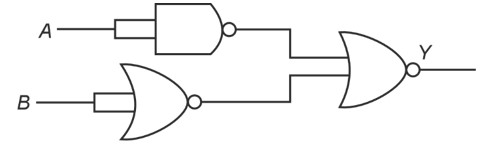
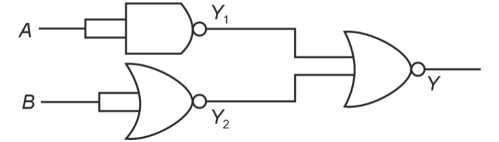
Y 1 = A · A ¯

= A ¯

Y 2 = B + B ¯

= B ¯

Y = Y 1 + Y 2 ¯

= A ¯ + B ¯ ¯

= A ¯ ¯ · B ¯ ¯

=A·B is similar to output of AND Gate 

New answer posted

a year ago

0 Follower 9 Views

A
alok kumar singh

Contributor-Level 10

(A) If c  is the velocity of light

so,   E = h ν   (Energy of photon)

(B) Velocity of photon is equal to velocity of light i.e. c.

(C)  λ = h p

p = h λ

p = h v c

(D) In photon-electron collision both total energy and total momentum are conserved.

New answer posted

a year ago

0 Follower 3 Views

S
Syed Aquib Ur Rahman

Contributor-Level 10

 For SHM, kinetic and potential energies are equal when displacement x = ± A 2  , where A is the amplitude. At this point, total energy is evenly shared between motion and position-dependent restoring forces.

New answer posted

a year ago

0 Follower 17 Views

A
alok kumar singh

Contributor-Level 10

At central point on screen, path difference is zero for all wavelength. So, central bright fringe is white and other fringes depend on wavelength as β = λ D d .

Therefore, other fringes will be coloured.

New answer posted

a year ago

0 Follower 6 Views

A
alok kumar singh

Contributor-Level 10

V . C = M S D − V S D     … (i)

given :  (N+1)VSD=NMSD

VSD= (NN+1)MSD     … (ii)

From (1) and (2)

V . C = ( MSD ) − N N + 1 ( MSD )

=MSD (1−NN+1)=MSDN+1

= 0 . 0 1 N + 1 = 1 1 0 0 ( N + 1 )

New answer posted

a year ago

0 Follower 2 Views

S
Syed Aquib Ur Rahman

Contributor-Level 10

In SHM, the restoring force, F is directly proportional to the negative of displacement. That is, F=- kx. This follows Hooke's law and ensures motion is oscillatory about the mean position with angular frequency,  

ω = k m

New answer posted

a year ago

0 Follower 45 Views

A
alok kumar singh

Contributor-Level 10

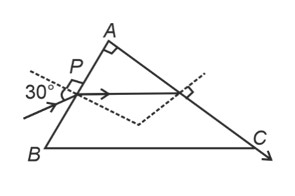
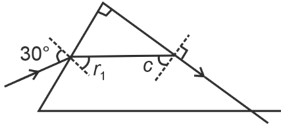
A = 9 0 ?

In prism,  r 1 + c = A

r 1 = 9 0 ? − c                  …(i)

sinc=1μ⇒cosc=μ2−1μ

⇒ Apply Snell's law, on incidence surface

1·sin30?=μsin(r1)⇒1*12=μ*sin(90?−c)

1 2 = μ * μ 2 − 1 μ

On squaring  1 4 = μ 2 − 1

⇒ μ 2 = 5 4 ⇒ μ = 5 2

Get authentic answers from experts, students and alumni that you won't find anywhere else

Sign Up on Shiksha

On Shiksha, get access to

  • 67k Colleges
  • 1.2k Exams
  • 718k Reviews
  • 1850k Answers

Share Your College Life Experience

×
×

This website uses Cookies and related technologies for the site to function correctly and securely, improve & personalise your browsing experience, analyse traffic, and support our marketing efforts and serve the Core Purpose. By continuing to browse the site, you agree to Privacy Policy and Cookie Policy.