Physics

Get insights from 5.6k questions on Physics, answered by students, alumni, and experts. You may also ask and answer any question you like about Physics

Follow Ask Question
5.6k

Questions

0

Discussions

24

Active Users

0

Followers

New answer posted

a year ago

0 Follower 2 Views

S
Syed Aquib Ur Rahman

Contributor-Level 10

Uniform circular motion has constant speed. But SHM requires velocity and acceleration to vary sinusoidally with displacement. SHM is the projection of uniform circular motion. But it's not the motion itself, due to differing energy and force characteristics.

New answer posted

a year ago

0 Follower 5 Views

A
alok kumar singh

Contributor-Level 10

A particle moving with uniform speed in a circular path maintains varying velocity and varying acceleration. It is because direction of both velocity as well as acceleration will change continuously.

New answer posted

a year ago

0 Follower 2 Views

A
alok kumar singh

Contributor-Level 10

A m a x = A c + A m

A m i n = A c − A m

A m i n A m a x = A c − A m A c + A m = 2 5 0 − 1 5 0 2 5 0 + 1 5 0

⇒ 1 0 0 4 0 0 = 5 0 2 0 0  

New answer posted

a year ago

0 Follower 6 Views

A
alok kumar singh

Contributor-Level 10

By work energy theorem

Work done = change in K.E.

Work done by friction work done by spring

= 0 − 1 2 m V 2              

As 90% of K.E. is losed by friction so that

− 9 0 1 0 0 ( 1 2 m V 2 ) − 1 2 K x 2 = − 1 2 m V 2                

-K -> -16 * 105

K = 16 * 105

New answer posted

a year ago

0 Follower 17 Views

A
alok kumar singh

Contributor-Level 10

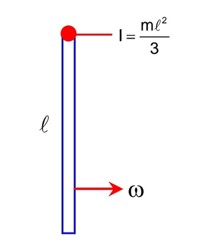
l = m l 2 3  

Energy conservation Low

m g l = 1 2 m l 2 3 ω 2 . . . . . ( i )                

And speed V =    ω r = ω l

then    V = 6 g l = 6 * 1 0 * . 6

->6 m/s


New answer posted

a year ago

0 Follower 4 Views

A
alok kumar singh

Contributor-Level 10

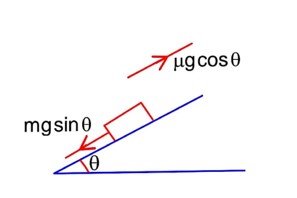
for smooth surface

a = g s i n 3 0 ° = g 2

S 1 = u t + 1 2 a t 2         

S 1 = 1 2 g 2 t 2 = g 4 t 2 . . . . . . . ( i )               

for rough Surface

S = 1 2 g 2 ( 1 − μ 3 ) α 2 t 2 . . . . . . . . ( i i )               

By (i) and (ii)

μ = 1 3 ( α 2 − 1 α 2 ) x = 3            


New answer posted

a year ago

0 Follower 3 Views

A
alok kumar singh

Contributor-Level 10

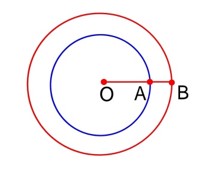
For A satellite T1 = 1hour

S o     ω 1 = 2 π r e d / h o u r                

for B satellite T2 = 8 hour

given R1 = 2 * 103 Km

Relative  ω = V 1 − V 2 R 2 − R 1 = 2 π * 1 0 3 6 * 1 0 3  

⇒ π 3 rad/hour

 x = 3


New answer posted

a year ago

0 Follower 7 Views

A
alok kumar singh

Contributor-Level 10

K.E. energy of electron = eV

Translational K.E. of N2 =   3 2 K T

So eV = 3 2 K T  

1 . 6 * 1 0 − 1 9 * 0 . 1 = 3 2 * 1 . 3 8 * 1 0 − 2 3 * T                

T = 773 – 273 = 500°C

New answer posted

a year ago

0 Follower 33 Views

A
alok kumar singh

Contributor-Level 10

Since process is isochoric

So    Δ U = n C v Δ T


Δ U = n ( 5 2 R ) Δ T − − ( i ) [ C V = 5 2 R ]      

And external work


Δ W = n R Δ T − − ( i i )    

5 2 = x 1 0 ⇒ x = 2 5 . 0 0                

New answer posted

a year ago

0 Follower 5 Views

A
alok kumar singh

Contributor-Level 10

In first condition R1 = 36 Ω  

In second condition R2 = 18  Ω

P 1 = V 2 R 1 = ( 2 4 0 ) 2 3 6               

P 2 = V 2 R 2 + V 2 R 2 = ( 2 4 0 ) 2 1 8 + ( 2 4 0 ) 2 1 8               

P 2 = ( 2 4 0 ) 2 9               

So   P 1 P 2 = ( 2 4 0 ) 2 / 3 6 ( 2 4 0 ) 2 / 9 = 1 4

x = 4

Get authentic answers from experts, students and alumni that you won't find anywhere else

Sign Up on Shiksha

On Shiksha, get access to

  • 67k Colleges
  • 1.2k Exams
  • 718k Reviews
  • 1850k Answers

Share Your College Life Experience

×
×

This website uses Cookies and related technologies for the site to function correctly and securely, improve & personalise your browsing experience, analyse traffic, and support our marketing efforts and serve the Core Purpose. By continuing to browse the site, you agree to Privacy Policy and Cookie Policy.