Physics

Get insights from 5.6k questions on Physics, answered by students, alumni, and experts. You may also ask and answer any question you like about Physics

Follow Ask Question
5.6k

Questions

0

Discussions

30

Active Users

0

Followers

New answer posted

6 months ago

0 Follower 2 Views

P
Payal Gupta

Contributor-Level 10

Conservation of Energy b/w (1) & (2)

1 2 m v 2 + m g l = 1 2 m u 2

v = u 2 2 g l

Δ v = v j ^ u i ^

| Δ v | = ( u ) 2 + ( u 2 2 g l ) 2

= u 2 + u 2 2 g l

= 2 ( u 2 g l )

x = 2

New answer posted

6 months ago

0 Follower 2 Views

P
Payal Gupta

Contributor-Level 10

F.B.D, with respect to Non-Inertial frame

k x = m ω 2 ( l 0 + x )

x | k m ω 2 ( l 0 + x )

x = m ω 2 l 0 k m ω 2


New answer posted

6 months ago

0 Follower 8 Views

P
Payal Gupta

Contributor-Level 10

Total time (T) = 4 sec

Given u = 0 m/sec

a = g = 9.8 m/sec2

h = 4.9 m, t =?

h = u t + 1 2 a t 2                

4 . 9 = 0 . t + 1 2 * 9 . 8 t 2                

t = 1 sec

'v' be the velocity with which ball hits the water v = u + at

= 0 + 9.8 * 1 = 9.8 m/sec

Time taken to reach the bottom of the lake from surface of the lake

= 4 – 1 = 3 sec

v = 9.8 m/sec

H = u t + 1 2 g t 2 = 9 . 8 * 3 + 1 2 * 9 . 8 * 9                

29.4 + 4.9 * 9 = 29.4 + 44.1

H = 73.5 m

New answer posted

6 months ago

0 Follower 21 Views

P
Payal Gupta

Contributor-Level 10

1° →  60'

⇒ 60' → 10°

6 0 ' π 1 8 0 C

θ = π * 2 * 1 0 3 1 8 0 * 3 6 0 0          

L = 1.5 * 1011 m

D = L θ = 1 . 5 * 1 0 1 1 * π 1 8 0 * 3 6 0 0 * 2 * 1 0 3 = 1 . 4 5 * 1 0 9 m    


New question posted

6 months ago

0 Follower 2 Views

New question posted

6 months ago

0 Follower 1 View

New answer posted

6 months ago

0 Follower 6 Views

P
Payal Gupta

Contributor-Level 10

S. I. unit Pascal – second   = N m 2 s e c  

= M L T 2 T L 2  

= M L 1 T 1  

New answer posted

6 months ago

0 Follower 2 Views

A
alok kumar singh

Contributor-Level 10

1°  ® 60'

              Þ 60' ® 10°


              L = 1.5 * 1011 m


New question posted

6 months ago

0 Follower 1 View

New answer posted

6 months ago

0 Follower 3 Views

A
alok kumar singh

Contributor-Level 10

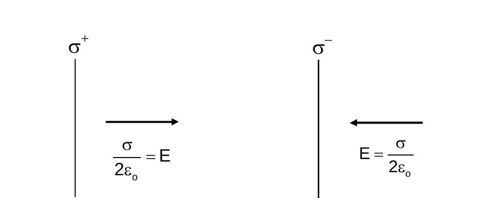
2.16 Electric field on one side of a charged body is E1 and electric field on the other side of the same body is E2. If infinite plane charged body has a uniform thickness, then electric field due to one surface of the charged body is given by,

E1? = σ2ε0n? ………….(i)

Where,

n? = unit vector normal to the surface at a point

σ = surface charge density at that point

Electric field due to the other surface of the charged body is given by

E2? = σ2ε0n? ………….(ii)

Electricfieldatanypoint due to the two surfaces,

E2?-E1?=σ2ε0n?+σ2ε0n?=σε0n? ……(iii)

Sinceinsideaclosedconductor,E1?=0,

E? = E2? = σε0n?

Therefore, the electric field just outside the conductor is σε0n?

W

...more

Get authentic answers from experts, students and alumni that you won't find anywhere else

Sign Up on Shiksha

On Shiksha, get access to

  • 66k Colleges
  • 1.2k Exams
  • 684k Reviews
  • 1800k Answers

Share Your College Life Experience

×
×

This website uses Cookies and related technologies for the site to function correctly and securely, improve & personalise your browsing experience, analyse traffic, and support our marketing efforts and serve the Core Purpose. By continuing to browse the site, you agree to Privacy Policy and Cookie Policy.