Moving Charges and Magnetism
Get insights from 125 questions on Moving Charges and Magnetism, answered by students, alumni, and experts. You may also ask and answer any question you like about Moving Charges and Magnetism
- 125
Questions
- 0
Discussions
- 0
Active Users
- 0
Followers
Have a question about Moving Charges and Magnetism? Ask our experts
Keep it short & simple. Type complete word. Avoid abusive language.
There are two types of electricity - static and current. The current electricity is divided into Alternating Current (AC) and Direct Current (DC). Based on the production methods, electricity is divided into - heat, chemical, pressure, light and magnetism.
 Upvote

There are four types of power supply - switch-mode power supplies, linear power supplies, linear power supplies, and programmable power supplies
Upvote According to this law, at any point, magnetic field due to a tiny current element is directly proportional to the current element length.
Upvote In Moving Charges and Magnetism, what is SI Unit of magnetic field?
In Moving Charges and Magnetism, what is SI Unit of magnetic field?
Tesla (T) is the SI unit of magnetic field. Tesla is named after Nikola Tesla.
Upvote According to chapter 4 physics class 12 Moving Charges and Magnetism, what are the types of magnetism?
According to chapter 4 physics class 12 Moving Charges and Magnetism, what are the types of magnetism?
The different types of magnetism are - Diamagnetism, Paramagnetism, and Ferromagnetism.
Upvote What is the formula for the force per unit length between two parallel current-carrying conductors?
What is the formula for the force per unit length between two parallel current-carrying conductors?
The exact formula for the magnetic force per unit length between two parallel current-carrying conductors:
For more information, check: Force between parallel conductors
Upvote A uniform conducting wire of length 12a and resistance ' R ' is wound up as a current
carrying coil in the shape of,
(i) an equilateral triangle of side ' a '.
(ii) a square of side ' a '.
The magnetic dipole moments of the coil in each case respectively are:
<!-- [if !supportLineBreakNewLine]-->
<!--[endif]-->
A uniform conducting wire of length 12a and resistance ' R ' is wound up as a current
carrying coil in the shape of,
(i) an equilateral triangle of side ' a '.
(ii) a square of side ' a '.
The magnetic dipole moments of the coil in each case respectively are:
<!-- [if !supportLineBreakNewLine]-->
<!--[endif]-->
M? = (√3/4 a²)I × 4 = √3I² no. of turns = 4
M? = a²I × 3 = 3Ia² no. of turns = 3
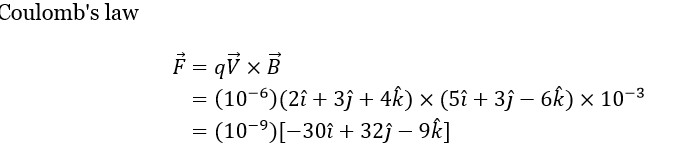
Upvote A charged particle carrying charge 1µC is moving with velocity (2î + 3ĵ + 4k) ms⁻¹. If an external magnetic field of (5î + 3ĵ – 6k) × 10⁻³T exists in the region where the particle is moving then the force on the particle is F⃗ × 10⁻⁹ N. The vector F⃗ is:
A charged particle carrying charge 1µC is moving with velocity (2î + 3ĵ + 4k) ms⁻¹. If an external magnetic field of (5î + 3ĵ – 6k) × 10⁻³T exists in the region where the particle is moving then the force on the particle is F⃗ × 10⁻⁹ N. The vector F⃗ is: