

Physics
Get insights from 5.6k questions on Physics, answered by students, alumni, and experts. You may also ask and answer any question you like about Physics
Follow Ask QuestionQuestions
Discussions
Active Users
Followers
New answer posted
a year agoContributor-Level 10
This is a Short Answer Type Questions as classified in NCERT Exemplar
Explanation- yes, the magnetic force differ from inertial frame to frame. The magnetic force is frame dependent.
The net acceleration which comes into existing out of this is however, frame independent for inertial frames.
New answer posted
a year agoContributor-Level 10
This is a short answer type question as classified in NCERT Exemplar
The force on a charge particle in electric field F = qE
The free electrons (negative charge) experience electrostatic force in a direction opposite to the direction of electric field.
The direction of electric field is always from higher potential to lower. Hence direction of travel of electrons is from lower potential to region of higher potential.
New answer posted
a year agoContributor-Level 10
This is a short answer type question as classified in NCERT Exemplar
Surface charge density is inversely proportional to radius of the sphere so larger sphere has less charge density and vice versa.
New answer posted
a year agoContributor-Level 10
This is a long answer type question as classified in NCERT Exemplar
Suppose the charge is slightly shifted to left so net potential energy will be
U=
U=
=
System will be in equilibrium if this energy is zero
But when we double differentiate it

But when x<0 this value is negative so less than 0
This shows an unstable equilibrium
It follows the parabolic graph

New answer posted
a year agoContributor-Level 10
This is a long answer type question as classified in NCERT Exemplar
Let any three point x,y,z seprated by a distance 2d
Then potential due to two charges
=0
=
X2+Y2+z2+ (2zd)+d2-0
this is equation of sphere .
New answer posted
a year agoContributor-Level 10
This is a long answer type question as classified in NCERT Exemplar
=charge/Area
Q= (2 )
V=KdQ/ 2+x2)=K (2 )/ 2+x2)

After integration we got
V= 2 ( )-x
New answer posted
a year agoContributor-Level 10
This is a Short Answer Type Questions as classified in NCERT Exemplar
Explanation- dW=F.dl=0
As dl = vdt
dW= Fvdt
dW= f.v=0
New answer posted
a year ago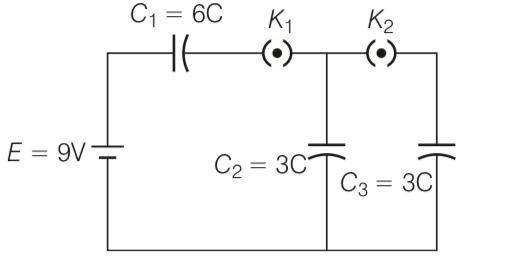
Contributor-Level 10
This is a long answer type question as classified in NCERT Exemplar
When initially K1 is closed and K2 is open, the capacitors C1 and C2 connected in series with battery
Q=CV=C (C1C2/C1+C2) = 6 3/6+3=18 C
Now K1 was opened and K2 was closed, the battery and capacitor C, are disconnected from the circuit .
Here charge being shared by both capacitor so a common potential will develop.
V=C1V1+C2V2/C1+C2 = 18/3+3=3V
Q2=3CV=3 3=9μC
Q3=3CV=3 3=9μC
New answer posted
a year ago
Contributor-Level 10
This is a Long Answer Type Questions as classified in NCERT Exemplar
Explanation- (a) Suppose the five wires A, B, C, D and E be perpendicular to the plane of paper at locations as shown in figure.
Thus, magnetic field induction due to five wires will be represented by various sides of a
closed pentagon in one order, lying in the plane of paper. So, its value is zero.
(b) Since, the vector sum of magnetic field produced by each wire at O is equal to 0.
Therefore, magnetic induction produced by one current carrying wire is equal in
magnitude of resultant of four wires and opposite in direction.
Therefore, the field if current in one of the wi
New answer posted
a year agoContributor-Level 10
This is a long answer type question as classified in NCERT Exemplar
As we know that, =charge/Area
Q1= (4 2)
Q2= (4 2)= 4Q1
when they come in contact with each other potential being same and charge will be conserved.
So net charge is 5Q1= 5 ( (4 2)
Also V1=V2
KQ1/R=KQ2/2R so Q1=Q2/2
Q1= (4 2) and Q2= (4 2)
=5 /3 and =5 /6
Taking an Exam? Selecting a College?
Get authentic answers from experts, students and alumni that you won't find anywhere else
Sign Up on ShikshaOn Shiksha, get access to
- 67k Colleges
- 1.2k Exams
- 718k Reviews
- 1850k Answers