

Physics
Get insights from 5.6k questions on Physics, answered by students, alumni, and experts. You may also ask and answer any question you like about Physics
Follow Ask QuestionQuestions
Discussions
Active Users
Followers
New answer posted
a year ago
Contributor-Level 10
This is a Long Answer Type Questions as classified in NCERT Exemplar
Explanation- iG (G) = (I1-IG) (S1+S2+S3) for I1= 10mA
iG (G+S1) = (I2-IG) (S2+S3) for I2= 100mA
iG (G+S1+S2) = (I3-IG) (S3) for I3= 1A
S1= 1W, S2= 0,1W and S3= 0.01W
New answer posted
a year agoContributor-Level 10
This is a Long Answer Type Questions as classified in NCERT Exemplar
Explanation- B (z) points in the same direction on z-axis and hence, J (L) isa monotonically function of L so B.dl = B.dl as cos 0 = 1
(b) but when L
So B 1/r3
(c) the magnetic field due to a circular current carrying loop of radius in the xy plane with centre at origin at any point lying at a distance of from origin.

B=
Z=Rtan
dz=Rsec2
=
New question posted
a year agoNew answer posted
a year agoContributor-Level 10
This is a long answer type question as classified in NCERT Exemplar
Potential energy of system of charges be algebraic sum
U =
9 109/10-15 (1.6 -19)2 (1/3)2- (2/3) (1/3)- (2/3) (1/3)
-7.68 10-14J
-7.68 10-14 -19= 0.48Mev
New answer posted
a year agoContributor-Level 10
This is a Long Answer Type Questions as classified in NCERT Exemplar
Explanation- B (z) points in the same direction on z-axis and hence, J (L) isa monotonically function of L so B.dl = B.dl as cos 0 = 1
(b) but when L
So B 1/r3
(c) the magnetic field due to a circular current carrying loop of radius in the xy plane with centre at origin at any point lying at a distance of from origin.
B=
Z=Rtan
dz=Rsec2
=
New answer posted
a year agoContributor-Level 10
This is a Long Answer Type Questions as classified in NCERT Exemplar
Explanation- as we know magnetic moment = nIA
For equilateral triangle M= nIA= 4I ( )
M= Ia2
For square, n=3 so total length of wire is 12a
M= nIA= 3I (a2) = 3Ia2
For regular hexagon of side a, n=2 so total length = 12a
M= nIA=2 ( )= 3 a2I
New answer posted
a year agoContributor-Level 10
This is a Long Answer Type Questions as classified in NCERT Exemplar
Explanation- Since, B is along the x-axis, for a circular orbit the momenta of the two particles are in the y-z plane. Let P1 and P2 be the momentum of the electron and positron, respectively. Both traverse a circle of radius R of opposite sense. Let P1 make an angle? with the y-axis P2 must make the same angle.

The centres of the respective circles must be perpendicular to the momenta and at a distance R. Let the centre of the electron be at Ce and of the positron at Cp . The coordinates of Ce is
Ce= (0, -Rsin )
Cp= (0, -Rsin )
The circles of the two
New answer posted
a year agoContributor-Level 10
This is a Long Answer Type Questions as classified in NCERT Exemplar
Explanation- the thicker wire has a resistance R, then the other wire has a resistance @R as the wires are of the same material but different area


New answer posted
a year ago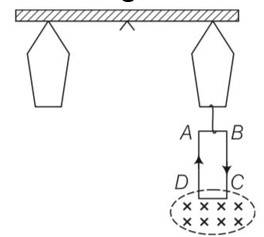
Contributor-Level 10
This is a Long Answer Type Questions as classified in NCERT Exemplar
Explanation – for equilibrium balance net torque should be zero
Mgl= Wcoill
500gl = Wcoill
Wcoil= 500 9.8N
Taking moment of force about mid point then magnetic field
Mgl+mgl=Wcoill+IBlsin90
Mgl=BILl
M= -3kg= 1g
New question posted
a year agoTaking an Exam? Selecting a College?
Get authentic answers from experts, students and alumni that you won't find anywhere else
Sign Up on ShikshaOn Shiksha, get access to
- 67k Colleges
- 1.2k Exams
- 718k Reviews
- 1850k Answers