
Physics Wave Optics
Get insights from 101 questions on Physics Wave Optics, answered by students, alumni, and experts. You may also ask and answer any question you like about Physics Wave Optics
- 101
Questions
- 0
Discussions
- 0
Active Users
- 0
Followers
Have a question about Physics Wave Optics? Ask our experts
Keep it short & simple. Type complete word. Avoid abusive language.
Sodium light of wavelength 650nm and 655 nm is used to study diffraction at a single slit of aperture 0.5 mm. The distance between the slit and the screen is 2.0 m. The separation between the positions of the first maximum of diffraction pattern obtained in the two cases is _________× 10-5 m.
Sodium light of wavelength 650nm and 655 nm is used to study diffraction at a single slit of aperture 0.5 mm. The distance between the slit and the screen is 2.0 m. The separation between the positions of the first maximum of diffraction pattern obtained in the two cases is _________× 10-5 m.
.For maxima = y = (2n + 1)
For 1st maxima for l1 wavelength (n = 1)
- (1)
First maxima for l2 wavelength
- (2)
 Upvote

In a double slit experiment with monochromatic light, fringes are obtained on a screen placed at some distance from the plane of slits. If the screen is moved by 5 × 10⁻²m towards the slits, the change in fringe width is 3 × 10⁻³cm. If the distance between the slits is 1mm, then the wavelength of the light will be_____________ nm.
In a double slit experiment with monochromatic light, fringes are obtained on a screen placed at some distance from the plane of slits. If the screen is moved by 5 × 10⁻²m towards the slits, the change in fringe width is 3 × 10⁻³cm. If the distance between the slits is 1mm, then the wavelength of the light will be_____________ nm.
According to Young’s double slit experiment, we can write
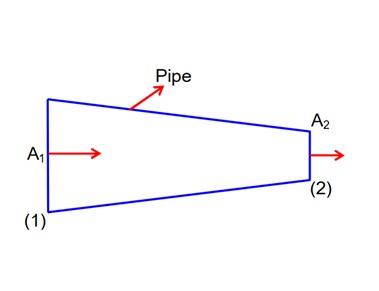
Upvote A liquid of density 750 kgm-3 flows smoothly through a horizontal pipe that tapers in cross-sectional area from A1 = 1.2 × 10⁻²m2 to A2 = <!-- [if gte mso 9]><xml>
A liquid of density 750 kgm-3 flows smoothly through a horizontal pipe that tapers in cross-sectional area from A1 = 1.2 × 10⁻²m2 to A2 = <!-- [if gte mso 9]><xml>
Given A2 =
Bernoulli’s b/w (1) & (2)
z1 = z2]
[Q = A1V1 = A2V2]
= 2.4 × 10⁻² m3 /sec
= 24 × 10-3 m3 /sec
= 24
Upvote In young’s double slit experiment performed using a monochromatic light of wavelength when a glass plate <!-- [if gte mso 9]><xml>
In young’s double slit experiment performed using a monochromatic light of wavelength when a glass plate <!-- [if gte mso 9]><xml>
Þ AC = d + t
BC = d
path different = AC – BC =
for contal maxima
Þ
0.5x = x
n = 0, 1,2- -
n = 0 Not possible
Now
Upvote Using Young’s double slit experiment, a monochromatic light of wavelength 5000 <!-- [if gte mso 9]><xml>
Using Young’s double slit experiment, a monochromatic light of wavelength 5000 <!-- [if gte mso 9]><xml>