
Probability
Get insights from 206 questions on Probability, answered by students, alumni, and experts. You may also ask and answer any question you like about Probability
- 206
Questions
- 0
Discussions
- 0
Active Users
- 0
Followers
Have a question about Probability? Ask our experts
Keep it short & simple. Type complete word. Avoid abusive language.
The probability that a randomly chosen 5 - digit number is made from exactly two digits is:
<!-- [if !supportLineBreakNewLine]-->
<!--[endif]-->
The probability that a randomly chosen 5 - digit number is made from exactly two digits is:
<!-- [if !supportLineBreakNewLine]-->
<!--[endif]-->
Total = 9 (10? )
Fav. Way =? C? (2? -2) +? C? (2? -1) = 36 (30) + 9 (15) = 1080 + 135
Probability = (36x30+9x15)/ (9x10? ) = (4x30+15)/10? = 135/10?
 Upvote

A die is thrown two times and the sum of the scorers appearing on the die is observed to be a multiple of 4. Then the conditional probability that the score 4 has appeared at least once is
<!-- [if !supportLineBreakNewLine]-->
<!--[endif]-->
A die is thrown two times and the sum of the scorers appearing on the die is observed to be a multiple of 4. Then the conditional probability that the score 4 has appeared at least once is
<!-- [if !supportLineBreakNewLine]-->
<!--[endif]-->
Sum obtained is a multiple of 4.
A = { (1,3), (2,2), (3,1), (2,6), (3,5), (4,4), (5,3) (6,2), (6,6)}
B: Score of 4 has appeared at least once.
B = { (1,4), (2,4), (3,4), (4,4), (5,4), (6,4), (4,1), (4,2), (4,3), (4,5), (4,6)}
Required probability = P (B/A) = P (B? A)/P (A)
= (1/36) / (9/36) = 1/9
Upvote 
Box I contains 30 cards numbered 1 to 30 and Box II contains 20 cards numbered 31 to 50. A box is selected at random and a card is drawn from it. The number on the card is found to be a non-prime number. The probability that the card was drawn from Box I is:
<!-- [if !supportLineBreakNewLine]-->
<!--[endif]-->
Let B? be the event where Box-I is selected and B? →where box-II selected
P (B? )=P (B? )=1/2
Let E be the event where selected card is non prime.
For B? : Prime numbers: {2,3,5,7,11,13,17,19,23,29}
For B? : Prime numbers: {31,37,41,43,47}
P (E)=P (B? )×P (E/B? )+P (B? )P (E/B? )
= 1/2×20/30+1/2×15/20
Requ
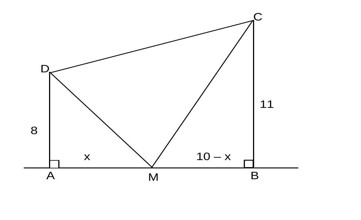
Upvote Let AD and BC be two vertical poles at A and B respectively on a horizontal ground. If AD=8m, BC=11m and AB=10m; then the distance (in meters) of a point M on AB from the point A such that MD²+MC² is minimum is [numerical value].
Let AD and BC be two vertical poles at A and B respectively on a horizontal ground. If AD=8m, BC=11m and AB=10m; then the distance (in meters) of a point M on AB from the point A such that MD²+MC² is minimum is [numerical value].
MD²+MC² is minimum when M is the midpoint of projection of CD on AB.
Upvote If {p} denotes the fractional part of the number p, then {3²⁰⁰/8}, is equal to
If {p} denotes the fractional part of the number p, then {3²⁰⁰/8}, is equal to
(80+1)? /8 = (¹C?80? +.+¹C? )/8. Remainder is 1/8.
Upvote Out of 11 consecutive natural numbers if three numbers are selected at random (without repetition), then the probability that they are in A.P. with positive common difference, is:
<!-- [if !supportLineBreakNewLine]-->
<!--[endif]-->
Out of 11 consecutive natural numbers if three numbers are selected at random (without repetition), then the probability that they are in A.P. with positive common difference, is:
<!-- [if !supportLineBreakNewLine]-->
<!--[endif]-->
Required probability = (? C? +? C? )/¹¹C? = 25/165=5/33.
Upvote The area (in sq. units) of the region A={(x,y): |x|+|y|≤1, 2y²≥|x|} is:
<!-- [if !supportLineBreakNewLine]-->
<!--[endif]-->
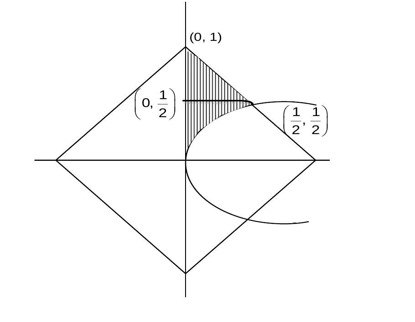
The area (in sq. units) of the region A={(x,y): |x|+|y|≤1, 2y²≥|x|} is:
<!-- [if !supportLineBreakNewLine]-->
<!--[endif]-->
Required area = 4 [∫? ¹/² 2y²dy + ½×½×1] = 5/6.
Upvote