
Probability
Get insights from 206 questions on Probability, answered by students, alumni, and experts. You may also ask and answer any question you like about Probability
- 206
Questions
- 0
Discussions
- 0
Active Users
- 0
Followers
Have a question about Probability? Ask our experts
Keep it short & simple. Type complete word. Avoid abusive language.
Out of 60% female and 40% male candidates appearing in an exam, 60% candidates qualify it. The number of females qualifying the exam is twice the number of males qualifying it. A candidate is randomly chosen from the qualified candidates. The probability, that the chosen candidate is a female, is:
Out of 60% female and 40% male candidates appearing in an exam, 60% candidates qualify it. The number of females qualifying the exam is twice the number of males qualifying it. A candidate is randomly chosen from the qualified candidates. The probability, that the chosen candidate is a female, is:
Probability that chosen candidate is female
 Upvote

If A and B are two events such that P(A) = , P(B) = and then is equal to
If A and B are two events such that P(A) = , P(B) = and then is equal to
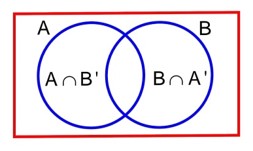
The sum and product of the main and variance of a binomial distribution are 82.5 and 1350 respectively. Then the number of trials in the binomial distribution is……………
The sum and product of the main and variance of a binomial distribution are 82.5 and 1350 respectively. Then the number of trials in the binomial distribution is……………
np + npq = 82.5 Þ np (1 + q) = 82.5
n = ?
-> 24q2 – 73q + 24 = 0
q
n = 96
Upvote Let E1 and E2 be two events such that conditional probabilities
Then:
Let E1 and E2 be two events such that conditional probabilities
Then:
If a random variable X follows the Binomial distribution B (33, p) such that 3P (X = 0) = P (X = 1) then the value of is equal to :L
If a random variable X follows the Binomial distribution B (33, p) such that 3P (X = 0) = P (X = 1) then the value of is equal to :L
n = 33, p = success, q = failure
3P (x = 0) = P (x = 1)
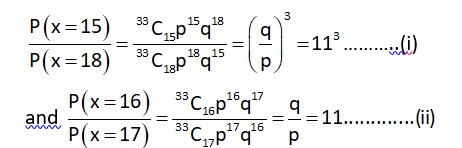
Subtracting, (ii) – (i), we get 1320
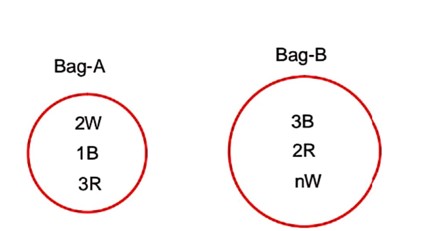
Upvote Bag A contains 2 white, 1 black and 3 red balls and bag B contains 3 black, 2 red and n white balls. One bag is chosen at random and 2 balls drawn from it at random are found to be 1 red and 1 black. If the probability that both balls come from Bag A is <!-- [if gte mso 9]><xml>
Bag A contains 2 white, 1 black and 3 red balls and bag B contains 3 black, 2 red and n white balls. One bag is chosen at random and 2 balls drawn from it at random are found to be 1 red and 1 black. If the probability that both balls come from Bag A is <!-- [if gte mso 9]><xml>
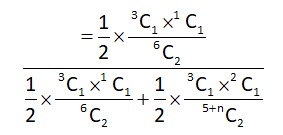
After solving, we get n = 4
Upvote In an examination, there are 1- true-false type questions. Out of 10, at student can guess the answer of 4 questions correctly with probability and the remaining 6 questions correctly with probability . If the probability that the student guesses the answer of exactly 8 questions correctly out of 10 is then k is equal to
In an examination, there are 1- true-false type questions. Out of 10, at student can guess the answer of 4 questions correctly with probability and the remaining 6 questions correctly with probability . If the probability that the student guesses the answer of exactly 8 questions correctly out of 10 is then k is equal to
Since student guesses only two wrong. So there are three possibilities
(i) both wrong in section A
(ii) both wrong in section B
(iii) one wrong in each section A and B.
Required possibilities =
Upvote A random variable X has the following probability distribution

A random variable X has the following probability distribution