
Probability
Get insights from 206 questions on Probability, answered by students, alumni, and experts. You may also ask and answer any question you like about Probability
- 206
Questions
- 0
Discussions
- 0
Active Users
- 0
Followers
Have a question about Probability? Ask our experts
Keep it short & simple. Type complete word. Avoid abusive language.
An ordinary dice is rolled for a certain number of times. If the probability of getting an odd number 2 times is equal to the probability of getting an even number 3 times, then the probability of getting an off number of times is:
An ordinary dice is rolled for a certain number of times. If the probability of getting an odd number 2 times is equal to the probability of getting an even number 3 times, then the probability of getting an off number of times is:
Let total number of throws = n
Probability of getting 2 times = Probability of getting an even number 3 times.
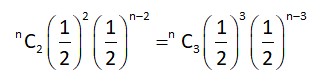
[as probability of getting odd number = probability of getting even number = ]

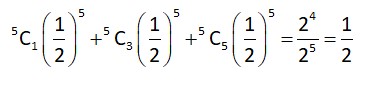
Probability of getting an odd number for odd number of times =
 Upvote

Let Bi (i = 1, 2, 3) be three independent events in a sample space. The probability that only B1 occurs is a, only B2 occurs is b and B3 occurs is <!-- [if gte mso 9]><xml>
Let Bi (i = 1, 2, 3) be three independent events in a sample space. The probability that only B1 occurs is a, only B2 occurs is b and B3 occurs is <!-- [if gte mso 9]><xml>
Let P (B1) = a P (B2) = b P (B3) = c
Given a (1 – b) (1 – c) = a . (i)
b (1 – a) (1 – c) = b . (ii)
c (1 – b) (1 – a) =
Upvote If the least and the largest real values of a, for which the equation z + a <!-- [if gte mso 9]><xml>
If the least and the largest real values of a, for which the equation z + a <!-- [if gte mso 9]><xml>
Let z = x + iy
for
= 0
Upvote Let <!-- [if gte mso 9]><xml>
Let <!-- [if gte mso 9]><xml>
=
=
55 + 135 + 120 = 310
Upvote The probability that two randomly selected subsets of the set <!-- [if gte mso 9]><xml>
The probability that two randomly selected subsets of the set <!-- [if gte mso 9]><xml>
Total possibilities = 25 × 25
Farounable case = 5C2 × 33 = 10 × 33
Upvote Let A be a set of all 4-digit natural numbers whose exactly one digit is 7. Then the probability that a randomly chosen element of A leaves remainder 2 when divided by 5 is
Let A be a set of all 4-digit natural numbers whose exactly one digit is 7. Then the probability that a randomly chosen element of A leaves remainder 2 when divided by 5 is
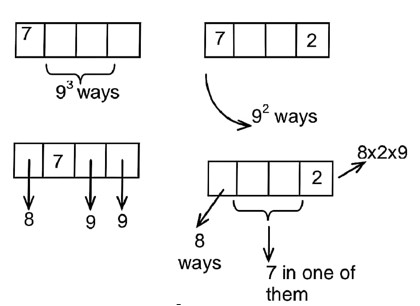
8 × 3 × 32 = 24 × 81
Total = n (A) = 93 + 24 × 81 = 81 × 33
In favourable events, the last digit of the number must be either 2 or 7.
Favourable cases =
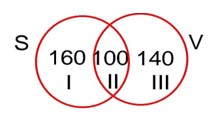
Upvote In a group of 400 people, 160 are smokers and non-vegetarian; 100 are smokers and vegetarian and the remaining 140 are non-smokers and vegetarian. Their chances of getting a particular chest disorder are 35%, 20% and 10% respectively. A person is chosen from the group at random and is found to be suffering from the chest disorder. The probability that the selected person is a smoker and non-vegetarian is
In a group of 400 people, 160 are smokers and non-vegetarian; 100 are smokers and vegetarian and the remaining 140 are non-smokers and vegetarian. Their chances of getting a particular chest disorder are 35%, 20% and 10% respectively. A person is chosen from the group at random and is found to be suffering from the chest disorder. The probability that the selected person is a smoker and non-vegetarian is
P {a person chosen from the group has chest disorder}
 Upvote
The coefficients a, b and c of the quadratic equation, ax2 + bx + c = 0 are obtained by throwing a dice three times. The probability that this equation has equal roots is:
The coefficients a, b and c of the quadratic equation, ax2 + bx + c = 0 are obtained by throwing a dice three times. The probability that this equation has equal roots is:
ax2 + bx + c = 0
D = b2 – 4ac
D = 0
b2 – 4ac = 0
b2 = 4ac
(i) AC = 1, b = 2 (1, 2, 1) is one way
(ii) AC = 4, b = 4
(iii) AC = 9, b = 6, a = 3, c = 3 is one way
1 + 3 + 1 = 5 way
Required probability =
Upvote When a missile is fired from a ship, the probability that it is intercepted is <!-- [if gte mso 9]><xml>
When a missile is fired from a ship, the probability that it is intercepted is <!-- [if gte mso 9]><xml>
Let
A : Missile hit the target
B : Missile intercepted
P (B) =
Required Probability =
Upvote Four dice are thrown simultaneously and the numbers shown on these dice are recorded in 2 × 2 matrices. The probability that such formed matrices have all different entries and are non-singular, is:
Four dice are thrown simultaneously and the numbers shown on these dice are recorded in 2 × 2 matrices. The probability that such formed matrices have all different entries and are non-singular, is:
All entries different which can be selected as 

Let be such matrix
|A| = ad – bc
Now | A| = 0 -> ad – bc = 0 cases
&nbs
Upvote