
Probability
Get insights from 206 questions on Probability, answered by students, alumni, and experts. You may also ask and answer any question you like about Probability
- 206
Questions
- 0
Discussions
- 0
Active Users
- 0
Followers
Have a question about Probability? Ask our experts
Keep it short & simple. Type complete word. Avoid abusive language.
Let 9 distinct balls be distributed among 4 boxes, B?, B?, B? and B?. If the probability that B? contains exactly 3 balls is k(3/4)? then k lies in the set:
Let 9 distinct balls be distributed among 4 boxes, B?, B?, B? and B?. If the probability that B? contains exactly 3 balls is k(3/4)? then k lies in the set:
Three balls can be given to B? in? C? ways. Now remaining 6 balls can be distributed into 3 boxes in 3? ways.
Total no. of favourable events =? C? × 3? = 28 × 3?
Total no. of events = 9 balls distributed into 4 boxes in 4? ways.
probability = 28 × 3? /4? = 28/9 × (3/4)? ⇒ k = 28/9
k ∈ |x-3|<1
 Upvote

In a workshop, there are five machines and the probability of any one of them to be out of service on a day is <!-- [if gte msEquation 12]>
<!-- [if !supportLineBreakNewLine]-->
<!--[endif]-->
In a workshop, there are five machines and the probability of any one of them to be out of service on a day is <!-- [if gte msEquation 12]>
<!-- [if !supportLineBreakNewLine]-->
<!--[endif]-->
Probability (at most two machines will be out of service) = (3/4)³ . k
⇒ ?C?(1/4)?(3/4)? + ?C?(1/4)¹(3/4)? + ?C?(1/4)²(3/4)³ = (3/4)³ . k
⇒ 17/8 (3/4)³ = (3/4)³ . k
⇒ k = 17/8
Upvote Let and be two independent events such that and . Then, which of the following is TRUE?
Let and be two independent events such that and . Then, which of the following is TRUE?
A and B are independent events so P(A/B) = 1/3
Upvote A fair coin is tossed n-times such that the probability of getting at least one head is at least 0.9. Then the minimum value of n is………….
A fair coin is tossed n-times such that the probability of getting at least one head is at least 0.9. Then the minimum value of n is………….
P (at least one head) = 1 - P (no heads) = 1 - (1/2)? ≥ 0.9.
0.1 ≥ (1/2)?
10 ≤ 2?
n=3, 2³=8. n=4, 2? =16.
Minimum value of n is 4.
Upvote The probability that a randomly selected 2-digit number belongs to the set {n ∈ N : (2ⁿ – 2) is a multiple of 3} is equal to:
The probability that a randomly selected 2-digit number belongs to the set {n ∈ N : (2ⁿ – 2) is a multiple of 3} is equal to:
(2? -2) is multiple of 3.
If n is odd, 2? ≡ (-1)? =-1 (mod 3). 2? -2 ≡ -1-2 = -3 ≡ 0 (mod 3).
If n is even, 2? ≡ (-1)? =1 (mod 3). 2? -2 ≡ 1-2 = -1 (mod 3).
So n must be odd.
2-digit numbers are 10-99 (90 numbers).
Odd numbers are 11,13, .,99. Number of terms = (99-11)/2 + 1 = 45.
Probability = 45/90 =
Upvote Two tangents are drawn from the point P(-1, 1) to the circle x² + y² - 2x – 6y + 6 = 0. If these tangents touch the circle at points A and B, and if D is a point on the circle such that length of the segments AB and AD are equal, then the area of the triangle ABD is equal to:
<!-- [if !supportLineBreakNewLine]-->
<!--[endif]-->
Two tangents are drawn from the point P(-1, 1) to the circle x² + y² - 2x – 6y + 6 = 0. If these tangents touch the circle at points A and B, and if D is a point on the circle such that length of the segments AB and AD are equal, then the area of the triangle ABD is equal to:
<!-- [if !supportLineBreakNewLine]-->
<!--[endif]-->
Circle: (x-1)² + (y-3)² = 4. C= (1,3), r=2.
Length of tangent from P (-1,1) is L = √ (-1)²+1²-2 (-1)-6 (1)+6) = √ (1+1+2-6+6) = √4 = 2.
Area of quadrilateral PACB = 2 * Area (PAC) = 2 * (1/2 * L * r) = 2*2=4.
AB is chord of contact. T=0 => -x+y- (x-1)-3 (y-1)+6=0 => -2x-2y+10=0 => x+y=5.
Distance of C f
Upvote Let X be a random variable such that the probability function of a distribution is given by P(X=0) = 1/2, P(X = j) = (1/3)? (j = 1,2,3,.∞). Then the mean of the distribution and P(X is positive and even) respectively are:
<!-- [if !supportLineBreakNewLine]-->
<!--[endif]-->
Let X be a random variable such that the probability function of a distribution is given by P(X=0) = 1/2, P(X = j) = (1/3)? (j = 1,2,3,.∞). Then the mean of the distribution and P(X is positive and even) respectively are:
<!-- [if !supportLineBreakNewLine]-->
<!--[endif]-->
Mean = Σx? p? = 0 (1/2) + Σ? ∞ j (1/3)? = (1/3)/ (1-1/3)² = (1/3)/ (4/9) = 3/4
P (X is positive and even) = P (X=2) + P (X=4) + .
= (1/3)² + (1/3)? + . = (1/9)/ (1-1/9) = (1/9)/ (8/9) = 1/8
Upvote A seven digit number is formed using digit 3,3,4,4,4,5,5. The probability, that number so formed is divisible by 2, is:
A seven digit number is formed using digit 3,3,4,4,4,5,5. The probability, that number so formed is divisible by 2, is:
3, 4, 5, 5
In remaining six places you have to arrange
3, 4, 5,5
So no. of ways
Total no. of seven digits nos. =
Hence Req. prob.
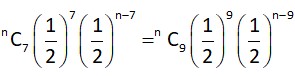
Upvote A fair coin is tossed a fixed number of times. If the probability of getting 7 heads is equal to probability of getting heads, then the probability of getting 2 heads is
A fair coin is tossed a fixed number of times. If the probability of getting 7 heads is equal to probability of getting heads, then the probability of getting 2 heads is
Let n be the number of times.
According to question,
 Upvote
The number of seven digit integers with sum of the digits equal to 10 and formed by using the digits 1,2 and 3 only is
The number of seven digit integers with sum of the digits equal to 10 and formed by using the digits 1,2 and 3 only is

No. of ways =
No. of ways =
Total number of required ways = 42 + 35 = 77
Upvote