
Relations and Functions
Get insights from 125 questions on Relations and Functions, answered by students, alumni, and experts. You may also ask and answer any question you like about Relations and Functions
- 125
Questions
- 0
Discussions
- 0
Active Users
- 0
Followers
Have a question about Relations and Functions? Ask our experts
Keep it short & simple. Type complete word. Avoid abusive language.
Let N be functions defined by f(a) = a, where a is the maximum of the powers of those primes p such that pa divides a, and g(a) = a + 1, for all <!-- [if gte mso 9]><xml>
Let N be functions defined by f(a) = a, where a is the maximum of the powers of those primes p such that pa divides a, and g(a) = a + 1, for all <!-- [if gte mso 9]><xml>
f (a) = a, a is max of powers of prime P such that Pa divides a.
f (2) = 1; g (2) = 3
f (3) = 1; g (3) = 4
f (4) = 2; g (4) = 5
f (5) = 1; g (5) = 6
f (2) + g (2) = 4
f (3) + g (3) = 5
f (4) + g (4) = 7
f (5) + g (5) = 7
So, f (x) + g (x) is many-one-and an into function. We won't get 'I' in the range.
 Upvote

Let <!-- [if gte mso 9]><xml>
Then <!-- [if gte mso 9]><xml>
Let <!-- [if gte mso 9]><xml>
Then <!-- [if gte mso 9]><xml>
a0 = 0, a1 = 0
an+2 = 3an+1 – 2an + 1
a25 a23 – 2a25a22 – a23a24 + 4a22a24 =?
a2 = 3a1 – 2a0 + 1
a3 = 3a2 – 2a1 + 1
a4 = 3a3 – 2a2 + 1
a5 = 3a4 – 2a3 + 1
an+2 = 3an+1 – 2an + 1
-> an+2 = 2 (a2 + a3 + …. + an + an+1) –2 (a1 + a2 + ….+ an) + n + 1
an+2 = 2an+1 + n + 1
a25 a23 -2a25 a22 -a23 a24 + 4a22
Upvote Let f(x) be a quadratic polynomial with leading coefficient 1 such that f(0) = p, p , and f(1) = If the equations f(x) = 0 and fo fo fo f(x) = 0 have a common real root , then f(3) is equal to
Let f(x) be a quadratic polynomial with leading coefficient 1 such that f(0) = p, p , and f(1) = If the equations f(x) = 0 and fo fo fo f(x) = 0 have a common real root , then f(3) is equal to
Let f (x) = (x -α) (x - β)
It is given that f (0) = p = p
and
Now, let us assume that is the common root of f (x) = 0 and fofofof (x) = 0
fofofof (x) = 0
Upvote The number of one-one functions f:{a, b, c, d} ® {0, 1, 2, ……., 10} such that 2f (a) – f(b) + 3f(c) + f(d) = 0 is ___________.
The number of one-one functions f:{a, b, c, d} ® {0, 1, 2, ……., 10} such that 2f (a) – f(b) + 3f(c) + f(d) = 0 is ___________.
f(b) = 2f(a) + 3f(c) + f(d)
Value of f(c) Value of f(a) Number of functions
Upvote The probability that a randomly chosen one-one function from the set to the set satisfies f(a) + 2f(b) – f(c) = f(d) is:
The probability that a randomly chosen one-one function from the set to the set satisfies f(a) + 2f(b) – f(c) = f(d) is:
No of one – one functions ® 5P4 = 120
f(a) + 2f(b) – f(c) = f(d)
2f(b) = f(d) + f(c) – f(a)
So, f(d) + f(c) – f(a) should be even.
Only possibilities of f(d) &n
Upvote <p><strong>The probability that a randomly chosen one-one function from the set </strong><span class="mathml" contenteditable="false"> <math> <mrow> <mrow> <mo>{</mo> <mrow> <mi>a</mi> <mo>,</mo> <mi>b</mi> <mo>,</mo> <mi>c</mi> <mo>,</mo> <mi>d</mi> </mrow> <mo>}</mo> </mrow> </mrow> </math> </span><strong>to the set </strong><span class="mathml" contenteditable="false"> <math> <mrow> <mrow> <mo>{</mo> <mrow> <mn>1</mn> <mo>,</mo> <mn>2</mn> <mo>,</mo> <mn>3</mn> <mo>,</mo> <mn>4</mn> <mo>,</mo> <mn>5</mn> </mrow> <mo>}</mo> </mrow> </mrow> </math> </span><strong>satisfies f(a) + 2f(b) – f(c) = f(d) is:</strong></p>
Let a biased coin be tossed 5 times. If the probability of getting 4 heads is equal to the probability of getting 5 heads, then the probability of getting atmost two heads is
Let a biased coin be tossed 5 times. If the probability of getting 4 heads is equal to the probability of getting 5 heads, then the probability of getting atmost two heads is
P (H) = x . P (T) = 1 – x
P (4H. 1T) = P (5H)
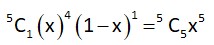
6x = 5 = 0
P (atmost 2H)
Upvote The mean and standard of 50 observations are 15 and 2 respectively. It was found that one incorrect observation was taken such that the sum of correct and incorrect observations is 70. If the correct mean is 16, then the correct variance is equal to:
The mean and standard of 50 observations are 15 and 2 respectively. It was found that one incorrect observation was taken such that the sum of correct and incorrect observations is 70. If the correct mean is 16, then the correct variance is equal to:
Let a be the correct observation and b is the incorrect observation then a + b = 70 and
Upvote Let denote the greatest integer . Then the equation in has:
Let denote the greatest integer . Then the equation in has: