
Solid State
Get insights from 127 questions on Solid State, answered by students, alumni, and experts. You may also ask and answer any question you like about Solid State
- 127
Questions
- 0
Discussions
- 0
Active Users
- 0
Followers
Have a question about Solid State? Ask our experts
Keep it short & simple. Type complete word. Avoid abusive language.
A diatomic molecule X₂ has a body centered cubic (bcc). The density of the molecule is 6.17 g cm⁻³. The number of molecules present in 200 g² of X₂ is: (Avogadro constant (NA) = 6 × 10²³ mol⁻¹)
A diatomic molecule X₂ has a body centered cubic (bcc). The density of the molecule is 6.17 g cm⁻³. The number of molecules present in 200 g² of X₂ is: (Avogadro constant (NA) = 6 × 10²³ mol⁻¹)
ρ = M/V
∴ 6.17 = (2 x MX? ) / (N? x (300 x 10? ¹? )³)
Solving MX? = 50 g
∴ No. of molecules in 200 g
= (200/50) x N? = 4 N?
 Upvote

A crystal is made up of metal ions ' M₁ ' and ' M₂ ' and oxide ions. Oxide ions form a ccp lattice structure. The cation ' M₁ ' occupies 50% of octahedral voids and the cation ' M₂ ' occupies 12.5% of tetrahedral voids of oxide lattice. The oxidation numbers of ' M₁ ' and ' M₂' are respectively:
A crystal is made up of metal ions ' M₁ ' and ' M₂ ' and oxide ions. Oxide ions form a ccp lattice structure. The cation ' M₁ ' occupies 50% of octahedral voids and the cation ' M₂ ' occupies 12.5% of tetrahedral voids of oxide lattice. The oxidation numbers of ' M₁ ' and ' M₂' are respectively:
In the ccp lattice of oxide ions effective number of O? ² ions = 8 ×? + 6 × ½ = 4
In the ccp lattice,
No. of octahedral voids = 4
No. of tetrahedral voids = 8
Given M? atoms occupies 50% of octahedral voids and M? atoms occupies 12.5 of tetrahedral voids
No. of M? metal atoms = 4 ×? /? = 2
No. of M? meta
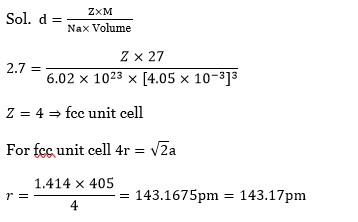
Upvote An element with molar mass 2.7 × 10?² kg mol?¹ forms a cubic unit cell with edge length 405pm. If its density is 2.7 × 10³ kg m?³, the radius of the element is approximately × 10?¹² m (to the nearest integer).
<!-- [if !supportLineBreakNewLine]-->
<!--[endif]-->
An element with molar mass 2.7 × 10?² kg mol?¹ forms a cubic unit cell with edge length 405pm. If its density is 2.7 × 10³ kg m?³, the radius of the element is approximately × 10?¹² m (to the nearest integer).
<!-- [if !supportLineBreakNewLine]-->
<!--[endif]-->
In an estimation of bromine by Carius method, 1.6 g of an organic compound gave 1.88 g of AgBr. The mass percentage of bromine in the compound is [numerical value] (Atomic mass, Ag=108, Br=80 g mol?¹)
In an estimation of bromine by Carius method, 1.6 g of an organic compound gave 1.88 g of AgBr. The mass percentage of bromine in the compound is [numerical value] (Atomic mass, Ag=108, Br=80 g mol?¹)
AgBr=1.88g. Br=0.8g. %Br= (0.8/1.6)×100=50%.
Upvote If AB? molecule is a polar molecule, a possible geometry of AB? is
<!-- [if !supportLineBreakNewLine]-->
<!--[endif]-->
If AB? molecule is a polar molecule, a possible geometry of AB? is
<!-- [if !supportLineBreakNewLine]-->
<!--[endif]-->
For AB? compound possible geometry are
S. No. | Bond pair | Lone pair | Total | Hybridisation | Geometry | Polarity |
1 | 4 | 0 | 4 |
| Tetrahedral | non polar |
2 | 4 | 1 | 5 |
| Sea-saw | Polar |
3 | 4 | 2 | 6 |
| Square Planar | non polar |


Square pyramidal can be polar due to lone pair moment as the bond pair moments will get cancelled out.
Upvote An element crystallises in a face-centred cubic (fcc) unit cell with cell edge a. The distance between the centres of two nearest octahedral voids in the crystal lattice is:
<!-- [if !supportLineBreakNewLine]-->
<!--[endif]-->
An element crystallises in a face-centred cubic (fcc) unit cell with cell edge a. The distance between the centres of two nearest octahedral voids in the crystal lattice is:
<!-- [if !supportLineBreakNewLine]-->
<!--[endif]-->
In FCC octahedral voids are present at the edge centers and body center
Consider a diagonal projected form edge centre passing through the body centre
Distance between octahedral voids = √2a/2 = a/√2
Upvote The parameters of the unit cell of substance are a = 2.5, b= 3.0, c=4.0, α = 90°, β =120°, γ = 90°. The crystal system of the substance is:
The parameters of the unit cell of substance are a = 2.5, b= 3.0, c=4.0, α = 90°, β =120°, γ = 90°. The crystal system of the substance is:
In Monoclinic crystal system, a ≠ b ≠ c and α = 90°, γ = 90° and β=120°.
Upvote The coordination number of an atom in a body- centred cubic structure is___________.
[Assume that the lattice is made up of atoms]
The coordination number of an atom in a body- centred cubic structure is___________.
[Assume that the lattice is made up of atoms]
Coordination no. of an atom in BCC is 8.
Upvote The number of octahedral voids per lattice site in a lattice is………. (Rounded off to the nearest integer)
The number of octahedral voids per lattice site in a lattice is………. (Rounded off to the nearest integer)
Effective no. of octahedral voids in a lattice = n
Effective no. of lattice point in a lattice = n
Ratio = n/n = 1
Upvote