
Thermodynamics
Get insights from 325 questions on Thermodynamics, answered by students, alumni, and experts. You may also ask and answer any question you like about Thermodynamics
- 325
Questions
- 0
Discussions
- 0
Active Users
- 0
Followers
Have a question about Thermodynamics? Ask our experts
Keep it short & simple. Type complete word. Avoid abusive language.
The enthalpies of elements in their standard states are taken as zero. The enthalpy of formation of a compound
(i) Is always negative
(ii) Is always positive
(iii) May be positive or negative
(iv) Is never negative
The enthalpies of elements in their standard states are taken as zero. The enthalpy of formation of a compound
(i) Is always negative
(ii) Is always positive
(iii) May be positive or negative
(iv) Is never negative
This is a Multiple Choice Questions as classified in NCERT Exemplar
option (iii)
The enthalpies of elements in their standard states are taken as zero. The enthalpy of formation of a compound as the reaction could be exothermic or endothermic.
 Upvote
Consider the reactions given below. On the basis of these reactions find out which of the algebric relations given in options (i) to (iv) is correct?
(a) C (g) + 4H (g) → CH4 (g); ∆r H = x kJ/ mol
(b) C (graphite,s) + 2H2 (g) → CH4 (g); ∆rH = y kJ /mol
(i) x = y
(ii) x = 2y
(iii) x > y
(iv) x < y
Consider the reactions given below. On the basis of these reactions find out which of the algebric relations given in options (i) to (iv) is correct?
(a) C (g) + 4H (g) → CH4 (g); ∆r H = x kJ/ mol
(b) C (graphite,s) + 2H2 (g) → CH4 (g); ∆rH = y kJ /mol
(i) x = y
(ii) x = 2y
(iii) x > y
(iv) x < y
This is a Multiple Choice Questions as classified in NCERT Exemplar
option (iii)
Same bonds are formed in reaction (a) and (b) but bonds between the reactant molecules are broken only in reaction (b)
Upvote On the basis of thermochemical equations (a), (b) and (c), find out which of the algebric relationships given in options (i) to (iv) is correct.
(a) C (graphite) + O2 (g) → CO2 (g) ; ∆rH = x kJ/ mol
(b) C (graphite) + O2 (g) → CO (g) ; ∆rH = y kJ/ mol
(c) CO (g) + O2 (g) → CO2 (g) ; ∆rH = z kJ/ mol
(i) z = x + y
(ii) x = y – z
(iii) x = y + z
(iv) y = 2z – x
On the basis of thermochemical equations (a), (b) and (c), find out which of the algebric relationships given in options (i) to (iv) is correct.
(a) C (graphite) + O2 (g) → CO2 (g) ; ∆rH = x kJ/ mol
(b) C (graphite) + O2 (g) → CO (g) ; ∆rH = y kJ/ mol
(c) CO (g) + O2 (g) → CO2 (g) ; ∆rH = z kJ/ mol
(i) z = x + y
(ii) x = y – z
(iii) x = y + z
(iv) y = 2z – x
This is a Multiple Choice Questions as classified in NCERT Exemplar
option (iii)
When we add equations (b) and (c) we will get equation (a); hence, the Algebraic sum of y and z will give x, x =y + z.
Upvote The entropy change can be calculated by using the expression ∆S = . When water freezes in a glass beaker, choose the correct statement amongst the following:
(i) ∆S (system) decreases, but ∆S (surroundings) remains the same.
(ii) ∆S (system) increases, but ∆S (surroundings) decreases.
(iii) ∆S (system) decreases, but ∆S (surroundings) increases.
(iv) ∆S (system) decreases, and ∆S (surroundings) also decreases.
The entropy change can be calculated by using the expression ∆S = . When water freezes in a glass beaker, choose the correct statement amongst the following:
(i) ∆S (system) decreases, but ∆S (surroundings) remains the same.
(ii) ∆S (system) increases, but ∆S (surroundings) decreases.
(iii) ∆S (system) decreases, but ∆S (surroundings) increases.
(iv) ∆S (system) decreases, and ∆S (surroundings) also decreases.
This is a Multiple Choice Questions as classified in NCERT Exemplar
option (iii)? S (system) decreases, but? S (surroundings) increases.
Upvote The pressure volume work for an ideal gas can be calculated by using the expression w = - dv. The work can also be calculated from the pV−plot by using the area under the curve within the specified limits. When an ideal gas is compressed (a) reversibly or (b) irreversibly from volume Vi to Vf. Choose the correct option.
(i) w (reversible) = w (irreversible)
(ii) w (reversible) < w (irreversible)
(iii) w (reversible) > w (irreversible)
(iv) w (reversible) = w (irreversible) + pex.?V
The pressure volume work for an ideal gas can be calculated by using the expression w = - dv. The work can also be calculated from the pV−plot by using the area under the curve within the specified limits. When an ideal gas is compressed (a) reversibly or (b) irreversibly from volume Vi to Vf. Choose the correct option.
(i) w (reversible) = w (irreversible)
(ii) w (reversible) < w (irreversible)
(iii) w (reversible) > w (irreversible)
(iv) w (reversible) = w (irreversible) + pex.?V
Kindly go through the solution
option (ii)
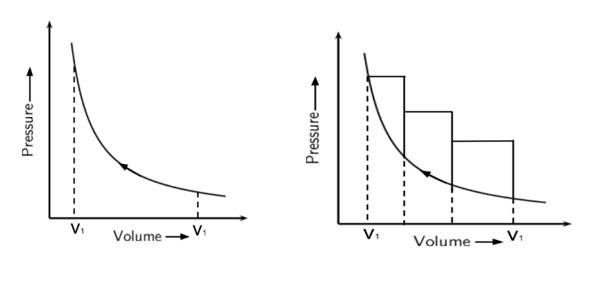 Upvote
 In an adiabatic process, no transfer of heat takes place between system and surroundings. Choose the correct option for free expansion of an ideal gas under adiabatic condition from the following.
(i) q = 0, ∆T ≠ 0, w = 0
(ii) q ≠ 0, ∆T = 0, w = 0
(iii) q = 0, ∆T = 0, w = 0
(iv) q = 0, ∆T < 0, w ≠ 0 Vf
In an adiabatic process, no transfer of heat takes place between system and surroundings. Choose the correct option for free expansion of an ideal gas under adiabatic condition from the following.
(i) q = 0, ∆T ≠ 0, w = 0
(ii) q ≠ 0, ∆T = 0, w = 0
(iii) q = 0, ∆T = 0, w = 0
(iv) q = 0, ∆T < 0, w ≠ 0 Vf
This is a Multiple Choice Questions as classified in NCERT Exemplar
Option (iii)
In free expansion, w=0 because volume is constant, as the process is adiabatic q = 0 and from first law of thermodynamics.
U=q+w
This means that internal energy remains constant.
Upvote ∆fU of formation of CH4 (g) at certain temperature is –393 kJ/mol. The value of ∆fH is
(i) zero
(ii) < ∆f U
(iii) > ∆f U
(iv) Equal to ∆fU
∆fU of formation of CH4 (g) at certain temperature is –393 kJ/mol. The value of ∆fH is
(i) zero
(ii) < ∆f U
(iii) > ∆f U
(iv) Equal to ∆fU
This is a Multiple Choice Questions as classified in NCERT Exemplar
The correct option is B <ΔU
The balanced equation for the combustion of methane is:
CH4 (g)+2O2 (g)→CO2 (g)+2H2O (l)
Here, Δng=1−3=−2
ΔH =ΔU +ΔngRT
ΔH =−393−2RT
∴ΔH <ΔU
Upvote During complete combustion of one mole of butane, 2658 kJ of heat is released. The thermochemical reaction for above change is
(i) 2C4H10(g) + 13O2(g) → 8CO2(g) + 10H2O(l) ∆c H = –2658.0 kJ/mol
(ii) C4H10(g) + O2 (g) → 4CO2 (g) + 5H2O (g) ∆c H = –1329.0 kJ/mol
(iii) C4H10(g) + O2 (g) → 4CO2 (g) + 5H2O (l) ∆c H = –2658.0 kJ/mol
(iv) C4H10 (g) + O2 (g) → 4CO2 (g) + 5H2O (l) ∆c H = +2658.0 kJ/mol
During complete combustion of one mole of butane, 2658 kJ of heat is released. The thermochemical reaction for above change is
(i) 2C4H10(g) + 13O2(g) → 8CO2(g) + 10H2O(l) ∆c H = –2658.0 kJ/mol
(ii) C4H10(g) + O2 (g) → 4CO2 (g) + 5H2O (g) ∆c H = –1329.0 kJ/mol
(iii) C4H10(g) + O2 (g) → 4CO2 (g) + 5H2O (l) ∆c H = –2658.0 kJ/mol
(iv) C4H10 (g) + O2 (g) → 4CO2 (g) + 5H2O (l) ∆c H = +2658.0 kJ/mol
This is a Multiple Choice Questions as classified in NCERT Exemplar
option (iii)
Standard enthalpy of combustion is defined as the enthalpy change per mole (or per unit amount) of a substance when it undergoes combustion and all the reactants and products being in their standard states at the specifie
Upvote The volume of gas is reduced to half from its original volume. The specific heat will be ______.
(i) Reduce to half
(ii) Be doubled
(iii) Remain constant
(iv) Increase four times
The volume of gas is reduced to half from its original volume. The specific heat will be ______.
(i) Reduce to half
(ii) Be doubled
(iii) Remain constant
(iv) Increase four times
This is a Multiple Choice Questions as classified in NCERT Exemplar
Option (iii)
Specific heat capacity is the quantity of heat required to raise the temperature of one unit mass of a substance by one degree Celsius (or 1 Kelvin). That is why it is an intensive property which does not depend on mass.
Upvote The state of a gas can be described by quoting the relationship between___.
(i) Pressure, volume, temperature
(ii) Temperature, amount, pressure
(iii) Amount, volume, temperature
(iv) Pressure, volume, temperature, amount
The state of a gas can be described by quoting the relationship between___.
(i) Pressure, volume, temperature
(ii) Temperature, amount, pressure
(iii) Amount, volume, temperature
(iv) Pressure, volume, temperature, amount
This is a Multiple Choice Questions as classified in NCERT Exemplar
option (i)
Variables like p, V, T are called state variables or state functions because their values depend only on the state of the system and not on how it is reached.
Upvote