
Thermodynamics
Get insights from 325 questions on Thermodynamics, answered by students, alumni, and experts. You may also ask and answer any question you like about Thermodynamics
- 325
Questions
- 0
Discussions
- 0
Active Users
- 0
Followers
Have a question about Thermodynamics? Ask our experts
Keep it short & simple. Type complete word. Avoid abusive language.
The change in the magnitude of the volume of an ideal gas when a small additional pressure is applied at a constant temperature, is the same as the change when the temperature is reduced by a small quantity at constant pressure. The initial temperature and pressure of the gas were and 2 atm. respectively. If then value of in (K/atm) is .
The change in the magnitude of the volume of an ideal gas when a small additional pressure is applied at a constant temperature, is the same as the change when the temperature is reduced by a small quantity at constant pressure. The initial temperature and pressure of the gas were and 2 atm. respectively. If then value of in (K/atm) is .

When 5 moles of He gas expand isothermally and reversibly at 300K from 10 litre to 20 litre, the magnitude of the maximum work obtained is___________J. (nearest integer)
[Given: R=8.3 JK-1mol-1 and log2 = 0.3010]
When 5 moles of He gas expand isothermally and reversibly at 300K from 10 litre to 20 litre, the magnitude of the maximum work obtained is___________J. (nearest integer)
[Given: R=8.3 JK-1mol-1 and log2 = 0.3010]
Number of moles, n = 5 mol
Temperature, T= 300 K
Initial volume, V1 = 10L
Final volume, V2 = 20 L
Using;
Work done; w = -2.303 nRT log10
= -8630 J
So, magnitude of work done is 8630 J.
 Upvote

A lead bullet penetrates into a solid object and melts. Assuming that 40% of its kinetic energy is used to heat it, the initial speed of bullet is:
(Given, initial temperature of the bullet = 127°C,
Melting point of the bullet = 327°C,
Latent heat of fusion of lead = 2.5 × 10⁴ J kg-1,
Specific heat capacity of lead = 125 J/kg K)
40% of K.E. =
v = 5 × 100
v = 500 m/sec
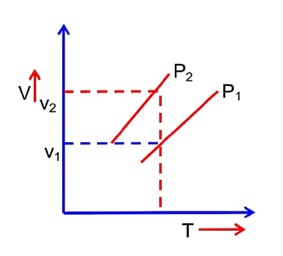
Upvote For a perfect gas, two pressures P1 and P2 are shown in figure. The graph shows:
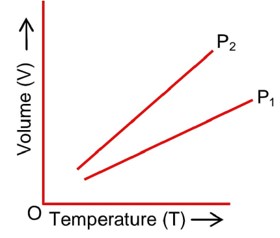
For a perfect gas, two pressures P1 and P2 are shown in figure. The graph shows:
At constant Temp
v2 > v1
⇒ P1 > P2
 Upvote
Assertion (A): A liquid crystallises into a solid and is accompanied by decrease in entropy.
Reason (R): In crystals, molecules organise in an ordered manner.
(i) Both A and R are true and R is the correct explanation of A.
(ii) Both A and R are true but R is not the correct explanation of A.
(iii) A is true but R is false.
(iv) A is false but R is true.
This is a Assertion and Reason Type Questions as classified in NCERT Exemplar
option (i)
Explanation: The entropy of a liquid reduces as it crystallises. Because the molecules are more organised in crystalline form.
Upvote Assertion (A): Spontaneous process is an irreversible process and may be reversed by some external agency.
Reason (R): Decrease in enthalpy is a contributory factor for spontaneity.
(i) Both A and R are true and R is the correct explanation of A.
(ii) Both A and R is true but R is not the correct explanation of A.
(iii) A is true but R is false.
(iv) A is false but R is true
Assertion (A): Spontaneous process is an irreversible process and may be reversed by some external agency.
Reason (R): Decrease in enthalpy is a contributory factor for spontaneity.
(i) Both A and R are true and R is the correct explanation of A.
(ii) Both A and R is true but R is not the correct explanation of A.
(iii) A is true but R is false.
(iv) A is false but R is true
This is a Assertion and Reason Type Questions as classified in NCERT Exemplar
Ans: (ii)
Explanation: The energy factor for a spontaneous process should be favourable (i.e., -ve) and the randomness should be positive.
Upvote Assertion (A): Combustion of all organic compounds is an exothermic reaction.
Reason (R) : The enthalpies of all elements in their standard state are zero.
(i) Both A and R are true and R is the correct explanation of A.
(ii) Both A and R are true but R is not the correct explanation of A.
(iii) A is true but R is false.
(iv) A is false but R is true.
Assertion (A): Combustion of all organic compounds is an exothermic reaction.
Reason (R) : The enthalpies of all elements in their standard state are zero.
(i) Both A and R are true and R is the correct explanation of A.
(ii) Both A and R are true but R is not the correct explanation of A.
(iii) A is true but R is false.
(iv) A is false but R is true.
This is a Assertion and Reason Type Questions as classified in NCERT Exemplar
option (ii)
Explanation: The enthalpy of the reactants is always greater than the enthalpy of the product in a combustion reaction.
Upvote 
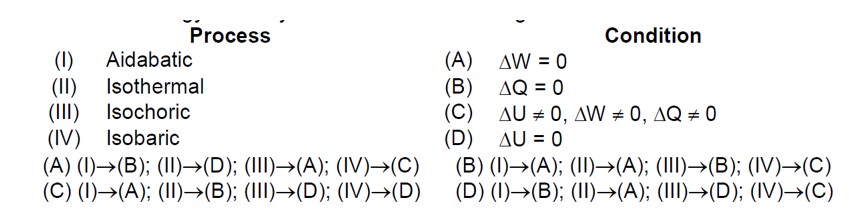
This is a Matching Type Questions as classified in NCERT Exemplar
(i)- (b), (d)
(ii)- (b)
(iii)- (c)
(iv)- (a)
Upvote