Vector Algebra

Get insights from 133 questions on Vector Algebra, answered by students, alumni, and experts. You may also ask and answer any question you like about Vector Algebra

Follow Ask Question
133

Questions

0

Discussions

0

Active Users

2

Followers

New answer posted

a year ago

0 Follower 10 Views

V
Vishal Baghel

Contributor-Level 10

(3a→−5b→). (2a→+7b→).

=3a→.2a→+3a→.7b→−5b→.2a→−5b→.7b→=6a→.a→+21a→.b→−10a→.b→−35b→.b→=6|a→|2+21a→.b→−10a→.b→−35|b→|2=6|a→|2+11a→.b→−35|b→|2

New answer posted

a year ago

0 Follower 11 Views

V
Vishal Baghel

Contributor-Level 10

|a→| and |b→| ,if (a→+b→).(a→−b→)=8 and |a→|=8|b→|

(a→+b→).(a→−b→)=8and|a→|=8|b→|(a→+b→).(a→−b→)=8a→.a→−a→.b→+b→.a→−b→.b→=8|a→|2−|b→|2=8(8|b→|)2−|b→|2=864|b→|2−|b→|2=863|b→|2=8|b→|=√8/√63(∴magnitudeofavectorisnon−negative)|b→|=2√23√7And|a→|=8|b→|=2*2√23√7=16√23√7

New answer posted

a year ago

0 Follower 7 Views

V
Vishal Baghel

Contributor-Level 10

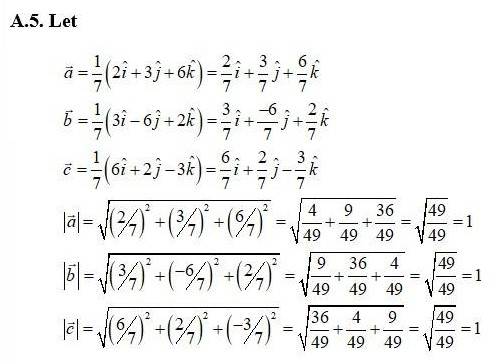
Here, each of the given three vector is a unit vector.

a→.b→=27*37+37*(−67)+67*27=649+(−1849)+1249=6−18+1249=0b→.c→=37*67+(−67)*27+27*(−37)=1849−1249+(−649)=18−12−649=0c→.a→=67*27+27*37+(−37)*67=1249+649−1849=0

Therefore, the given three vectors are mutually perpendicular to each other.
New answer posted

a year ago

0 Follower 11 Views

V
Vishal Baghel

Contributor-Level 10

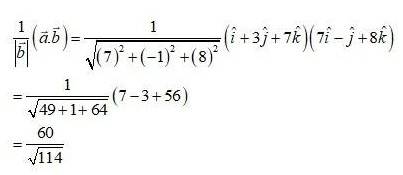
Let,

a→=i^+3j^+7k^b→=7i^−j^+8k^

The project of vector a→ on b→ is.

New answer posted

a year ago

0 Follower 5 Views

V
Vishal Baghel

Contributor-Level 10

Let,

a→=i^−j^b→=i^+j^

The projection of vector a→ on b→ is given by,

∴ The projection of vector a→ on b→ is 0.

New answer posted

a year ago

0 Follower 4 Views

V
Vishal Baghel

Contributor-Level 10

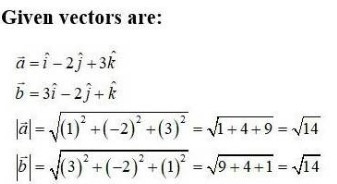
Now,

a→.b→= (i^−2j^+3k^) (3i^−2j^+k^)=1.3+ (−2). (−2)+3.1=3+4+3=10

Also, we know,

New answer posted

a year ago

0 Follower 18 Views

V
Vishal Baghel

Contributor-Level 10

Given,

=√3

, |b→
=2anda→.b→=√6

We have,

New answer posted

a year ago

0 Follower 10 Views

V
Vishal Baghel

Contributor-Level 10

We know,

If a→ and b→ are two collinear vector, they are parallel.

So,

b→=λa→If,λ=±1,then,a→=±b→If,a→=a1i^+a2j^+a3k^b→=b1i^+b2j^+b3k^,thenb→=λa→b1i^+b2j^+b3k^=λ(a1i^+a2j^+a3k^)=(λa1)i^+(λa2)j^+(λa3)k^b1=λa1,b2=λa2,b3=λa3b1a1=b2a2=b3a3=λ

Hence, the respective component are proportional but, vector a→ and b→ can have different direction.

Thus, the statement given in D is incorrect.

The correct answer is D.

New answer posted

a year ago

0 Follower 20 Views

V
Vishal Baghel

Contributor-Level 10

(A) AB→+BC→+CA→=0→

By triangle law of addition in given triangle, we get:

AB→+BC→=AC→−−−−−(1)AB→+BC→=−CA→

AB→+BC→+CA→=0→−−−−−(2)

So, (A) is true.

(B) AB→+BC→−AC→=0

AB→+BC→=AC→AB→+BC→−AC→=0

So, (B) is true.

(C) AB→+BC→−CA→=0

AB→+BC→=CA→−−−−−(3)From,(1)&(3),AC→=CA→AC→=−AC→AC→+AC→=02AC→=0

∴ The eQ.uation in alternative C AC→=0→ , which is not true, is incorrect.

(D) AB→−CB→+CA→=0→

From,eqn(2)wehaveAB→−CB→+CA→=0

The, equation given is alternative is D is true.

∴ The correct answer is C.

New answer posted

a year ago

0 Follower 37 Views

V
Vishal Baghel

Contributor-Level 10

We have,

a→=3i^−4j^−4k^b→=2i^−j^+k^c→=i^−3j^−5k^

AB→=(2−3)i^+(−1−(−4))j^+(1−(−4))k^=−i^+3j^+5k^BC→=(1−2)i^+(−3−(−1))j^+(−5−1)k^=−i^−2j^−6k^CA→=(1−3)i^+(−3−(−4))j^+(−5−(−4))k^=−2i^+j^−k^

Now,

Hence,

|AB→|2+|CA→|2=35+6=41=|BC→|2

Hence, given points from the vertices of a right angled triangle.

Get authentic answers from experts, students and alumni that you won't find anywhere else

Sign Up on Shiksha

On Shiksha, get access to

  • 67k Colleges
  • 1.2k Exams
  • 719k Reviews
  • 1850k Answers

Share Your College Life Experience

×
×

This website uses Cookies and related technologies for the site to function correctly and securely, improve & personalise your browsing experience, analyse traffic, and support our marketing efforts and serve the Core Purpose. By continuing to browse the site, you agree to Privacy Policy and Cookie Policy.