
VSEPR Theory
Get insights from 17 questions on VSEPR Theory, answered by students, alumni, and experts. You may also ask and answer any question you like about VSEPR Theory
- 17
Questions
- 0
Discussions
- 0
Active Users
- 0
Followers
Have a question about VSEPR Theory? Ask our experts
Keep it short & simple. Type complete word. Avoid abusive language.
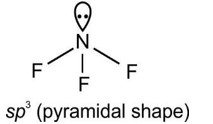
Which among the following species is pyramidal in shape?
Which among the following species is pyramidal in shape?
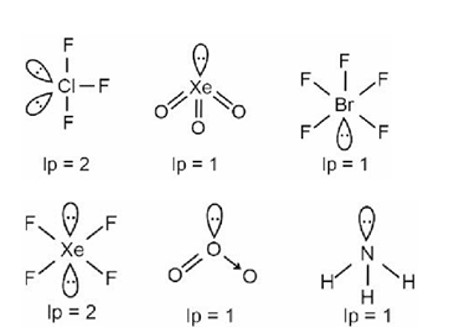
How many of the following compounds have one lone pair in central atom?
ClF3, XeO3, BrF5, XeF4, O3, NH3
How many of the following compounds have one lone pair in central atom?
ClF3, XeO3, BrF5, XeF4, O3, NH3
Which of the following have trigonal bipyramidal shape?
PF5, PBr5, [PtCl4]2–, SF6, BF3, BrF5, PCl5, [Fe(CO)5]
Which of the following have trigonal bipyramidal shape?
PF5, PBr5, [PtCl4]2–, SF6, BF3, BrF5, PCl5, [Fe(CO)5]
PF5, PCl5, PBr5, Fe (CO)5 Þ Trigonal bipyramidal
BrF5 Þ Square pyramidal
[PtCl4]2– Þ Square planar
SF6 Þ Octahedral
 Upvote

Consider the following reaction.
<!--[endif]--><!-- [if gte mso 9]><xml>
The dihedral angle in product A in its solid phase at 110 K is:
Consider the following reaction.
<!--[endif]--><!-- [if gte mso 9]><xml>
The dihedral angle in product A in its solid phase at 110 K is:
During the electrolysis of dilute H2SO4
In the solid form of dihedral angle is equal to 90.2°.
Upvote Total number of electron in Ti = 22
Total number of electron in Ti? = 22 – 4 = 18 So EAN value of Ti = 18 + 12 + 4 = 34
Upvote In which of the following groups all the members have linear shape?
<!-- [if !supportLineBreakNewLine]-->
<!--[endif]-->
In which of the following groups all the members have linear shape?
<!-- [if !supportLineBreakNewLine]-->
<!--[endif]-->
Amongst SF4, XeF4, CF4 and H2O, the number of species with two lone pairs of electrons is___________.
Amongst SF4, XeF4, CF4 and H2O, the number of species with two lone pairs of electrons is___________.
Water has only two lone pair and XeF4 has two lone pair electron in opposite plane of the central atom.

Upvote Amongst the following which one will have maximum lone pair -lone pair' electron repulsions?
<!-- [if !supportLineBreakNewLine]-->
<!--[endif]-->
Amongst the following which one will have maximum lone pair -lone pair' electron repulsions?
<!-- [if !supportLineBreakNewLine]-->
<!--[endif]-->
Maximum lone pair - lone pair repulsions are there in XeF?
Upvote A central atom in a molecule has two lone pairs of electrons and forms three single bonds. The shape of this molecule is:
<!-- [if !supportLineBreakNewLine]-->
<!--[endif]-->
A central atom in a molecule has two lone pairs of electrons and forms three single bonds. The shape of this molecule is:
<!-- [if !supportLineBreakNewLine]-->
<!--[endif]-->
A central atom having two lone pairs and three bond pairs reflects sp³d hybridization and a corresponding T-shaped geometry.
Upvote The correct shape and I – I – I bond angles respectively in <!-- [if gte mso 9]><xml>
The correct shape and I – I – I bond angles respectively in <!-- [if gte mso 9]><xml>
Kindly consider the following figure
Linear (180°)
Upvote