
Work, Energy and Power
Get insights from 175 questions on Work, Energy and Power, answered by students, alumni, and experts. You may also ask and answer any question you like about Work, Energy and Power
- 175
Questions
- 0
Discussions
- 0
Active Users
- 5
Followers
Have a question about Work, Energy and Power? Ask our experts
Keep it short & simple. Type complete word. Avoid abusive language.
A body of man 100 kg travelled 10 m before coming to rest. If m = 0.4, work done against friction is (motion is happening on horizontal surface, take g=10 m/s2)
A body of man 100 kg travelled 10 m before coming to rest. If m = 0.4, work done against friction is (motion is happening on horizontal surface, take g=10 m/s2)
v2 = 2 × mgs
v2 = 2 × (0.4) × 10 × 10
v2 = 80
Wf = Dk
=
Wf = – 4000
 Upvote

A ball is released from a height of 1 m on a smooth hemispherical surface as shown. Find its velocity when it is at a height of 0.5 m. (Take g = 10 m/s2)
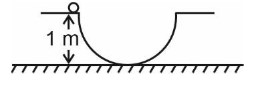
A ball is released from a height of 1 m on a smooth hemispherical surface as shown. Find its velocity when it is at a height of 0.5 m. (Take g = 10 m/s2)
By conservation of mechanical energy
mg (1) = mv2 + mg (0.5)
v2 = 10
v = m/s
Upvote Force on a particle moving in straight line is given by <!-- [if gte mso 9]><xml>
Force on a particle moving in straight line is given by <!-- [if gte mso 9]><xml>
= 18t4 – 18t2
->P (t = 2) =18 [16 − 4] = 216 W
Upvote If the coefficient of restitution is 0.5, what is the percentage loss of energy on each rebounding of a ball dropped from a height?
If the coefficient of restitution is 0.5, what is the percentage loss of energy on each rebounding of a ball dropped from a height?
h2 = e2h1
h2 = h1/4
Energy loss =mgh1 - mgh2 /mgh1*100 = 75%
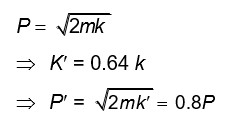
Upvote The kinetic energy of a body decreases by 36%. The decrease in linear momentum is
The kinetic energy of a body decreases by 36%. The decrease in linear momentum is
A particle of mass m is dropped from rest from a height h0 on a horizontal floor. The coefficient of restitution between the floor and particle is e. Maximum height attained by the particle after second collision is
A particle of mass m is dropped from rest from a height h0 on a horizontal floor. The coefficient of restitution between the floor and particle is e. Maximum height attained by the particle after second collision is
Height attained after first collision (h1) = e2h0
h2 = e2h1 = e4h0
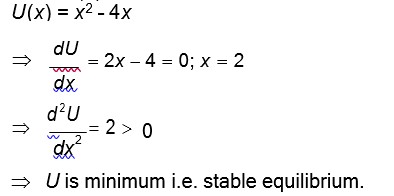
Upvote The potential energy of a particle varies with x according to the relation U(x) = x2 – 4x. The point x = 2 is a point of
The potential energy of a particle varies with x according to the relation U(x) = x2 – 4x. The point x = 2 is a point of
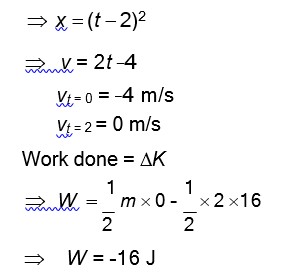
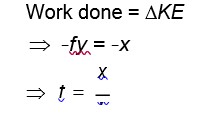
A small block of mass 10 g is projected along the smooth path from rest as shown in the given figure below. Find its speed at the point B

<!--[endif]--><!-- [if gte mso 9]><xml>
A small block of mass 10 g is projected along the smooth path from rest as shown in the given figure below. Find its speed at the point B
<!--[endif]--><!-- [if gte mso 9]><xml>
m
h=
By work energy theorem
gh
Upvote