
Work, Energy and Power
Get insights from 175 questions on Work, Energy and Power, answered by students, alumni, and experts. You may also ask and answer any question you like about Work, Energy and Power
- 175
Questions
- 0
Discussions
- 0
Active Users
- 5
Followers
Have a question about Work, Energy and Power? Ask our experts
Keep it short & simple. Type complete word. Avoid abusive language.
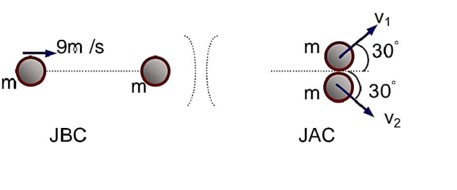
A ball with a speed of 9m/s collides with another identical ball at rest. After the collision the direction of each ball makes an angle 30° with the original direction. The ratio of velocities of the balls after collision is x : y, where x is_________.
A ball with a speed of 9m/s collides with another identical ball at rest. After the collision the direction of each ball makes an angle 30° with the original direction. The ratio of velocities of the balls after collision is x : y, where x is_________.
Using conversation of momentum in direction perpendicular to the original direction of motion,
mv1 sin 30° = mv2 sin 30°
 Upvote

What are conservative and non conservative forces?
What are conservative and non conservative forces?
Power calculations can also differ based on the nature of forces, which are as follows:
- Conservative Forces: Here, work done is path-independent. e.g., gravity, spring force
- Non-Conservative Forces: Work depends on the path. e.g., friction
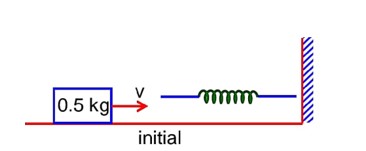
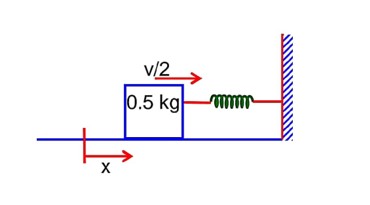
Upvote A 0.5kg block moving at a speed of 12ms1 compresses a spring through a distance 30cm when its speed is halved. The spring constant of the spring will be…………Nm1.
A 0.5kg block moving at a speed of 12ms1 compresses a spring through a distance 30cm when its speed is halved. The spring constant of the spring will be…………Nm1.
by conservation of mechanical energy
K.Ei + P.Ei = K.Ef + P.Ef
&nbs
Upvote A ball of mass 0.15 kg is dropped from a height. 10 m, strikes the ground and rehounds to the same height. The magnitude of impulse imparted to the ball is (g = 10 m/s² ) nearly:
<!-- [if !supportLineBreakNewLine]-->
<!--[endif]-->
A ball of mass 0.15 kg is dropped from a height. 10 m, strikes the ground and rehounds to the same height. The magnitude of impulse imparted to the ball is (g = 10 m/s² ) nearly:
<!-- [if !supportLineBreakNewLine]-->
<!--[endif]-->
Velocity just before striking the ground
v? = √2gh
v? = √ (2×10×10) = 10√2 m/s
v? = -10√2?
If it reaches the same height, speed remains same after collision only the direction changes.
v? = 10√2 m/s
v? = 10√2?
|Impulse| = m|Δv|
= m|10√2? - (-10√2? )|
= 0.15 [2 (10√2)]
= 3√2 kg m/s
= 4.2 kg m/s
Upvote A bullet from a gun is fired on a rectangular wooden block with velocity . When bullet travels 24cm through the block along its length horizontally, velocity of bullet become . Then it further penetrates into the block in the same direction before coming to rest exactly at the other end of the block. The total length of the block is:
A bullet from a gun is fired on a rectangular wooden block with velocity . When bullet travels 24cm through the block along its length horizontally, velocity of bullet become . Then it further penetrates into the block in the same direction before coming to rest exactly at the other end of the block. The total length of the block is:
The potential energy of a long spring when stretched by <!-- [if gte msEquation 12]>
<!-- [if !supportLineBreakNewLine]-->
<!--[endif]-->
The potential energy of a long spring when stretched by <!-- [if gte msEquation 12]>
<!-- [if !supportLineBreakNewLine]-->
<!--[endif]-->
Potential energy stored in the spring
Upvote A bullet from a gun is fired on a rectangular wooden block with velocity . When bullet travels through the block along its length horizontally, velocity of bullet become . Then it further penetrates into the block in the same direction before coming to rest exactly at the other end of the block. The total length of the block is:
<!-- [if !supportLineBreakNewLine]-->
<!--[endif]-->
A bullet from a gun is fired on a rectangular wooden block with velocity . When bullet travels through the block along its length horizontally, velocity of bullet become . Then it further penetrates into the block in the same direction before coming to rest exactly at the other end of the block. The total length of the block is:
<!-- [if !supportLineBreakNewLine]-->
<!--[endif]-->