
Alcohol Phenol And Ethers
Get insights from 261 questions on Alcohol Phenol And Ethers, answered by students, alumni, and experts. You may also ask and answer any question you like about Alcohol Phenol And Ethers
- 261
Questions
- 0
Discussions
- 0
Active Users
- 0
Followers
Have a question about Alcohol Phenol And Ethers? Ask our experts
Keep it short & simple. Type complete word. Avoid abusive language.
Which of the following compound given pink colour on reaction with phthalic anhydride in conc. H2SO4 followed by treatment with NaOH?
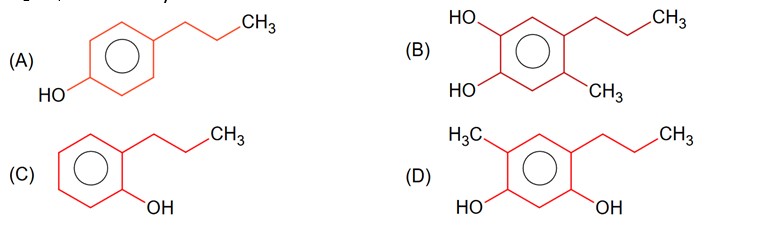
Which of the following compound given pink colour on reaction with phthalic anhydride in conc. H2SO4 followed by treatment with NaOH?
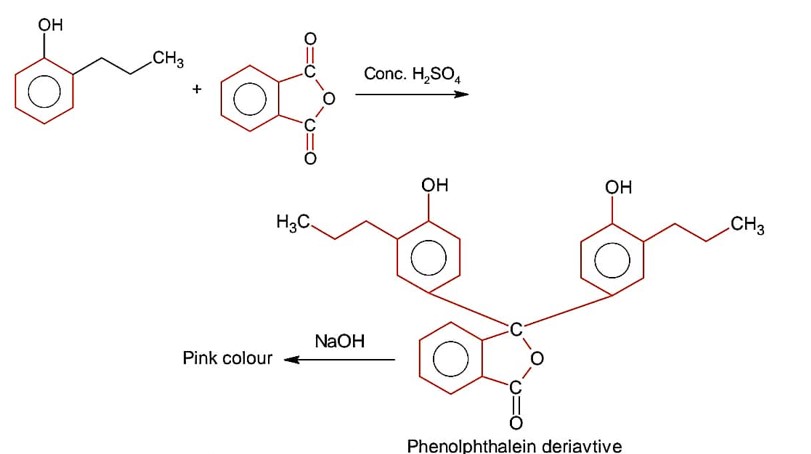
First reaction is EAS which will be given by that phenol derivative whose p-position is free for EAS reaction.
 Upvote

Consider the above reaction, and choose the correct statement:

Consider the above reaction, and choose the correct statement:
Trans product is more stable than Cis. ( Trans product feel less repulsion due to opposite direction)
Upvote Correct reactivity order towards anhydrous ZnCl₂ + conc. HCl
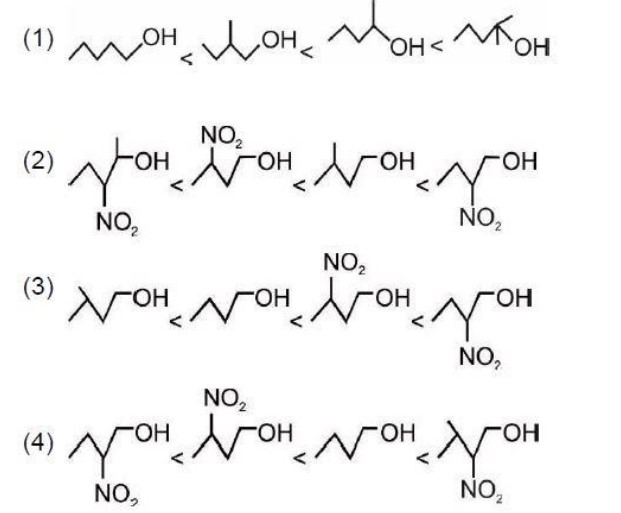
Correct reactivity order towards anhydrous ZnCl₂ + conc. HCl
Which amongst the following will be most readily dehydrated under acidic conditions?
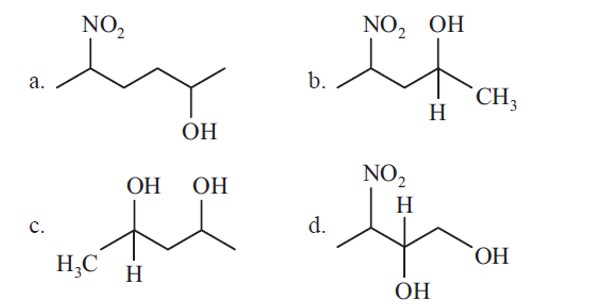
Which amongst the following will be most readily dehydrated under acidic conditions?
Formation of Conjugated diene in option 3 make the given reactant most reactive towards dehydration in acidic conditions.
Upvote The reaction that does not take place in blast furnace between 900 K to 1500 K in temperature range during extraction of iron is:
<!-- [if !supportLineBreakNewLine]-->
<!--[endif]-->
The reaction that does not take place in blast furnace between 900 K to 1500 K in temperature range during extraction of iron is:
<!-- [if !supportLineBreakNewLine]-->
<!--[endif]-->
Fe? O? + CO → 2FeO + CO?
The above reaction takes place at 500 – 800 K in blast furnace.
Upvote Pumice stone is an example of:
<!-- [if !supportLineBreakNewLine]-->
<!--[endif]-->
Pumice stone is an example of:
<!-- [if !supportLineBreakNewLine]-->
<!--[endif]-->
Pumice stone is an example of solid sol. In this type of colloid, the dispersion medium is solid and the dispersion phase is gas.
Upvote In which one of the following arrangements the given sequence is not strictly according to the properties indicated against it?
<!-- [if !supportLineBreakNewLine]-->
<!--[endif]-->
In which one of the following arrangements the given sequence is not strictly according to the properties indicated against it?
<!-- [if !supportLineBreakNewLine]-->
<!--[endif]-->
H? O < H? S < H? Se < H? Te
Down the group acidic strength increases
So pK? value decreases
Upvote The reagent ' R ' in the given sequence of chemical reaction is:
2,4,6-tribromoaniline --NaNO₂, HCl, 0-5°C--> Diazonium salt --R--> 1,3,5-tribromobenzene
The reagent ' R ' in the given sequence of chemical reaction is:
2,4,6-tribromoaniline --NaNO₂, HCl, 0-5°C--> Diazonium salt --R--> 1,3,5-tribromobenzene
R: CH? OH
Certain mild reducing agents like hypophosphorus acid or ethanol reduce diazonium salts to arene and themselves get oxidised to phosphorous acid and ethanal respectively.
Upvote The correct IUPAC name of the following compound is:
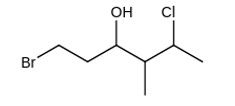
The correct IUPAC name of the following compound is:
The IUPAC name giving the lowest number to the functional group obeying the lowest set of locants is 1-bromo-5-chloro-4-methylhexan-3-ol.
Upvote Given below are two statements:
Statement I: In Lucas test, primary, secondary and tertiary alcohols are distinguished on the basis of their respectively with conc. HCl + ZnCl2, known as Lucas Reagent.
Statement II: Primary alcohols are most reactive and immediately produce turbidity at room temperature on reaction with Lucas Reagent
In the light of the above statements, choose the most appropriate answer from the options given below:
<!-- [if !supportLineBreakNewLine]-->
<!--[endif]-->
Given below are two statements:
Statement I: In Lucas test, primary, secondary and tertiary alcohols are distinguished on the basis of their respectively with conc. HCl + ZnCl2, known as Lucas Reagent.
Statement II: Primary alcohols are most reactive and immediately produce turbidity at room temperature on reaction with Lucas Reagent
In the light of the above statements, choose the most appropriate answer from the options given below:
<!-- [if !supportLineBreakNewLine]-->
<!--[endif]-->
Statement I is true but statement II is incorrect as 3°-alcohols are the most reactive and give immediate turbidity with Luca's reagent.
Upvote