
Alcohol Phenol And Ethers
Get insights from 261 questions on Alcohol Phenol And Ethers, answered by students, alumni, and experts. You may also ask and answer any question you like about Alcohol Phenol And Ethers
- 261
Questions
- 0
Discussions
- 0
Active Users
- 0
Followers
Have a question about Alcohol Phenol And Ethers? Ask our experts
Keep it short & simple. Type complete word. Avoid abusive language.
Which of the following compounds will give positive test with FeCl3?
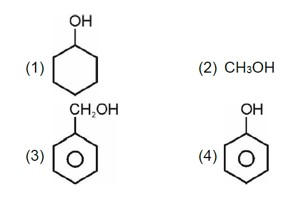
Which of the following compounds will give positive test with FeCl3?

Major product of the given reaction is <!-- [if gte mso 9]><xml>
Major product of the given reaction is <!-- [if gte mso 9]><xml>
Alkene on reaction with cold, dilute aqueous solution of KMnO4 produces vicinal glycols.
 Upvote

Which among the following compounds on reaction with methyl magnesium bromide followed by hydrolysis gives a tertiary alcohol?

Which among the following compounds on reaction with methyl magnesium bromide followed by hydrolysis gives a tertiary alcohol?
Kindly consider the following figure
Upvote 
This is the nucleophilic addition reaction of Grignard reagent on carbonyl compounds

Upvote Which reagent can not be used to distinguish t-Butyl alcohol and isopropyl alcohol:
Which reagent can not be used to distinguish t-Butyl alcohol and isopropyl alcohol:
The major product of the following reaction is:
(3-methylpentan-2-ol reacts with conc. H?SO? and Heat)
The major product of the following reaction is:
(3-methylpentan-2-ol reacts with conc. H?SO? and Heat)

CMC is the particular concentration above which micelle formation takes place. CMC for soap lies between:
CMC is the particular concentration above which micelle formation takes place. CMC for soap lies between:
Above a particular concentration called critical micelle concentration at which micelles are formed. for soaps, the
is to
Upvote Consider the following molecules and statements related to them:
Molecule (P) is p-nitrophenol.
Molecule (Q) is o-nitrophenol.
(a) (Q) is more volatile than (P)
(b) (Q) has higher boiling point than (P)
(c) (P) dissolves more readily than (Q) in water
(d) pKa value of (P) is higher than (Q)
Identify the correct option from below:
<!-- [if !supportLineBreakNewLine]-->
<!--[endif]-->
Consider the following molecules and statements related to them:
Molecule (P) is p-nitrophenol.
Molecule (Q) is o-nitrophenol.
(a) (Q) is more volatile than (P)
(b) (Q) has higher boiling point than (P)
(c) (P) dissolves more readily than (Q) in water
(d) pKa value of (P) is higher than (Q)
Identify the correct option from below:
<!-- [if !supportLineBreakNewLine]-->
<!--[endif]-->
Due to Intramolecular hydrogen bonding, O-nitrophenol fails to spread its surface, so that its b.p is less than para-nitrophenol.
Upvote Ethylidene chloride is
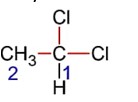
1, 1 Dichloro ethane.
Upvote Phenol on reaction with dilute nitric acid, gives two products. Which method will be most efficient for large scale separation?
Phenol on reaction with dilute nitric acid, gives two products. Which method will be most efficient for large scale separation?
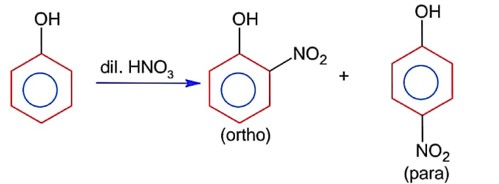
Ortho product has intramolecular H- bonding & para product has intermolecular H- bonding. Thus it can be separated by steam distillation due to difference in B.
Upvote