

Chemistry
Get insights from 6.9k questions on Chemistry, answered by students, alumni, and experts. You may also ask and answer any question you like about Chemistry
Follow Ask QuestionQuestions
Discussions
Active Users
Followers
New answer posted
a year agoContributor-Level 10
This is a Short Answer Type Questions as classified in NCERT Exemplar
Ans: pH of the substance depends on the concentration of hydronium ions present. Here the concentration of hydronium ions remains constant so pH remains constant.
The electrolysis reaction is as follows;
At anode: 2H2O (l)→O2 (g)+ 4H+ + 4e−
At cathode:4H+ + 4e− →2H2
New answer posted
a year agoContributor-Level 10
This is a Short Answer Type Questions as classified in NCERT Exemplar
Ans: Stronger electrolytes undergo cent percent dissociation. Electrolyte B will be the stronger electrolyte since the concentration of ions remains the same upon dilution.
New answer posted
a year agoContributor-Level 10
This is a Short Answer Type Questions as classified in NCERT Exemplar
Ans: The number of ions present in the cell decides the life-time of any cell. In mercury cells, ions are not involved so the mercury cell has a constant cell potential throughout its useful life.
New answer posted
a year agoContributor-Level 10
This is a Short Answer Type Questions as classified in NCERT Exemplar
Ans: Electrolysis of brine solution is as follows
NaCl (aq)→Na+ (aq)+Cl− (aq)
At the cathode, the reaction goes this way,
H2O (l) + e−→12H2 (g)+OH− (aq)
At the anode, the reaction goes this way,
Cl− (aq)→12Cl2 (g) + e−
The pH of the solution will increase as sodium hydroxide is being formed.
New question posted
a year ago
New answer posted
a year agoContributor-Level 10
This is a Short Answer Type Questions as classified in NCERT Exemplar
Ans: When the opposing potential becomes equal to the electrical potential there is no current flowing in the cell and the cell reaction stops and there is no chemical reaction in the cell
New answer posted
a year agoContributor-Level 10
This is a Short Answer Type Question as classified in NCERT Exemplar
The concentration of the reactants does not change with time in a zero -order reaction, and the rate of concentration remains constant. The molecularity of a reaction cannot be 0 because it indicates the number of reactants involved.
New answer posted
a year agoContributor-Level 10
This is a Short Answer Type Questions as classified in NCERT Exemplar
Ans: Alternating current is used to stop electrolysis so that the concentration of the ions in the solution remains constant.
New answer posted
a year ago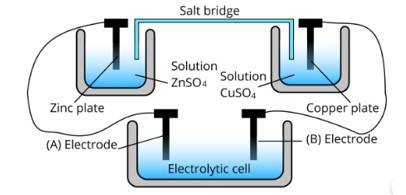
Contributor-Level 10
This is a Short Answer Type Questions as classified in NCERT Exemplar
Ans: The cell represented above shows an electrochemical cell in which two different electrodes are present and the cell at the bottom represents the electrolytic cell.
In this zinc is losing electrons moving towards electrode A and copper is accepting an electron from electrode B. Therefore, the polarity of electrode A is positive and electrode B is negative.
New answer posted
a year agoContributor-Level 10
This is a Short Answer Type Question as classified in NCERT Exemplar
When the Threshold energy is less than the energy of the molecules and the orientation of the molecules is proper for the effective collision, the reaction happens. As a result, the reaction is slow, and the number of effective collisions is reduced
Taking an Exam? Selecting a College?
Get authentic answers from experts, students and alumni that you won't find anywhere else
Sign Up on ShikshaOn Shiksha, get access to
- 67k Colleges
- 1.2k Exams
- 717k Reviews
- 1850k Answers