

Chemistry
Get insights from 6.9k questions on Chemistry, answered by students, alumni, and experts. You may also ask and answer any question you like about Chemistry
Follow Ask QuestionQuestions
Discussions
Active Users
Followers
New answer posted
a year agoContributor-Level 10
This is a Long Answer Type Question as classified in NCERT Exemplar
Ans: Catalyst action is a complicated concept. A catalyst aids in the formation of temporary bonds during a chemical reaction. The objective of a catalyst is to lowers the activation energy. A catalyst is a substance that increases the rate of a reaction without itself undergoing any permanent chemical change. The action of the catalyst can be explained by intermediate complex theory. According to this theory, a catalyst participates in a chemical reaction by forming temporary bonds with the reactants resulting in an intermediate complex. This has transitory existe
New question posted
a year ago
New answer posted
a year agoContributor-Level 10
This is a Long Answer Type Question as classified in NCERT Exemplar
Ans:
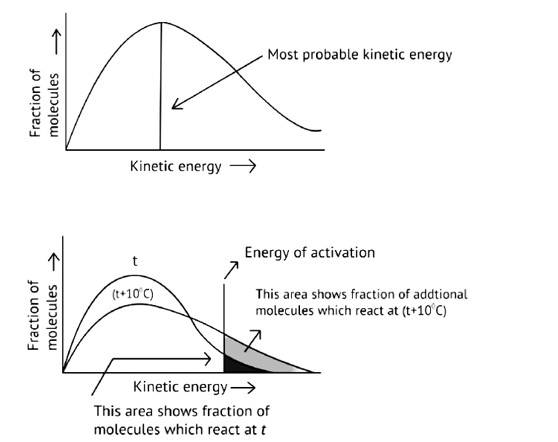
As illustrated in the graph, as the temperature rises, the peak pushes ahead, increasing probable kinetic energy while decreasing the number of molecules utilizing it, resulting in a faster rate of reaction.
New answer posted
a year agoContributor-Level 10
This is a Long Answer Type Question as classified in NCERT Exemplar
The reaction rate in collision theory is determined by two factors: energy and orientation factor. Certain reactions can be highly exothermic and energetically favoured, meaning the reactants have enough activation energy to collide effectively. However, they do not proceed at a fixed temperature, which is why the reactant molecules are not orientated properly during collisions, resulting in atoms of reactant molecules combining to produce products that do not face each other.
New answer posted
a year agoContributor-Level 10
Linear motion is one-dimensional motion. It refers to motion in a single direction or in a straight line. In linear motion, the object either moves forward or backward along one axis, i.e. x-axis. For example - a ball dropped from a height vertically downward or a car moving straight on a road. Motion in a Plane refers to an object moving in two dimensions, usually along x and y axes. For example, a football kicked at an angle.
New answer posted
a year agoContributor-Level 10
The angle of projection is used to find the trajectory, horizontal range of a projectile, maximum height, and time of flight. For example, the maximum range on level ground is given by the 45-degree angle.
New answer posted
a year agoContributor-Level 10
The vectors like velocity, displacement, and acceleration act along different directions in the two-dimensional motion. Resolving the vectors into the vertical and horizontal components allows the application of one-dimensional kinematic equations in each direction separately. It helps solve the problems more accurately and also simplifies the analysis.
New answer posted
a year ago

Contributor-Level 10
This is a matching answer type question as classified in NCERT Exemplar
Correct option is (iii)
New answer posted
a year ago
Contributor-Level 10
This is a matching answer type question as classified in NCERT Exemplar
Correct option is (ii)
New answer posted
a year ago
Contributor-Level 10
This is a matching answer type question as classified in NCERT Exemplar
Correct option is (i)
CCl3NO2 stands for chloropicrin, which is known as tear gas. Cl is the element of the highest electron gain enthalpy. Sulphur is the element belonging to 16th group, also known as chalcogens.
Taking an Exam? Selecting a College?
Get authentic answers from experts, students and alumni that you won't find anywhere else
Sign Up on ShikshaOn Shiksha, get access to
- 67k Colleges
- 1.2k Exams
- 717k Reviews
- 1850k Answers