

Chemistry
Get insights from 6.9k questions on Chemistry, answered by students, alumni, and experts. You may also ask and answer any question you like about Chemistry
Follow Ask QuestionQuestions
Discussions
Active Users
Followers
New answer posted
a year agoContributor-Level 10
20. (iv) They are anisotropic in nature since amorphous solid shows isotropic properties as they exhibit same values of the properties like refractive index, electrical resistance when measured along different directions.
New answer posted
a year agoContributor-Level 10
19. Option (i) Same in all directions is correct since quartz glass is an amorphous solid showing isotropic properties and hence exhibits the same values of refractive index when measured along different directions.
New answer posted
a year ago
Contributor-Level 10
18. Option (iv) is correct since in antiferromagnetic substances the domains are oppositely oriented and hence they cancel out each other's magnetic moments.

New answer posted
a year agoContributor-Level 10
17. Option (ii) Quartz glass (SiO2) is correct since quartz glass (SiO2)is amorphous in nature as there is no long range ordered arrangement of the constituent particles being present in it and hence it is an amorphous solid.
New answer posted
a year agoContributor-Level 10
16. Option (ii) Isotropic nature is correct since crystalline solids exhibit anisotropic properties like refractive index, electrical resistance etc. Since these are found to have different values when measured along different directions in the same crystal and hence they are not isotropic in nature.
New answer posted
a year agoContributor-Level 10
15. Option (ii) Low temperature is correct since at sufficiently low temperature, the thermal energy is low, so the intermolecular forces bring the molecules of a substance closer so that they cling to one another and occupy fixed positions. They keep on vibrating about their fixed positions. Such conditions favours the existence of the substance in solid state.
New answer posted
a year agoContributor-Level 10
14. On heating the amorphous substance it gets changed to the crystalline form at some temperature. This is due to the process called crystallization. As on heating at some temperature it may become crystalline since slow heating and cooling over a longer period of time makes these changes.
New answer posted
a year agoContributor-Level 10
13. In ccp lattice the number atoms per unit cell = 4
The number of tetrahedral voids is given as = 2 (n) = 2 x 4 = 8
Only one-third of tetrahedral voids are occupied by metal M so, the ratio of atoms of element M to that of element N = 1/3 (8) : (4) = 2 : 3
or M : N = 2 : 3
Hence, the formula of the compound is M2N3.
New answer posted
a year agoContributor-Level 10
12. When tetravalent germanium is doped with trivalent gallium then some of the positions of the lattice of germanium gets occupied by the gallium. Since the gallium atom has only three valence electrons, the fourth valency of the nearby germanium atom does not get satisfied and hence this place remains vacant. This place is deficient of electrons and is therefore called an electron hole or electron vacancy.
Now, the electron from the neighbouring atom comes and fills the gap and leads to the formation of a hole in its original position. Under the influence of electric fields, the electrons move towards the positively charged plat
New answer posted
a year agoContributor-Level 10
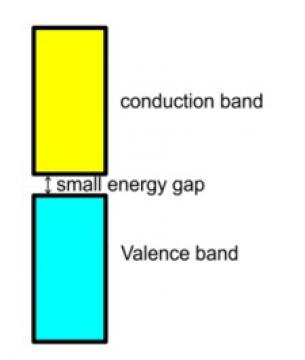
11. In semiconductors the gap between conduction band and valence band is small and hence some of the electrons from the valence band can easily jump to the conduction band and shows some conductivity but with rise in the temperature more of the electrons gets jump to the conduction band and thus, their electrical conductivity increases with rise in the temperature.
Taking an Exam? Selecting a College?
Get authentic answers from experts, students and alumni that you won't find anywhere else
Sign Up on ShikshaOn Shiksha, get access to
- 67k Colleges
- 1.2k Exams
- 718k Reviews
- 1850k Answers