

Chemistry
Get insights from 6.9k questions on Chemistry, answered by students, alumni, and experts. You may also ask and answer any question you like about Chemistry
Follow Ask QuestionQuestions
Discussions
Active Users
Followers
New answer posted
a year ago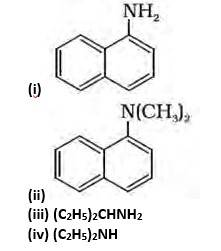
Contributor-Level 10
(ii) Tertiary, because the Nitrogen atom is attached to the 3 carbon atoms.
(iii) Primary, because the nitrogen atom is attached to the only 1 carbon atom.
(iv) Secondary, because the nitrogen atom is attached to the only 1 carbon.
New answer posted
a year agoContributor-Level 10
5.26
Soap is sodium or potassium salts of fatty acids (long chain). Represented as RCOO–Na+. When dissolved in Water it dissociates in the RCOO– and Na+. In first ion there are two parts R and COO–. R is hydrophobic tail and COO– Hydrophilic head. RCOO– ions present at the surface with COO– group inside and R group outside.
Increasing concentration to critical micelle concentration anions are pulled inside the bulk and Form a spherical shape of hydrocarbon chain pointing towards the centre and COO– pointing outside this are called as micelle.
Cleansing action of soap: Soap molecules form micelle around oil droplets. So
New answer posted
a year agoContributor-Level 10
8.6 The oxidation state increases when an atom loses its Example: When Fe loses 2 electrons, its oxidation state becomes +2 from 0.
Oxygen (O) and fluorine (F) are very strong oxidizing agents. Both oxide and fluoride ions are highly electronegative and have a very small size, so they attract the electrons from metal atoms. Hence, they oxidize the metal to its the highest oxidation state.
New answer posted
a year agoContributor-Level 10
5.25
Emulsifiers form an interfacial film between the suspended particles and medium. It provide coating to every drop of suspended particle and prevent it from coagulating. And it remain suspended in medium. Ex- Proteins, gums, alcohols, Lampblack etc.
New answer posted
a year agoContributor-Level 10
8.5 The ionization energy increases due to the gradual filling of electrons in the d- subshells. The irregular variation of ionization energy is due to the fact that half-filled and completely filled subshells are more stable and have very high ionization energy.
In case of first ionization energy, Cr ( [Ar]3d54s1) attains the stable configuration (3d5) by losing one electron from s-subshell and hence, it has low ionization energy.
Whereas, Zn has high ionization energy because it has completely filled subshells and are very stable.
Second ionization energies are higher than the first since it becomes difficult to remove an electron
New answer posted
a year agoContributor-Level 10
5.25
Emulsions –The system which has Liquid as both dispersed phase and dispersion medium. There are two types of emulsions
Oil in Water-Ex-Milk
Water in oil-Ex-Butter.
New answer posted
a year agoContributor-Level 10
8.4 The E0 (M2+/M) value of a metal depends on the energy changes involved in the following reactions:
1. Sublimation energy: The energy needed to convert one mole of atoms from a solid state to gaseous
2. Ionization energy: The energy supplied to remove electrons from one mole of atoms, which are in the gaseous
3. Hydration energy: The energy emitted to hydrate one mole of
Now, copper has a high ionisation energy and low hydration energy. Hence, the E0 (M2+/M) value for copper is positive.
New answer posted
a year agoContributor-Level 10
5.23
(i) In this case Tyndall effect is observed i.e. scattering of light by the colloidal particles takes place and the path of light become visible.
(ii) The coagulation takes place in this case positive charge particles of Fe (OH)2 gets attached with Cl-. And of FeCl3 is obtained.
(iii) In this case coagulation will take place. After passing electric current through colloidal solution particle will get attracted towards oppositely charged and lose their charge and coagulate.
New answer posted
a year agoContributor-Level 10
8.3 Manganese (Z = 25) exhibits the largest number of oxidation states. This is because its electronic configuration is 3d54s2.
Because it has the maximum number of electrons (5 d electrons and 2s electrons) to easily lose and share.
Therefore, it can exhibit an oxidation state of +2 to +7. The compounds are as follows:
Mn (0) as Mn (s), Mn (II) as MnO, Mn (II, III), Mn etc.
New answer posted
a year agoContributor-Level 10
5.22
Colloidal solutions get classified in 8 Types on the basis of physical state of the dispersed phase and dispersion This are given in following table-
Dispersed phase | Dispersion media | Types of colloids | Example |
Solid | Solid Sol | Gem stone | |
Solid | Liquid | sol | Paints, cell fluid. |
Solid | Gas | Aerosol | Dust, smoke. |
Liquid | Solid | Gel | Butter, Cheese. |
Liquid | Emulsion | Milk, Hair cream. | |
Liquid | Gas | Aerosol | Fog, Mist, Cloud. |
Gas | Solid | Solid Sol | Pumice stone. |
Gas | Liquid | Foam | Froth, soap lather. |
2) Depending upon nature of Particles of dispersed phase it can be classified into 3 categories
Multimolecular Colloids-In this colloidal particle consist of aggregates of atoms having diameter less than
Macromolecular colloids-The colloids in which Large particle aggregates and dissolved into suitable
Associated colloids – This colloids show Colloidal property at higher This contains ions of colloidal size.
3) Depending upon interactions between dispersed phase and dispersion medi
Taking an Exam? Selecting a College?
Get authentic answers from experts, students and alumni that you won't find anywhere else
Sign Up on ShikshaOn Shiksha, get access to
- 67k Colleges
- 1.2k Exams
- 718k Reviews
- 1850k Answers