

Chemistry
Get insights from 6.9k questions on Chemistry, answered by students, alumni, and experts. You may also ask and answer any question you like about Chemistry
Follow Ask QuestionQuestions
Discussions
Active Users
Followers
New answer posted
a year agoContributor-Level 10
9.41. (d) Hard water forms scum/precipitate with soap. Soap containing sodium stearate (C17H35COONa) reacts with hard water to precipitate out Ca/Mg stearate.It is, therefore, unsuitable for laundry. It is harmful for boilers as well, because of deposition of salts in the form of scale. This reduces the efficiency of the boiler.
New answer posted
a year agoContributor-Level 10
9.40. (c) The crystalline form of water is ice. Atatmospheric pressure ice crystallises in the hexagonal form, but at very low temperatures it condenses to cubic form. Density of ice is less than that of water. Therefore, an ice cube floats on water. In winter season ice formed on the surface of a lake provides thermal insulation which ensures the survival of the aquatic life. This fact is of great ecological significance.
New answer posted
a year agoContributor-Level 10
9.39. (c) Lithium hydride is rather unreactive atmoderate temperatures with O2 or Cl2. It is, therefore, used in the synthesis of other usefulhydrides, e.g.,
8LiH + Al2Cl6 → 2LiAlH4 + 6LiCl
2LiH + B2H6 → 2LiBH4
New answer posted
a year agoContributor-Level 10
9.38. (b) Loss of the electron from hydrogen atomresults in nucleus (H+) of ~1.5*10–3 pm size.This is extremely small as compared to normalatomic and ionic sizes of 50 to 200pm. As a consequence, H+ does not exist freely and isalways associated with other atoms ormolecules.
New answer posted
a year agoContributor-Level 10
9.37. (a) H2O2 decomposes slowly on exposure to light.
2H2O2 (l) → 2H2O (l) + O2 (g)
In the presence of metal surfaces or traces ofalkali (present in glass containers), the above
reaction is catalysed. It is, therefore, stored inwax-lined glass or plastic vessels in dark.
New answer posted
a year agoContributor-Level 10
11.84
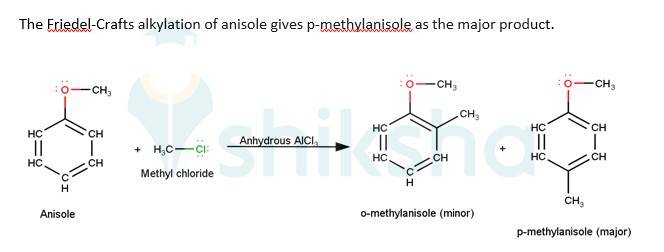
The driving force of all the reactions given to the question is that the alkoxy group is an ortho and para directing group because it exerts its +R effect in the benzene ring. Para position being comparatively more stable than the ortho position is usually preferred because ortho position leads to stearic hindrance, hence the major product is mostly the para- substituted compound.
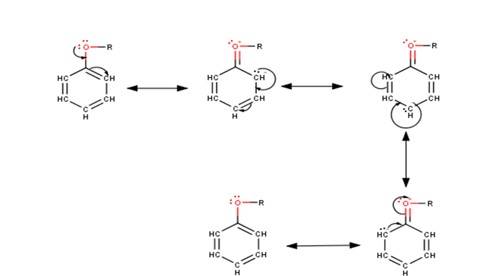
As seen from the resonating structures above the structure in which the negative charge is in the para position will form a more stable product when attacked by an electrophile. Hence in the following reactions, we will be considering that resonating stru
Taking an Exam? Selecting a College?
Get authentic answers from experts, students and alumni that you won't find anywhere else
Sign Up on ShikshaOn Shiksha, get access to
- 67k Colleges
- 1.2k Exams
- 718k Reviews
- 1850k Answers