

Chemistry
Get insights from 6.9k questions on Chemistry, answered by students, alumni, and experts. You may also ask and answer any question you like about Chemistry
Follow Ask QuestionQuestions
Discussions
Active Users
Followers
New question posted
a year agoNew answer posted
a year agoContributor-Level 10
(a) (i) Primary alcohols do no react appreciably with Lucas' reagent (HCl –ZnCl2) at room temperature.
(ii) Tertiary alcohol reacts immediately with Lucas 'reagent.
New answer posted
a year agoContributor-Level 10
11.5 In this reaction, when propene reacts with the given reagent then the double bond of propene breaks down with charges on them. So, H+ gets placed on the carbon which already has two hydrogen atom and OH- gets substituted on center carbon because it has the more positive charge which attracts OH-. Thus we get propene-2-or as a
2. In this reaction, when Methyl ( 2-oxocyclohexyl) ethanoate reacts with the given reagent then the double bond between the oxygen atom and cyclohexyl gets breaks down, such that O has a negative charge and that particular carbon will have a positive charge on it. So, to neutralize it, H+ gets substitut
New answer posted
a year agoContributor-Level 10
11.4 In the Grignard reagent reaction, the first step of the reaction is the nucleophilic addition of Grignard reagent to the carbonyl group to form an adduct, Hydrolysis of adduct results in the formation of alcohol.
Here, is the general reaction with Grignard reagent below:-
From here, it is clear that HCHO gives CH2OH groups, so R of Grignard reagent is the remaining part of given alcohols. Thus, select the suitable Grignard reagent by substituting the value of R. Now we can see the reaction given below:-
Methanal reacts with iso-propyl magnesium bromide, in presence of dry ether gives an additional compound. And this additional compou
New answer posted
a year agoContributor-Level 10
11.3 (i) 3-chloroethyl-2-isopropylpentan-1-ol
(ii) 2,5-Dimethylhexane-1,3-diol
(iv) 3-Bromocyclohexanol
(v) Hex-1-en-3-ol
(vi) 2-Bromo-3-methylbut-2-en-1-ol
New answer posted
a year agoContributor-Level 10
3.60. In a multi-electron atom, the electrons present in the inner shells shield the electrons in the valence shell from the attraction of the nucleus. They act as a screen between the nucleus and these electrons. This is known as the shedding effect or the screening effect.
As the screening effect increases, the effective nuclear charge decreases. Consequently, the force of attraction by the nucleus for the valence shell electrons decreases, and hence the ionization enthalpy decreases.
New answer posted
a year agoContributor-Level 10
11.2 Allylic alcohol is an organic compound which has the structural formula CH2 = CHCH2OH. In other words, in these alcohols, the-OH group is attached to sp2 hybridized carbon next to the carbon-carbon double bond, that is to an allylic carbon. Therefore, in the above examples, the following are the allylic alcohols.
(ii) H2C = CH – CH2OH and
New answer posted
a year agoContributor-Level 10
3.59. The d-block elements are known as transition elements.
They have electronic configuration= (n – 1) d1-10 ns1-2
Characteristics of d-block elements are:
They show variable oxidation states.
Their compounds are generally paramagnetic.
Most of the transition elements form coloured compounds.
They are all metals with high melting and boiling points.
These elements are used in the formation of alloys.
New answer posted
a year agoContributor-Level 10
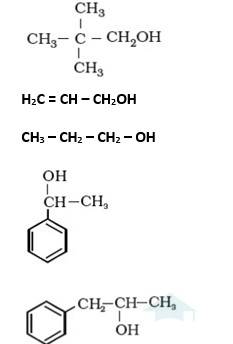
It is primary alcohol because carbon which carries the –OH group is only attached to one alkene group.
It is primary alcohol because the carbon which carries the –OH group is only attached to one propyl group.
It is secondary alcohol because the carbon which carries the –OH group is joined directly to methyl and benzene.
It is secondary alcohol because the carbon which carries the –OH group is joined directly to two different alkyl groups.
New answer posted
a year agoContributor-Level 10
3.58. Elements gallium and germanium were unknown at the time Mendeleev published his Periodic Table. He left the gap under aluminium and a gap under silicon, and called these elements Eka-Aluminium and Eka-Silicon. Mendeleev predicted not only the existence of gallium and germanium but also described some of their general physical properties.
Taking an Exam? Selecting a College?
Get authentic answers from experts, students and alumni that you won't find anywhere else
Sign Up on ShikshaOn Shiksha, get access to
- 67k Colleges
- 1.2k Exams
- 718k Reviews
- 1850k Answers