Class 11th

Get insights from 8k questions on Class 11th, answered by students, alumni, and experts. You may also ask and answer any question you like about Class 11th

Follow Ask Question
8k

Questions

0

Discussions

0

Active Users

0

Followers

New answer posted

a year ago

0 Follower 4 Views

A
alok kumar singh

Contributor-Level 10

  z + α | z − 1 | + 2 i = 0

Let z = x + iy

⇒ x + i ( y + 2 ) = − α ( x − 1 ) 2 + y 2            

 for α ∈ R y + 2 = 0 ⇒ y = − 2  

x 2 = α 2 [ ( x − 1 ) 2 + 4 ]      = 0

1 α 2 ≥ 4 5 ⇒ α 2 ≤ 5 4 ⇒ − 5 2 ≤ α ≤ 5 2

4 ( p 2 + q 2 ) = 4 ( 5 4 + 5 4 ) = 1 0


New answer posted

a year ago

0 Follower 2 Views

A
alok kumar singh

Contributor-Level 10

  ∑ r = 1 n t a n − 1 1 1 + r + r 2 = ∑ r = 1 n t a n − 1 ( r + 1 ) 1 + r ( r + 1 )

= t a n − 1 2 − t a n − 1 + . . . . . . + t a n − 1 ( n + 1 ) − t a n − 1 n            

For n  ∞ value = π 2 − π 4 = π 4  

∴ t a n ( π 4 ) = 1           

New answer posted

a year ago

0 Follower 4 Views

P
Payal Gupta

Contributor-Level 10

From volume conservation

n*43πr3=43πR3⇒R3=nr3.........(1)

Decrease in surface area = n*4πr2−4πR2

(ΔA)=4π[nr2−R2]=4π[n*r3r−R2]=4π[R3r−R2]=4πR3[1r−1R]

Energy released (W) = T*ΔA=4πR3T[1r−1R]

Heat produced (Q) = WJ=4πTR3J[1r−1R]

Now,Q=msΔθ

⇒4πR3TJ[1r−1R]=(43πR3)*|x|*Δθ=3TJ[1r−1R]

New answer posted

a year ago

0 Follower 13 Views

P
Payal Gupta

Contributor-Level 10

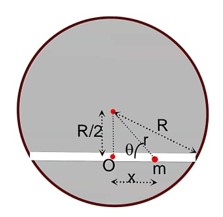
F = m E cos θ

 =m (GMR3*r)*xr ma=mgR*⇒a=gRx

⇒ T = 2 π R g


New answer posted

a year ago

0 Follower 10 Views

P
Payal Gupta

Contributor-Level 10

Mass m will acquire velocity 2u. Total momentum of system will be conserved but total kinetic energy is not conserved during collision.
New answer posted

a year ago

0 Follower 5 Views

P
Payal Gupta

Contributor-Level 10

F=kR3=mv2R⇒v=kmR2=km*1R

T=2πRv=2πRkm* (1R)⇒TαR2

New answer posted

a year ago

0 Follower 2 Views

P
Payal Gupta

Contributor-Level 10

W=α2β    e−−βx2kT

[βx2]= [kT]= [ML2T−2]

β=MT−2

[W]= [α2β]⇒ [ML2T−2]= [α2] [MT−2]⇒ [α2]= [L2]⇒ [α]= [L]

New answer posted

a year ago

0 Follower 7 Views

P
Payal Gupta

Contributor-Level 10

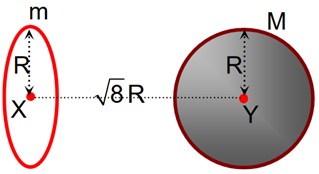
Method – I:

F=MsphereEring=M*Gmx (R2+x2)32=M*Gmx8R (R2+8R2)32=8GMm27R2

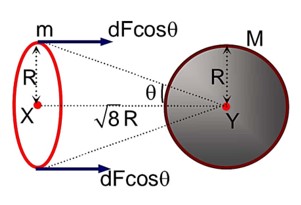
Method – II:

F=∫dFcosθ=cosθ∫ (dm)GM (R2+8R2)=8GMm27R2

New answer posted

a year ago

0 Follower 1 View

S
Syed Aquib Ur Rahman

Contributor-Level 10

Correctly identifying isotopes and isobars requires knowing both the atomic and mass numbers. Relying on only one is a common error.

  • Isotopes: Same element (atomic number), different mass.
  • Isobars: Different elements (atomic number), same mass.

New answer posted

a year ago

0 Follower 3 Views

S
Syed Aquib Ur Rahman

Contributor-Level 10

Rutherford's atomic model was a breakthrough, but it was flawed. It couldn't explain atomic stability, as orbiting electrons should lose energy and spiral into the nucleus. It also failed to account for the discrete line spectra observed from excited atoms.

Get authentic answers from experts, students and alumni that you won't find anywhere else

Sign Up on Shiksha

On Shiksha, get access to

  • 67k Colleges
  • 1.2k Exams
  • 717k Reviews
  • 1850k Answers

Share Your College Life Experience

×
×

This website uses Cookies and related technologies for the site to function correctly and securely, improve & personalise your browsing experience, analyse traffic, and support our marketing efforts and serve the Core Purpose. By continuing to browse the site, you agree to Privacy Policy and Cookie Policy.