

Class 11th
Get insights from 8k questions on Class 11th, answered by students, alumni, and experts. You may also ask and answer any question you like about Class 11th
Follow Ask QuestionQuestions
Discussions
Active Users
Followers
New answer posted
a year agoContributor-Level 10
Suppose the position-time graph is a straight line, in this case, the velocity is constant. This means that there is no acceleration.
If the graph is curved, velocity is changing, which means that there is acceleration. If the graph is concave, the slopes will get more positive with time. This means that there is positive acceleration. If the graph is cap-shaped, the slope will become more negative with time. This is known as negative acceleration.
New answer posted
a year agoContributor-Level 10
To graph motion in a straight line, you need to visualise the relationship between different kinematic quantities like position, velocity and time. Suppose an object moves with a constant velocity, the position-time graph will be a straight line with constant slope. If the object accelerates, the slope of position-time graph will change with time and result in a curved line.
New answer posted
a year agoContributor-Level 10
No. Since kinetic energy is a scalar quantity, it only depends on speed of the body and not the direction. So if the direction of the body is changed but the speed remains unchanged, there won't be any effect on the kinetic energy. However, if changing the direction also changes the speed of the body, then kinetic energy of the body will also change.
New answer posted
a year agoContributor-Level 10
If you look closely at the formula of kinetic energy (1/2*m*v^2), the velocity is squared which automatically gives a positive integer. And mass of the body can never be a negative value, which leads to the result being a positive integer.
New answer posted
a year agoContributor-Level 10
The 1/2 is a result of mathematical calculation, which occurs when we integrate? vdv in the formula of work done according to Newton's second law of motion. Without this, the final result will turn out to be twice of the actual value.
New answer posted
a year agoContributor-Level 10
Class | Frequency | xi | xifi |
|
0 - 6 6 – 12 12 – 18 18 – 24 24 – 30 | a b 12 9 5 a + b + 26 = N | 3 9 15 21 27 | 3a 9b 180 189 135 | -> 81a + 37b = 1018 -(i) |
->a + b = 18 -(ii)
Solving (i) & (ii) a = 8 & b = 10
->(a – b)2 = 4
New answer posted
a year agoContributor-Level 10
Let the constant term is (k + 1)th term.
For constant term 10r – rk – 2k = 0.
For k = 6 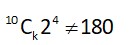
For k = 8 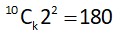
New answer posted
a year agoContributor-Level 10
2040 = 23 * 3 * 5 * 17
If HCF between {n & 2040} = 1
n can not be multiple of 2, 3, 5, 17.
Let S(n) denote sum of numbers divisible by n.
S(34) = 34 + 68 = 102
S (51) = 51
S (85) = 85, S (30) = 30 + 60 + 90 = 180 S (all other combinations) = 0
Sum of all numbers which are either divisible by 2, 3, 5, or 17 is
&nb
New answer posted
a year agoContributor-Level 10
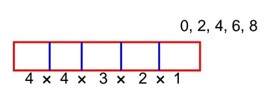
1st position can be filled in 4 ways as zero cannot appear in 1st position.
2nd position can be filled in 4 ways and so on.
Total cases = 4 * 4 * 3 * 2 * 1 = 96
New answer posted
a year agoContributor-Level 10

->For the inequality Satisfies.
For n= 4. 2 [4 * 103 + 4 * 10] > 104
->8 * 1010 > 104 which is a contradiction
all values satisfies. Hence possible values of n is 96
Taking an Exam? Selecting a College?
Get authentic answers from experts, students and alumni that you won't find anywhere else
Sign Up on ShikshaOn Shiksha, get access to
- 67k Colleges
- 1.2k Exams
- 717k Reviews
- 1850k Answers