

Class 11th
Get insights from 8k questions on Class 11th, answered by students, alumni, and experts. You may also ask and answer any question you like about Class 11th
Follow Ask QuestionQuestions
Discussions
Active Users
Followers
New answer posted
a year ago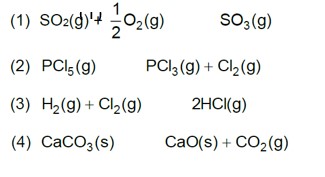
Contributor-Level 10
On increasing pressure, equilibrium moves in that direction where number of gaseous moles decreases.

New answer posted
a year agoContributor-Level 10
We consider the enthalpy change (delta H) more important than the internal energy (delta U) for practical reasons. When we go by the definitions alone, internal energy is the heat absorbed or released at a constant volume. This only happens in a sealed container. But in real life experiments held at laboratories, we have open vessels like test tubes, and there, only atmospheric pressure as a state variable remains constant, and not volume per se. This condition of constant pressure becomes more useful to calculate enthalpy in the chemical reaction.
New answer posted
a year agoContributor-Level 10
We cannot universally say that negative enthalpy is the cause for spontaneity in chemical reactions. Though it is commonly seen in spontaneous reactions that heat releases or follows the exothermic definition, some spontaneous reactions can also absorb heat. They can be endothermic in nature. With that, we get a positive value for enthalpy change. So the better approach is to look into entropy and Gibbs Energy. These two quantities can define or tell us that a chemical process is spontaneous when the total entropy change is positive and when the Gibbs energy change is negative.
New answer posted
a year agoContributor-Level 10
This can be a little confusing when we already know the equation from the First Law of Thermodynamics (delta U = q + W) has internal energy as a state function. Work (W) and heat (q) are dependent on the path entirely, but internal energy is only concerned with initial and final states. We can consider the example of work done for an extremely slow or quick process of a gas expanding. The work done for slow work will be different from that of a faster one, but their initial and final states won't have any effect.

New answer posted
a year agoContributor-Level 10
E =
As temperature increases, strain increases
Elasticity decreases
Taking an Exam? Selecting a College?
Get authentic answers from experts, students and alumni that you won't find anywhere else
Sign Up on ShikshaOn Shiksha, get access to
- 67k Colleges
- 1.2k Exams
- 716k Reviews
- 1850k Answers