

Class 11th
Get insights from 8k questions on Class 11th, answered by students, alumni, and experts. You may also ask and answer any question you like about Class 11th
Follow Ask QuestionQuestions
Discussions
Active Users
Followers
New answer posted
a year agoContributor-Level 10
The surface tension of a liquid is inversely proportional to temperature. Decreases
Most fluids offer resistance to their motion. It is like internal mechanical friction, known as viscosity. Gas viscosity increases with temperature, whereas liquid viscosity decreases with temperature. Because, intermolecular forces weaken with temperature increase, viscosity decreases.
With reference to the elastic modulus of rigidity for solids, the shearing force is proportional to the shear strain. With reference to elastic modulus of rigidity for fluids, the shearing force is proportional to the rate of shear strain.
For a steady-flowing fluid, an inc
New answer posted
a year agoContributor-Level 10
11.10 Initial temperature, = 40.0°C, Final temperature, = 250°C, T = - = 210°C
Initial length of the brass rod at , = 50 cm, Initial diameter of the brass rod at , = 3 mm
Length of the steel rod
For the expansion of the brass rod, we have:
= , then = 50 = 0.21 cm
For the expansion of the steel rod, we have:
= , then = 50 = 0.126 cm
Total change in length = 0.21 + 0.126 = 0.336 cm
Since the rods are free at the end, no thermal stress developed.
New answer posted
a year agoContributor-Level 10
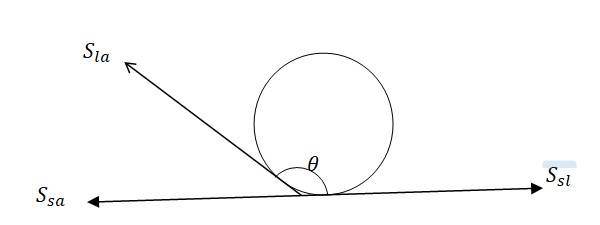
The angle between the tangent to the liquid surface at the point of contact and the surface inside the liquid is called the angle of contact ( , as shown in the diagram
= Interfacial tension between liquid-air interface
= Interfacial tension between solid -liquid interface
= Interfacial tension between solid-air interface
At the line of contact of contact, the surface forces between the three media must be in equilibrium. Hence
=
The angle of contact is obtuse, if , as in the case of mercury on glass

This angle is acute if , as in the case of water on glass
Mercury molecules (which mak
New answer posted
a year agoContributor-Level 10
11.9 Initial temperature, = 27°C, Length of the wire at = 1.8 m
Final temperature, = -39°C
Diameter of the wire, d = 2.0 mm = 2 m
Coefficient of linear expansion of brass, /K
Youngs' modulus of brass, Y = 0.91 Pa
Let the tension developed be F
We know Youngs' modulus = =
Y = or F =
Here, A = cross-sectional area of the wire = = = 3.1416
Now can be written as = = ( = -1.32 L
Substituting all values, we get
F = (3.1416 = -377.37 N
New answer posted
a year agoContributor-Level 10
11.8 Initial temperature, = 27.0 °C, Initial diameter of the hole, = 4.24 cm
Final temperature, = 227.0 °C, Final diameter of the hole
Coefficient of linear expansion of copper, = 1.70 K–1
We know
= T where is the coefficient of superficial expansion,
= T
= T
- 1= 2 1.70 (227-27) = 6.8
= 4.2544 cm
So change in diameter = 4.2544 – 4.24 = 0.01439 cm
Diameter increase by 1.44 cm
New answer posted
a year agoContributor-Level 10
The pressure of a liquid is given by the following relation:
P = h g, where P = Pressure, h = height of the liquid column, = is the density of the liquid and g= acceleration due to gravity
From the above relation, because of the h factor (height of the human body), the pressure is more at the feet and less at the brain
The said phenomenon is due to the factor. Density of air is maximum at the sea level. At height, density decreases and pressure also decreases. At 6 km height, the density of air is nearly half of that of a t sea level
When pressure is applied on the liquid, the pressure is transmitted in all dir
New answer posted
a year agoContributor-Level 10
11.7 Given, temperature = 27 °C = 27 + 273.16 K = 300.16 K
Outer dia of the shaft at temp , = 8.7 cm
Diameter of the central hole of the wheel, = 8.69 cm
The change in diameter, Δd= 8.69 – 8.7 = 0.01 cm
After the shaft is cooled in dry ice, its temperature becomes . It can be calculated from the relation
Δd= (
-0.01 = 8.7
= -95.78
= 204.22 K = -68.94
New answer posted
a year agoContributor-Level 10
11.6 Length of the steel tape, l = 1 m = 100 cm, At temperature T = 27 C
Coefficient of linear expansion of steel = 1.2 / K
Let be the length of the steel rod at temperature = 45.0 °C and
be the length of the steel rod and l' be the length of the steel tape at 45.0 °C
We have l' = l + = 100 + 1.2 (45-27) = 100.0216 cm
can be calculated as = = 63.0136 cm
New answer posted
a year agoContributor-Level 10
11.5 (a) For Thermometer A
Triple point of water, T = 273.16 K
At this temperature, the pressure in thermometer A , = 1.250 Pa
Let be the temperature for the normal melting point of sulphur and be the corresponding pressure. It is given, = 1.797 Pa
From Charles' law, we get = , = = = 392.69 K
For Thermometer B
Triple point of water, T = 273.16 K
At this temperature, the pressure in thermometer B , = 0.2 Pa
Let be the temperature for the normal melting point of sulphur and be the co
New answer posted
a year agoContributor-Level 10
11.4 (a) The triple point of water has a unique value of 273.16 K, irrespective of pressure and volume. Whereas, melting point of ice and boiling point of water, the temperature value depends on pressure and volume.
(b) The other fixed point on Kelvin scale is 0 K.
(c) The temperature 273.16 K is the triple point of water, it is not the melting point of ice. The melting point of ice is specified in Celsius scale as 0 Hence the absolute temperature in Kelvin scale, is related to temperature in Celsius scale as
(d) Let and be the temperature in Fahrenheit and absolute scale. From the co-rela
Taking an Exam? Selecting a College?
Get authentic answers from experts, students and alumni that you won't find anywhere else
Sign Up on ShikshaOn Shiksha, get access to
- 67k Colleges
- 1.2k Exams
- 718k Reviews
- 1850k Answers