

Class 11th
Get insights from 8k questions on Class 11th, answered by students, alumni, and experts. You may also ask and answer any question you like about Class 11th
Follow Ask QuestionQuestions
Discussions
Active Users
Followers
New answer posted
a year agoContributor-Level 10
11.3 It is given that R = [1 + α(T – )] ………(i)
Where Ro and To are the initial resistance and temperature and R and T are the final resistance and temperature.
At the triple point of water, To = 273.15 K, = 101.6 Ω
At normal melting point of lead, T = 600.5 K, R = 165.5 Ω
Substituting these values in equation (i), we get
165.5 = [1 + α(600.5 – )]
= 1 + 327.35 α, or α = = 1.92
When R = 123.4 Ω, T can be calculated as
123.4 = [1 + 1.92 (T – )]
1.214 = 1 + T1.92 - 1.92 273.15
T = 384.6 K
New answer posted
a year agoContributor-Level 10
11.2 Triple point of water on absolute scale A, = 200 A
Triple point of water on absolute scale B, = 350 B
Triple point of water on absolute Kelvin scale, = 273.15 K
The temperature 273.15 K on Kelvin scale is equivalent to 200 on absolute scale A
200 A = 273.15 K, Therefore A =
Similarly B =
If is the triple point of water on scale A and is the triple point of water on scale B, we have
=
=
New answer posted
a year agoContributor-Level 10
11.1 Kelvin and Celsius scales are related as
= - 273.15 ….(i),
Where temperature in Celsius scale and = temperature in Kelvin scale
Celsius and Fahrenheit scales are related as
= , where = temperature in Fahrenheit scale
(a) For Neon, = 24.57. Hence = 24.57 – 273.15 = -248.58 degree Celsius
= = -415.44 degree Fahrenheit
(b) For Carbon dioxide, = 216.55. Hence = 216.55 – 273.15 = -56.6 degree Celsius
= = -69.88 degree Fahrenheit
New answer posted
a year agoContributor-Level 10
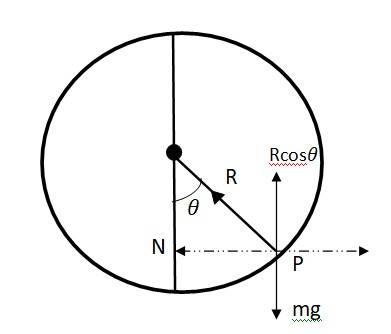
Let be the angle made by the radius vector joining the bead and the centre of the wire with the downward direction. Let, N be the normal reaction.
mg = N …….(1)
mr = N ……(2)
m(R ) = N
Hence N = m(R)
Substituting the value on N in eqn (1)
mg = mR
or = g/ R ………(3)
As 1, the bead will remain at the lowermost point
g/ R
For = becomes
= g/ R
=(g/R)(R/2g) = ½
New answer posted
a year agoContributor-Level 10
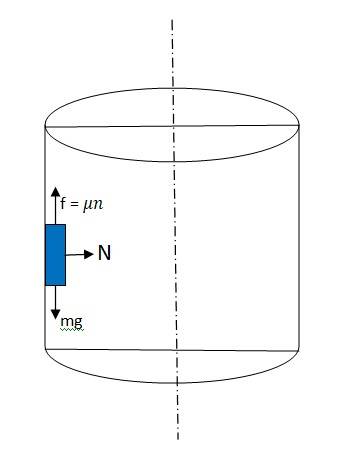
Mass of the man, m = 70 kg
Radius of the drum, r = 3 m
Coefficient of friction between the wall and his clothing, = 0.15
Number of revs of hollow cylindrical drum = 200 rev/min = 200/60 rev/s = 3.33 rev/s
The centripetal force required is provided by the normal N of the wall on the man
N = m = m R
When the floor revolves, the man sticks to the wall of the drum. Hence, the weight of the man (mg) acting downwards is balanced by the frictional force acting vertically upwards.
The man will not fall, if
mg
mg )
= 10/ (3 0.15)
New answer posted
a year agoContributor-Level 10
When the motorcyclist is at the uppermost point of the death well, the normal reaction R on the motorcyclist by the ceiling of the chamber acts downwards. His weight mg also acts downwards. The outward centrifugal force acting on the motorcyclist is balanced by two forces.
R + mg = m , where v is the velocity and m is the combined mass of the motorcycle and motorcyclist
Because of the balance between the forces, the motorcyclist does not fall.
The minimum speed required at the uppermost position to perform a vertical loop is given by R = 0 in the above equation.
So mg = m or v = = = 15.8 m/s
New answer posted
a year agoContributor-Level 10
Speed of revolution of the disc, n = rev/min = 100/3 rpm = 100/ (3
Angular acceleration = 2 = 2 = 3.492 rad/s
The coins revolve with the disc. The centripetal force is provided by the frictional force …. (1)
As v = r , the above equation becomes mr
r
r (0.15 = 12 cm
For coin A, r = 4 cm
The condition (r 12 ) is satisfied for the coin placed at r = 4 cm, so coin A will revolve with the disc.
The condition (r 12 ) is not satisfied for the coin placed at r = 14 cm, so coin B will not revolve with the disc.
New answer posted
a year ago
Contributor-Level 10
Force on the box, F = MA = 40 2 N = 80 N
Frictional force, Ff = = 0.15 60 N
Net force = F – Ff = 80 – 60 = 20 N
From the equation F = ma, we get the backward acceleration produced in the box
a = 20/40 = 0.5 m/s2
From the equation s = ut + , to travel s = 5 m by the box to fall off from the truck, we get
5 = 0 + 0.5
5 = 0.25 , t = 4.47 s
The travel of truck during t = 4.47 s is
= 0 + 0.5 = 0.5 = 19.98 m
New answer posted
a year agoContributor-Level 10
Mass of the block = 15 kg
Coefficient of static friction between the block and the trolley = 0.18
Acceleration of the trolley = 0.5 m/s2
(a) Force experienced by block, F = MA = 15 0.5 = 7.5 N. This fore acts in the direction of motion of the trolley
Force of friction, Ff = = 0.18 N = 27 N
Force experienced by the block is less than the friction, hence for a stationary observer on the ground, the block will be stationary
(b) When an observer moves with the trolley, the trolley will appear to be at rest
New answer posted
a year ago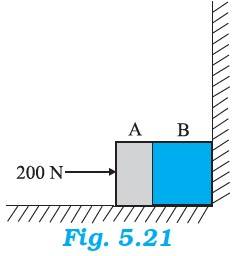
Contributor-Level 10
Mass of the body A, = 5 kg
Mass of the body B, = 10 kg
Applied force = 200 N
Coefficient of friction between the bodies and the table, μs = 0.15
(a) The frictional force is given by the relation
fs = ( + )g = 0.15 22.5 N. towards left
Hence, the force on the partition = 200 – 22.5 N = 177.5 N, acting rightwards
According to Newton's 3rd law, the reaction of the partition will be 177.5 N, acting towards left
(b) Force of friction on mass A is given by
Fa = mAg = 0.15 7.5 N, acting leftward
The net force exerted by mass A on mass B = 200 -7.5 N =
Taking an Exam? Selecting a College?
Get authentic answers from experts, students and alumni that you won't find anywhere else
Sign Up on ShikshaOn Shiksha, get access to
- 67k Colleges
- 1.2k Exams
- 718k Reviews
- 1850k Answers