

Class 11th
Get insights from 8k questions on Class 11th, answered by students, alumni, and experts. You may also ask and answer any question you like about Class 11th
Follow Ask QuestionQuestions
Discussions
Active Users
Followers
New answer posted
a year agoContributor-Level 10
11.22
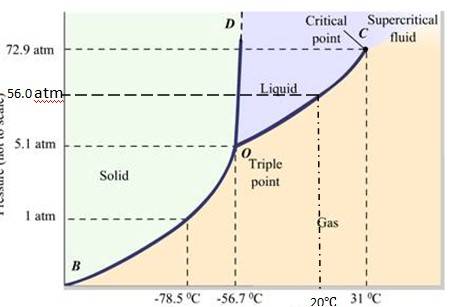
The fusion and boiling points are given by the intersection point where this parallel line cuts the fusion and vaporization curves. It departs from ideal gas behavior as pressure increases.
(a) At 1 atm pressure and at – 60 °C, it lies left of -56.6 (triple point O). Hence, it lies in the region of vapour and solid phases. Thus, CO2 condenses into solid state directly, without going through liquid phases.
(b) At 4 atm pressure, CO2 lies below 5.11 atm (triple point O). Hence it lies in the region of vaporous and solid phases. Thus, CO2 condenses into solid state directly, without going through liquid state.
New answer posted
a year agoContributor-Level 10
Base area of the given tank, A = 1.0
Area of the hinged door, a = 20 = 20
Density of water, = kg/
Density of acid, = 1.7 kg/
Height of the water column, = 4 m
Height of the acid column, = 4 m
Acceleration due to gravity, g = 9.8 m/
The pressure due to Water column, = = = 3.92 Pa
The pressure due to Acid column, = = 1.7 = 6.64 Pa
Pressure difference between two columns ΔP = - = 2.774 Pa
Force exerted on the small hi
New answer posted
a year agoContributor-Level 10
Soap bubble radius, r = 5.0 mm = 5 m
Surface tension of the soap bubble, S = 2.50 N/m
Relative density of soap solution = 1.20, hence density of soap solution, = 1.2 Kg/
Air bubble formed at a depth, h = 40 cm = 0.4 m
1 atmospheric pressure = 1.01 Pa
Acceleration due to gravity, g = 9.8 m/
We know, the excess pressure inside the soap bubble is given by the relation:
P = = Pa = 20 Pa
Hence, the excess pressure inside the air bubble is given by the relation, P' = = 10 Pa
At a depth of h, the total pressure inside the air bubble = Atmospheric press
New answer posted
a year agoContributor-Level 10
11.21
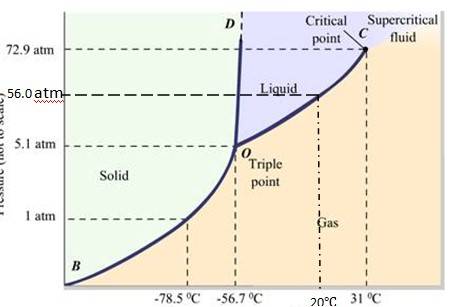
(a) The P-T phase diagram for CO2 is shown here. O is the triple point of the CO2 phase diagram. This means that at the temperature and pressure corresponding to this point, the solid, liquid and vaporous phases of CO2 exists in equilibrium.
(b) The fusion and the boiling points of CO2 decreases with a decrease in pressure.
(c) The critical temperature and critical pressure of CO2 are 31 72.9 atm respectively. Even if it is compressed to a pressure greater than 72.9 atm, CO2 will not liquefy above the critical temperature.
(d) It can be concluded from the P-T phase diagram of CO2 that:
CO2 is gaseous at -70 , under 1 atm pr
New answer posted
a year agoContributor-Level 10
Radius of the mercury droplet, r = 3.00 mm = 3 m
Surface tension, S = 4.65 N/m
Atmospheric pressure, = 1.01 Pa
Total pressure inside the mercury drop = Excess pressure inside mercury + Atmospheric pressure
= + = + 1.01 = 1.01310 Pa
Excess pressure inside mercury = = = 310 Pa
New answer posted
a year ago
Contributor-Level 10
The length of the liquid film supported by the weight, l = 40 cm = 0.4 m
The weight supported by the film, W = 4.5 N
Since a liquid film has two free surfaces,
Surface tension = = = 5.625 N/m
In all 3 figures, the liquid is the same, temperature is also the same. Hence the surface tension in (b) and (c) are also going to be the same, with the value of 5.625 N/m and weight supported in each case is also going to be the same, since length of the film is same.
New answer posted
a year agoContributor-Level 10
The weight that the soap film supports, W = 1.5 N
Length of the slider, l = 30 cm = 0.3 m
A soap film has two free surfaces, hence total length = 2l = 0.6 m
Surface tension, S= = = 2.5 N/m
New answer posted
a year agoContributor-Level 10
11.20 According to Newton’s law of cooling, we have
= K(T - ) or = -Kdt……(i)Where, temperature of the body = T
Temperature of the surroundings = = 20 °C
K is a constant
The temperature of the body falls from 80 to 50
Integrating equation (i), we get
= -
= -K
= -300
= K ….(ii)
The temperature of the body falls from 60 to 30
Hence, we get:
= -t'
= K.(iii)
Equating equations (ii) and (iii), we get,
=
= 10 min
Hence, the time taken to cool the body from 60 to 30 is 10 minutes.
New answer posted
a year agoContributor-Level 10
Area of cross-section of the spray pump, = 8 = 8
Number of holes, n = 40
Diameter of each hole, d = 1 mm = 1 m
Radius of each hole, r = d/2 = 0.5 m
Area of cross-section of each hole, a = =
Total area of 40 holes, = 40 = 3.14
Speed of liquid inside the tube, = 1.5 m/min = 0.025 m/s
Speed of ejection of liquid =
According to law of continuity, we have = or =
= 0.637 m/s
New answer posted
a year ago
Contributor-Level 10
Take the case given in figure (b)

= Area of pipe 1, = Area of pipe 2, = Speed of fluid in pipe 1, = Speed of fluid in pipe 2
From the law of continuity, we have
=
When the area of cross-section in the middle of the venturimeter is small, the speed of the flow of liquid through this part is more. According to Bernoulli's principle, if speed is more, the pressure is less. Pressure is directly proportional to height, hence the level of water in pipe 2 is less. Therefore, figure (a) is not possible.
Taking an Exam? Selecting a College?
Get authentic answers from experts, students and alumni that you won't find anywhere else
Sign Up on ShikshaOn Shiksha, get access to
- 67k Colleges
- 1.2k Exams
- 718k Reviews
- 1850k Answers