

Class 12th
Get insights from 12k questions on Class 12th, answered by students, alumni, and experts. You may also ask and answer any question you like about Class 12th
Follow Ask QuestionQuestions
Discussions
Active Users
Followers
New answer posted
a year agoContributor-Level 10
I = ∫ (e²? + 2e? - e? - 1)e^ (e? +e? ) dx
I = ∫ (e²? + e? - 1)e^ (e? +e? ) dx + ∫ (e? - e? )e^ (e? +e? ) dx
I = ∫ (e? + 1 - e? )e^ (e? +e? ) dx + e^ (e? +e? )
(e? - e? + 1)dx = du
I = e^ (e? +e? ) + e^ (e? +e? ) = e^ (e? +e? ) (e? + 1) then g (x) = e? + 1
g (0) = 2
New answer posted
a year agoContributor-Level 10
Here D = | 2 -4 λ |
| 1 -6 1 | = (λ-3) (3λ+2)
| λ -10 4 |
D = 0 ⇒ λ = 3, -2/3
New answer posted
a year agoContributor-Level 9
Let A (α, 0,0), B (0, β, 0), C (0,0, γ), then the centroid is G (α/3, β/3, γ/3) = (1,1,2).
α = 3, β = 3, γ = 6
∴ Equation of plane is x/α + y/β + z/γ = 1
⇒ x/3 + y/3 + z/6 = 1
⇒ 2x + 2y + z = 6
∴ Required line passing through G (1,1,2) and normal to the plane is (x-1)/2 = (y-1)/2 = (z-2)/1.
New answer posted
a year agoContributor-Level 9
A = [cosθ, sinθ], [-sinθ, cosθ]
A² = [cos2θ, sin2θ], [-sin2θ, cos2θ]
⇒ A? = [cos4θ, sin4θ], [-sin4θ, cos4θ]
B = [cos4θ, sin4θ], [-sin4θ, cos4θ] + [cosθ, sinθ], [-sinθ, cosθ]
= [cos4θ + cosθ, sin4θ + sinθ], [- (sin4θ + sinθ), cos4θ + cosθ]
det (B) = (cos4θ + cosθ)² + (sin4θ + sinθ)²
= (cos²4θ + sin²4θ) + (cos²θ + sin²θ) + 2 (cos4θcosθ + sin4θsinθ)
= 1 + 1 + 2cos (4θ - θ)
= 2 + 2cos3θ
Given 3θ = 3π/5
|B| = 2 + 2cos (3π/5)
= 2 + 2 (- (√5-1)/4) = 2 - (√5-1)/2 = (4-√5+1)/2 = (5-√5)/2 ∈ (1,2)
New answer posted
a year agoContributor-Level 10
Image by objective must be at focus of eye piece.
1/v - 1/u = 1/f?
1/5 - 1/u = 1 ; u = -5/4 cm
Hence, N = 50.
New answer posted
a year agoContributor-Level 10
We know, P = √2Em and λ = h/√2Em
For 1st maxima, 2nd sinθ = λ
Put (1) and get the answer
E = 50.47eV.
B = µ? I (200)/2R? R? = 20 cm; R? = 1 cm
e = -dΦ/dt = π (R? )² (500) dB/dt
= π (R? )² (500) (µ? I/2R? ²) (200) (10t-2)
= π (1/10000) (500) (200) (µ? ) (8) (5)/ (2)
= 16π² x 10 x 5 x 10?
= 800π² x 10?
e = 0.7887mv
4/x = 0.8; x = 5.
New answer posted
a year agoContributor-Level 10
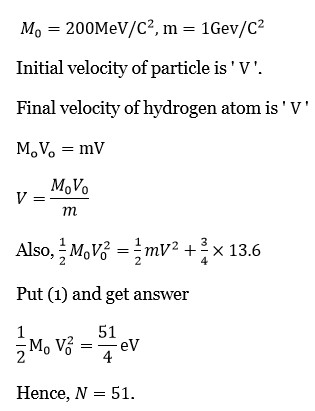
M? = 200MeV/C², m = 1Gev/C²
Initial velocity of particle is 'V'.
Final velocity of hydrogen atom is 'V'
M? V? = mV
V = M? V? /m
Also, 1/2 M? V? ² = 1/2 mV² + 3/4 x 13.6
Put (1) and get answer
1/2 M? V? ² = 51/4 eV
Hence, N = 51.
New answer posted
a year agoContributor-Level 10
Power delivered = 1000 W
Voltage = 220 V
Transmission 'I' = 1000/220
Power loss = I²R
Efficiency = (1000x100)/ (1000 + I²R)
Taking an Exam? Selecting a College?
Get authentic answers from experts, students and alumni that you won't find anywhere else
Sign Up on ShikshaOn Shiksha, get access to
- 67k Colleges
- 1.2k Exams
- 716k Reviews
- 1850k Answers