

Class 12th
Get insights from 12k questions on Class 12th, answered by students, alumni, and experts. You may also ask and answer any question you like about Class 12th
Follow Ask QuestionQuestions
Discussions
Active Users
Followers
New answer posted
a year agoContributor-Level 10
sum 6 → (1,5), (5,1), (3,3), (2,4), (4,2)
sum 7 → (1,6), (6,1), (5,2), (2,5), (3,4), (4,3)
= P (A) + P (? ) · P (B) · P (A) + P (? )P (B)P (? ) · P (B) · P (A) + …
This is infinite G.P. with common ratio P (? ) * P (B)
Probability of A wins = P (A) / (1 - P (? )P (B? )
= (5/36) / (1 - (31/36)* (30/36) = 30/61
New answer posted
a year agoContributor-Level 10
Equation PQ
(x-1)/2 = (y+2)/3 = (z-3)/ (-6) = λ
Let Q = (2λ + 1, 3λ − 2, −6λ + 3)
Q lies on x - y + z = 5
⇒ (2λ + 1) − (3λ − 2) + (−6λ + 3) = 5
⇒ λ = -1/7
Q = (5/7, -17/7, 15/7)
∴ PQ = √ (2/7)² + (3/7)² + (6/7)²)
New answer posted
a year agoContributor-Level 10
This type of refraction is the bending of light rays when they pass through the atmosphere of Earth because of the change in the air density. The density of air varies with pressure and temperature.
Due to the atmospheric refraction, celestial objects appear higher than they actually are. This leads to an advanced sunrise and a delayed sunset as well as the twinkling of stars.
When light from space enters the Earth's atmosphere, it slows down and changes direction as light moves from a rarer to a denser medium, which causes refraction.
New answer posted
a year agoContributor-Level 10
The refractive index is an optical property of the material that describes how much does the light bend or refract while passing from one medium to another. It is the ratio of spee of light in vacuum (c) to speed of light in a material (v) Refractive index is the reason which causes refraction. When light travels from a rarer medium (low refractive index) to denser medium (higher refractive index), it will slow down and bend toward the normal. Refractive index also changes according to the wavelength of light. Air has 1.003 refractive index, water has 1.33 refractive index and glass has a refractive index of 1.5 to 1.9.
New answer posted
a year agoContributor-Level 10
dy/dx = (y-3x)/ln (y-3x) - 3
dy/dx + 3 = (y+3x)/ln (y+3x)
d/dx (y+3x) = (y+3x)/ln (y+3x)
∫ (ln (y+3x)/ (y+3x) d (y+3x) = ∫ dx
Let ln (y+3x) = t
1/ (y+3x) d (y+3x) = dt
∫ tdt = ∫ dx
t²/2 = x+c
(ln (y+3x)²/2 = x+c
New answer posted
a year agoContributor-Level 10
Let A =
| a? |
| b? |
| c? |
Ax? = B?
a? + a? + a? = 1
b? + b? + b? = 0
c? + c? + c? = 0
Similar 2a? + a? = 0 and a? = 0
2b? + b? = 2, b? = 0
2c? + c? = 0, c? = 2
∴ a? = 0, b? = 1, c? = -1,
a? = 1, b? = -1, c? = -1
A =
| 1 0 |
| -1 0 |
| -1 -1 2 |
∴ |A| = 2
New answer posted
a year agoContributor-Level 10
A (α, 0), B (-α, 0)
⇒ D (α, α² − 1)
Area (ABCD) = (AB) (AD)
⇒ S = (2α) (1 − α²) = 2α – 2α³
dS/dα = 2 - 6α²
= 0 ⇒ α² = 1/3
⇒ α = 1/√3
Area = 2α – 2α³ = 2/√3 - 2/ (3√3)
= 4/ (3√3)
New answer posted
a year agoContributor-Level 10
∫ [π/6 to π/3] (d/dx (tan? x) * sin³3x + tan? x * d/dx (sin³3x) dx
= 1/2 ∫ [π/6 to π/3] d/dx (tan? x * sin?3x) dx
= 1/2 [tan? x · sin?3x] from π/6 to π/3
= 1/2 [ (√3)? · 0 - 1/ (√3)? )]
= -1/18
New answer posted
a year ago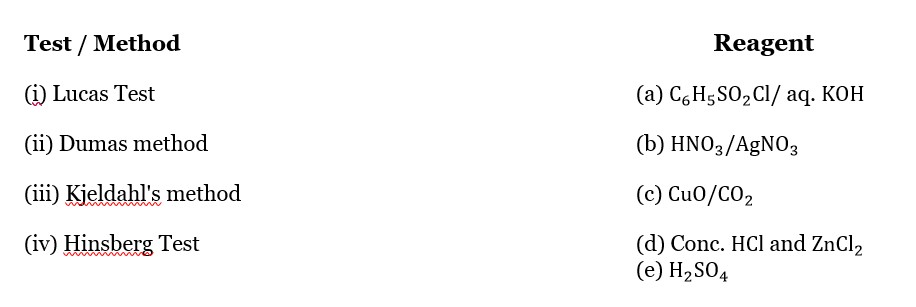
Contributor-Level 10
(I) Lucas reagent → Only ZnCl? /Conc. HCl
(II) Dumas method → CuO/Δ
(III) Kjeldahl's method → Conc. H? SO? /Δ
(IV) Heinsberg reagent → C? H? SO? Cl/ aq. NaOH
New answer posted
a year agoContributor-Level 10
Here,
| 1 |
| 2 4 -1 | = 0 ⇒ λ = 9/2
| 3 2 λ |
Also,
| 1 2 |
| 2 4 6 | = 0 ⇒ μ = 5
| 3 2 μ |
∴ Option B is correct.
Taking an Exam? Selecting a College?
Get authentic answers from experts, students and alumni that you won't find anywhere else
Sign Up on ShikshaOn Shiksha, get access to
- 67k Colleges
- 1.2k Exams
- 716k Reviews
- 1850k Answers