

Class 12th
Get insights from 12k questions on Class 12th, answered by students, alumni, and experts. You may also ask and answer any question you like about Class 12th
Follow Ask QuestionQuestions
Discussions
Active Users
Followers
New answer posted
a year agoContributor-Level 10
This is a short answer type question as classified in NCERT Exemplar
If there is a potential then E? 0 electric field comes into existence, which is given by as E=-dV/dr
It means there will be field lines pointing inwards or outwards from the surface. These lines cannot be again on the surface, as the surface is equipotential. It is possible only when the other end of the field lines are originated from the charges inside. Hence, the entire volume inside must be equipotential.
New answer posted
a year agoContributor-Level 10
This is a short answer type question as classified in NCERT Exemplar
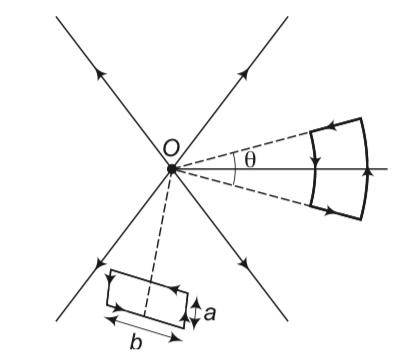
As the electric field and force both are conservative so work done in conservative body as the body is closed is zero.
New question posted
a year agoNew answer posted
a year ago
Contributor-Level 10
This is a Short Answer Type Questions as classified in NCERT Exemplar
Explanation- the system will be in stable equilibrium if the net force on the system is zero and net torque on the system is also zero.

New answer posted
a year ago
Contributor-Level 10
This is a Short Answer Type Questions as classified in NCERT Exemplar
Explanation- magnetic moment of dipole at origin o is
M=Mk
Magnetic field induction at p due to dipole moment
B= r
dS= r(rsin )r = (r2 sind )
= r(r2sin )
{cos4 }
(1-1)= 0
New answer posted
a year agoContributor-Level 10
Explanation- When a diamagnetic material is dipped in liquid nitrogen, it again behaves as a diamagnetic material. Thus, superconducting material will again behave as a diamagnetic material. When this diamagnetic material is placed near a bar magnet, it will be feebly magnetised opposite to the direction of magnetising field.
(i) Thus, it will be repelled.
(ii) Also its direction of magnetic moment will be opposite to the direction of magnetic field of magnet.
New answer posted
a year agoContributor-Level 10
This is a Short Answer Type Questions as classified in NCERT Exemplar
Explanation - = I/H
Diamagnetism is due to orbital motion of electrons in an atom developing magnetic moments opposite to applied field. Thus, the resultant magnetic moment of the diamagnetic material is zero and hence, the susceptibility χ of diamagnetic material is not much affected by temperature.
Paramagnetism and ferromagnetism is due to alignments of atomic magnetic moments in the direction of the applied field. As temperature is raised, the alignment is disturbed, resulting decrease in susceptibility of both with increase in temperature.
New answer posted
a year agoContributor-Level 10
This is a Short Answer Type Questions as classified in NCERT Exemplar
Answer- density of nitrogen = 28g/22.4L= 28g/22400cc
density of copper = 8g/22.4L= 8g/22400cc
on comparing = = 1.6 10-4
= = 5 10-4
As we know
= 1.6 10-4
New answer posted
a year agoContributor-Level 10
This is a Short Answer Type Questions as classified in NCERT Exemplar
Answer- M (intensity of magnetisation) = 106A/m
Length = 10cm = 10 10-2= 0.1m
M= Im/l
Im= M l= 106 0.1 = 105A
New question posted
a year agoTaking an Exam? Selecting a College?
Get authentic answers from experts, students and alumni that you won't find anywhere else
Sign Up on ShikshaOn Shiksha, get access to
- 67k Colleges
- 1.2k Exams
- 718k Reviews
- 1850k Answers