

Communication Systems
Get insights from 65 questions on Communication Systems, answered by students, alumni, and experts. You may also ask and answer any question you like about Communication Systems
Follow Ask QuestionQuestions
Discussions
Active Users
Followers
New answer posted
a year agoContributor-Level 10
This is a Short Answer Type Questions as classified in NCERT Exemplar
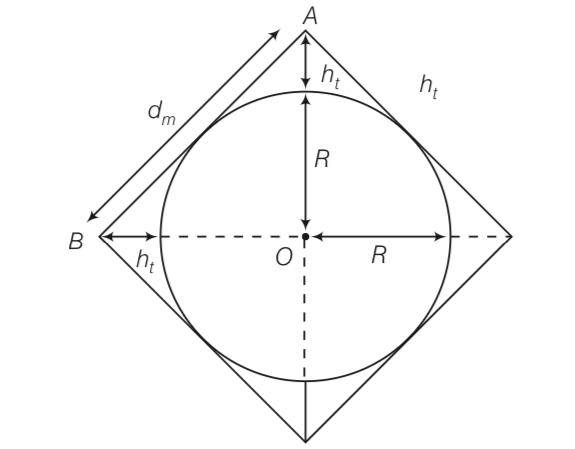
dm2= (R+h)2+ (R+h)2= 2 (R+h)2
So dm=
8hR= R2+2Rh+h2
R-h=0
R=h so frequency of space wave Is less than height of tower. So it is also keep in consideration. for 3 dimension coverage 2 antennna each side means total 6 antenna required.
New answer posted
a year agoContributor-Level 10
This is a Short Answer Type Questions as classified in NCERT Exemplar
Range =
Area = =803.84km2
When H= 25 m
Range = = 33.9km
Area= 3.14 2
percentage increase = %
New answer posted
a year ago
Contributor-Level 10
This is a Short Answer Type Questions as classified in NCERT Exemplar
Total distance = 5km and loss is 2 dB/km
So total loss = 5 (2)= 10 dB
Total gain in amplifier 10+20= 30dB and gain in signal is 20dB
So by the formula 20= 10log10
log10 = 2
so po/pi= 102
so Po= Pi (100)= 101mW
New answer posted
a year agoContributor-Level 10
This is a Short Answer Type Questions as classified in NCERT Exemplar
In modulating signal we add career wave or noise signal to send it to receiver end and this wave is varied from time to time that is why more noise appear.
But in frequency modulation frequency is not varied so less noise appear.
New answer posted
a year agoContributor-Level 10
This is a Short Answer Type Questions as classified in NCERT Exemplar
Frequency tuned amplifier is
=1/2
New answer posted
a year agoContributor-Level 10
This is a Short Answer Type Questions as classified in NCERT Exemplar
Maximum amplitude = Am+Ac =12 while minimum amplitude is Ac-Am=3
Using elimination method = 2Ac= 18
Ac=9 and Am= 6V
So modulating index m = 6/9= 2/3
New answer posted
a year agoContributor-Level 10
This is a Short Answer Type Questions as classified in NCERT Exemplar
As frequency of B is more than A so it has more refractive index also and if a wave have higher refractive index then it has less angle of refraction. So wave B travel more in ionosphere.
New answer posted
a year agoContributor-Level 10
This is a Short Answer Type Questions as classified in NCERT Exemplar
When we send a signal to be transmitted through sky waves must have a frequency range of 1710 kHz to 40 MHz.
But, the frequency of TV signals are 60 MHz which is beyond the required range.
So, sky waves will not be suitable for transmission of TV signals of 60 MHz frequency.
New answer posted
a year agoContributor-Level 10
Frequency of career wave is 20MHz
Bandwidth require for modulation is 3kHz/2= 1.5kHz
For demodulating we need to reciprocal it
1/f= 1/20MHz= 0.5 10-7s
For modulation = 1/1.5KHz= 0.7 103s
According to first option =RC= 1 0.01= 10-5s
So it will demodulated
According to 2nd option- RC= 10-4s
So it can also be demodulated
According to third option – RC= 10-8s
So it cannot be modulated
New answer posted
a year agoContributor-Level 10
This is a Long Answer Type Questions as classified in NCERT Exemplar
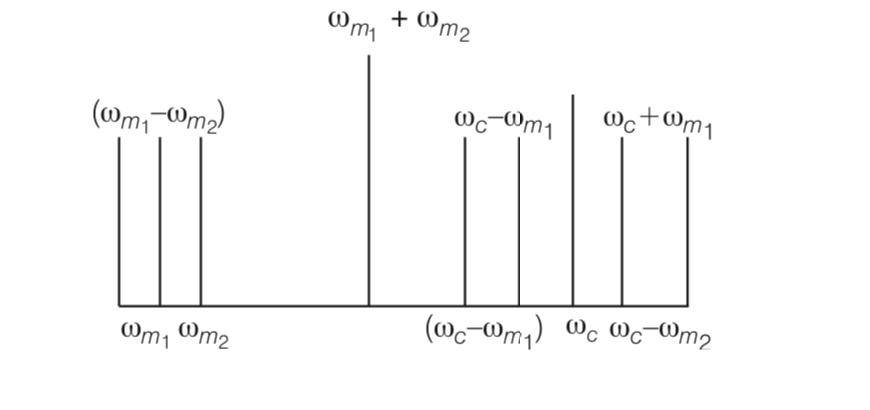
in first case crowding spectrum is visible
If we want more wave to be modulated then more crowding will occur and more mixing up of signal.
But we want to accommodate this we use higher band width and frequency career wave
Taking an Exam? Selecting a College?
Get authentic answers from experts, students and alumni that you won't find anywhere else
Sign Up on ShikshaOn Shiksha, get access to
- 67k Colleges
- 1.2k Exams
- 716k Reviews
- 1850k Answers