
Communication Systems
Get insights from 65 questions on Communication Systems, answered by students, alumni, and experts. You may also ask and answer any question you like about Communication Systems
- 65
Questions
- 0
Discussions
- 0
Active Users
- 0
Followers
Have a question about Communication Systems? Ask our experts
Keep it short & simple. Type complete word. Avoid abusive language.
We do not transmit low frequency signal to long distances because-
(A) The size of the antenna should be comparable to signal wavelength which is unreal
(B) Effective power radiated by a long wavelength baseband signal would be high.
(C) We want to avoid mixing up signals transmitted by different transmitter simultaneously.
(D) Low frequency signal can be sent to log distances by superimposing with a high frequency wave as well.
Therefore, the most suitable options will be
For high wavelength, size of antenna should be high.
 Upvote

<p><strong>Suppose a n-type wafer is‘created by doping Si crystal having 5 x 10<sup>28</sup>atoms/m<sup>3</sup> with 1 ppm concentration of As. On the surface 200 ppm boron is added to create ‘p’ region in this wafer. Considering n<sub>i</sub> = 1.5 x 10<sup>16</sup> m<sup>-3</sup>,</strong><br><strong>(i) </strong>Calculate the densities of the charge carriers in the n and p regions,<br><strong>(ii) </strong>Comment which charge carriers would contribute largely for the reverse saturation current when diode is reverse biased.</p>
Which of the following would produce analog signals and which would produce digital signals?
(a) A vibrating tuning fork
(b) Musical sound due to a vibrating sitar string
(c) Light pulse
(d) Output of NAND gate
Which of the following would produce analog signals and which would produce digital signals?
(a) A vibrating tuning fork
(b) Musical sound due to a vibrating sitar string
(c) Light pulse
(d) Output of NAND gate
This is a Multiple Choice Questions as classified in NCERT Exemplar
Analog and digital signals are used to transmit information, usually through electric signals. In both these technologies, the information such as any audio or video is
transformed into electric signals.
The difference between analog a
Upvote In amplitude modulation, the modulation index m is kept less than or equal to 1 because
(a) m> 1, will result in interference between carrier frequency and message frequency, resulting into distortion.
(b) m > 1, will result in overlapping of both side bands resulting into loss of information
(c) m > 1, will result in change in phase between carrier signal and message signal.
(d) m > 1, indicates amplitude of message signal greater than amplitude of carrier signal resulting into distortion.
In amplitude modulation, the modulation index m is kept less than or equal to 1 because
(a) m> 1, will result in interference between carrier frequency and message frequency, resulting into distortion.
(b) m > 1, will result in overlapping of both side bands resulting into loss of information
(c) m > 1, will result in change in phase between carrier signal and message signal.
(d) m > 1, indicates amplitude of message signal greater than amplitude of carrier signal resulting into distortion.
This is a Multiple Choice Questions as classified in NCERT Exemplar
Answer- b, d
Explanation- modulation index m= Am/Ac
If m>1 then Am>Ac
maximum modulation frequency mf= frequency deviation / maximum frequency of modulating wave
here if m>1 then it means overlapping of both sides resulting loss of infor
Upvote The frequency response curve (figure) for the filter circuit used for production of AM wave should be
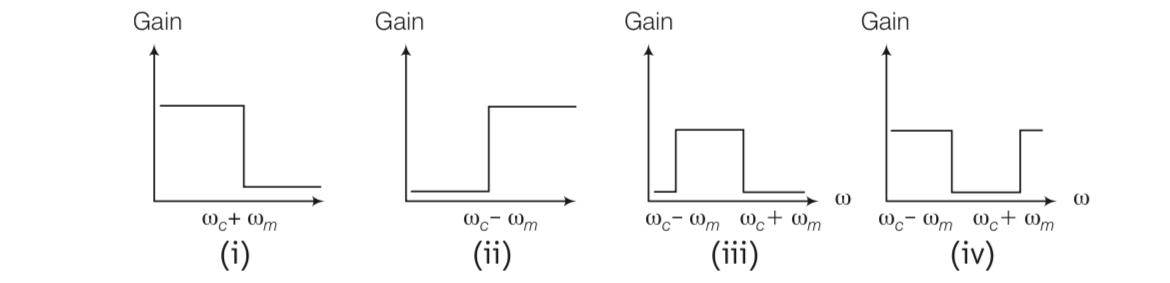
The frequency response curve (figure) for the filter circuit used for production of AM wave should be

This is a Multiple Choice Questions as classified in NCERT Exemplar
Answer- a, b, c
Explanation- production of modulated wave is given by frequency of upper side band – frequency of lower side band so in first three cases it is clearly visible.
Upvote A TV transmission tower has a height of 240 m. Signals broadcast from this tower will be received by LOS communication at a distance of (assume the radius of earth to be (6.4 x 10⁶m)
(a) 100 km (b) 24 km (c) 55 km (d) 50 km
A TV transmission tower has a height of 240 m. Signals broadcast from this tower will be received by LOS communication at a distance of (assume the radius of earth to be (6.4 x 10⁶m)
(a) 100 km (b) 24 km (c) 55 km (d) 50 km
This is a Multiple Choice Questions as classified in NCERT Exemplar
Answer-b, c, d
Explanation- height of tower= 240m
For line of sight communication maximum distance would be d=
So d= = 55.4km
So distance under this are communicable
Upvote Audio sine waves of 3 kHz frequency are used to amplitude modulate a carrier signal of 1.5 MHz. Which of the following statements are true?
(a) The side band frequencies are 1506 kHz and 1494 kHz
(b) The bandwidth required for amplitude modulation is 6 kHz
(c) The bandwidth required for amplitude modulation is 3 MHz
(d) The side band frequencies are 1503 kHz and 1497 kHz
Audio sine waves of 3 kHz frequency are used to amplitude modulate a carrier signal of 1.5 MHz. Which of the following statements are true?
(a) The side band frequencies are 1506 kHz and 1494 kHz
(b) The bandwidth required for amplitude modulation is 6 kHz
(c) The bandwidth required for amplitude modulation is 3 MHz
(d) The side band frequencies are 1503 kHz and 1497 kHz
This is a Multiple Choice Questions as classified in NCERT Exemplar
Answer- b, d
Explanation- wm=3KHz
And wc= 1.5MHz= 1500KHz
By using these two 1500 3= 1503 and 1497
Bandwidth = 2wm= 2 = 6KHz
Upvote An audio signal of 15 kHz frequency cannot be transmitted over long distances without modulation, because
(a) The size of the required antenna would be at least 5 km which is not convenient
(b) The audio signal cannot be transmitted through sky waves
(c) The size of the required antenna would be at least 20 km, which is not convenient
(d) Effective power transmitted would be very low, if the size of the antenna is less than 5 km
An audio signal of 15 kHz frequency cannot be transmitted over long distances without modulation, because
(a) The size of the required antenna would be at least 5 km which is not convenient
(b) The audio signal cannot be transmitted through sky waves
(c) The size of the required antenna would be at least 20 km, which is not convenient
(d) Effective power transmitted would be very low, if the size of the antenna is less than 5 km
This is a Multiple Choice Questions as classified in NCERT Exemplar
Answer- a, b, d
Explanation- frequency is given by Vm=15KHz
So wavelength is given by
Also we know that l = = 5km
The audio signals are of low frequency waves. Thus, they cannot be transmitted through sky
Waves as they are absor
Upvote Identify the mathematical expression for amplitude modulated wave,
(a) Acsin[{wc+K1Vm(t)}t+ ]
(b) Acsin[{wct+ K2Vm(t)]
(c) Ac+K2Vmt}+sinwct+ ]
(d) Ac Vm(t)sin[{wct+ )
Identify the mathematical expression for amplitude modulated wave,
(a) Acsin[{wc+K1Vm(t)}t+ ]
(b) Acsin[{wct+ K2Vm(t)]
(c) Ac+K2Vmt}+sinwct+ ]
(d) Ac Vm(t)sin[{wct+ )
This is a Multiple Choice Questions as classified in NCERT Exemplar
Explanation-equation of modulating wave is, m (t)= Amsinwmt
Carrier wave equation is Cm (t)= (Ac+Amsinwmt)sinwct
= Ac [1+ ]sinwct
Also = M
Cmt= (Ac+Ac )sinwct
Ac =K
Sinwmt= Vm
equation having phase
so equation is Ac+K2Vmt}+s
Upvote