Differential Equations

Get insights from 323 questions on Differential Equations, answered by students, alumni, and experts. You may also ask and answer any question you like about Differential Equations

  • 323

    Questions

  • 0

    Discussions

  • 0

    Active Users

  • 1

    Followers

Have a question about Differential Equations? Ask our experts

Ask Your Question

Keep it short & simple. Type complete word. Avoid abusive language.

New question posted•a year ago

<p><strong> State True or False for the following:</strong></p> <p><strong>(i) </strong>The integrating factor of a differential equation of the form&nbsp;<math><mrow><mfrac><mrow><mi>d</mi><mi>y</mi></mrow><mrow><mi>d</mi><mi>x</mi></mrow></mfrac><mo>+</mo><msub><mrow><mi>P</mi></mrow><mrow><mn>1</mn></mrow></msub><mi>x</mi><mo>=</mo><msub><mrow><mi>Q</mi></mrow><mrow><mn>1</mn></mrow></msub><mo>&nbsp;</mo></mrow></math>&nbsp;is given by&nbsp;<math><mrow><msup><mrow><mi>e</mi></mrow><mrow><mo>∫</mo><msub><mrow><mi>P</mi></mrow><mrow><mn>1</mn></mrow></msub><mi>d</mi><mi>y</mi></mrow></msup><mo>.</mo></mrow></math></p> <p><strong>(ii)</strong> solution of a differential equation of the type&nbsp;<math><mrow><mfrac><mrow><mi>d</mi><mi>y</mi></mrow><mrow><mi>d</mi><mi>x</mi></mrow></mfrac><mo>+</mo><msub><mrow><mi>P</mi></mrow><mrow><mn>1</mn></mrow></msub><mi>x</mi><mo>=</mo><msub><mrow><mi>Q</mi></mrow><mrow><mn>1</mn></mrow></msub></mrow></math>&nbsp;is given by&nbsp;<math><mrow><mi>y</mi><mo>⋅</mo><mi>I</mi><mo>.</mo><mi>F</mi><mo>.</mo><mo>=</mo><mrow><mo>(</mo><mrow><mi>I</mi><mo>.</mo><mi>F</mi><mo>.</mo></mrow><mo>)</mo></mrow><msub><mrow><mi>Q</mi></mrow><mrow><mn>1</mn></mrow></msub><mi>d</mi><mi>y</mi><mo>.</mo></mrow></math></p> <p><strong>(iii)</strong> Correct substitution for solving the differential equation of the type&nbsp;<math><mrow><mfrac><mrow><mi>d</mi><mi>y</mi></mrow><mrow><mi>d</mi><mi>x</mi></mrow></mfrac><mo>=</mo><mi>f</mi><mrow><mo>(</mo><mrow><mi>x</mi><mo>,</mo><mi>y</mi></mrow><mo>)</mo></mrow><mo>,</mo></mrow></math>&nbsp;where&nbsp;<math><mrow><mi>f</mi><mrow><mo>(</mo><mrow><mi>x</mi><mo>,</mo><mi>y</mi></mrow><mo>)</mo></mrow></mrow></math>&nbsp;is a homogeneous function of zero degree, is&nbsp;<math><mrow><mi>y</mi><mo>=</mo><mi>v</mi><mi>x</mi></mrow></math>&nbsp;.</p> <p><strong>(iv)</strong> Correct substitution for the solution of the differential equation of the type <em>dx/dy</em> = <em>g</em>(<em>x</em>, <em>y</em>) where <em>g</em> (<em>x</em>, <em>y</em>) is a homogeneous function of the degree zero is <em>x </em>= <em>vy.</em></p> <p><strong>(v) </strong>Number of arbitrary constants in the particular solution of a differential equation of order two is two.</p> <p><strong>(vi)</strong> The differential equation representing the family of circles <em>x</em><sup>2</sup> + (<em>y </em>– <em>a</em>)<sup>2</sup> = <em>a</em><sup>2</sup> will be of order two.</p> <p><strong>(vii) </strong>The solution of <em>dy</em>/<em>dx</em> = (<em>y</em>/<em>x</em>)<sup>1/3 </sup>is <em>y</em> <sup>2/3</sup>-<em>x</em><sup>2/3 </sup>= <em>c</em>.</p> <p><strong>(viii)</strong> Differential equation representing the family of curves</p> <p>&nbsp;<em>y e<sup>x</sup></em> (A cos <em>x</em> + B sin <em>x </em>is<em> d<sup>2 </sup>y/dx<sup>2</sup> </em>– 2<em>dy</em>/<em>dx</em> + 2<em>y</em> = 0</p> <p><strong>(ix)</strong> The solution of the differential equation <em>dy</em>/<em>dx</em> = <em>x</em> + 2<em>y</em>/<em>x</em> is <em>x</em> + <em>y</em> = <em>kx</em><sup>2</sup>.</p> <p><strong>&nbsp;(x) </strong>Solution of <em>xdy/dx = y +x tan y/x is sin (y/x) =cx&nbsp;&nbsp;&nbsp;&nbsp;&nbsp;&nbsp;&nbsp;&nbsp; </em></p> <p><strong>(xi) </strong>The differential equation of all non- horizontal lines in a plane is <em>d<sup>2 </sup>y/dx<sup>2</sup></em>=0</p> <p>&nbsp;</p>

3 Views|Posted a year ago
New answer posted•a year ago
S
a year ago

This is a Fill in the Blanks Type Questions as classified in NCERT Exemplar
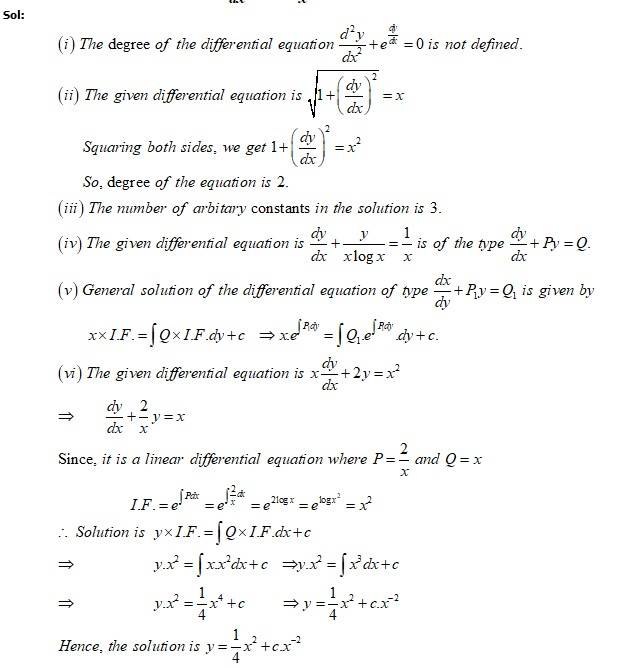
( v i i )     T h e     g i v e n     d i f f e r e n t i a l     e q u a t i o n     i s     ( 1 + x 2 ) d y d x + 2 x y − 4 x 2 = 0 ⇒                                         d y d x + 2 x y 1 + x 2 = 4 x 2 1 + x 2 Since,  it  is  a  linear  differential  equation  where  P=2x1+x2  and  Q=4x21+x2                                                 I . F . = e ∫ P d x = e ∫ 2 x 1 + x 2 d x = e l o g ( 1 + x 2 ) = 1 + x 2 ∴       S o l u t i o n     i s       y × I . F . = ∫ Q × I . F . d x + c ⇒                                             y . ( 1 + x 2 ) = ∫ 4 x 2 1 + x 2 × ( 1 + x 2 ) d x + c ⇒                                               y . ( 1 + x 2 ) = ∫ 4 x 2 d x + c                 ⇒ y . ( 1 + x 2 ) = 4 3 x 3 + c ⇒                                                                                   y = 4 3 x 3 ( 1 + x 2 ) + c ( 1 + x 2 ) − 1 H e n c e ,     t h e     s o l u t i o n     i s     y = 4 3 x 3 ( 1 + x 2 ) + c ( 1 + x 2 ) − 1 ( v i i i )     T h e     g i v e n     d i f f e r e n t i a l     e q u a t i o n     i s     y d x + ( x + x y ) d y = 0 ⇒         ( x + x y ) d y = − y d x       ⇒ x ( 1 + y ) d y = − y d x ⇒                     1 + y y d y = − 1 x d x I n t e g r a t i n g     b o t h     s i d e s ,     w e     g e t                       ∫ 1 + y y d y = − ∫ 1 x d x ⇒ ∫ ( 1 y + 1 ) d y = − ∫ 1 x d x ⇒                   l o g y + y = − l o g x + l o g c ⇒                   l o g y + l o g x + l o g e y = l o g c ⇒                                                           l o g ( x y . e y ) = l o g c ⇒                   x y = c . e − y H e n c e ,     t h e     s o l u t i o n     i s     x y = c . e − y


Thumbs Up IconUpvote Thumbs Down Icon
New answer posted•a year ago
S
a year ago

This is a Short Answer Type Questions as classified in NCERT Exemplar

Sol:

F a m i l y     o f     c o n c e n t r i c     c i r c l e s     w i t h     c e n t r e ( 1 , 2 )     a n d     r a d i u s     ' r '     i s                                         ( x − 1 ) 2 + ( y − 2 ) 2 = r 2 D i f f e r e n t i a t i n g     b o t h     s i d e s     w . r . t . x ,     w e     g e t                         2 ( x − 1 ) + 2 ( y − 2 ) d y d x = 0 ⇒                             ( x − 1 ) + ( y − 2 ) d y d x = 0 W h i c h     i s     t h e     r e q u i r e d     e q u a t i o n .

Thumbs Up IconUpvote Thumbs Down Icon
New answer posted•a year ago
S
a year ago

This is a Short Answer Type Questions as classified in NCERT Exemplar

Sol:

G i v e n     d i f f e r e n t i a l     e q u a t i o n     i s                                         ( 1 + y 2 ) t a n − 1 x d x + 2 y ( 1 + x 2 ) d y = 0 ⇒                                         2 y ( 1 + x 2 ) d y = − ( 1 + y 2 ) . t a n − 1 x . d x ⇒                           2 y 1 + y 2 d y = − t a n − 1 x 1 + x 2 . d x I n t e g r a t i n g     b o t h     s i d e s ,     w e     g e t                               ∫ 2 y 1 + y 2 d y = − ∫ t a n − 1 x 1 + x 2 . d x ⇒                       l o g | 1 + y 2 | = − 1 2 ( t a n − 1 x ) 2 + c ⇒                         1 2 ( t a n − 1 x ) 2 +   l o g | 1 + y 2 | = c H e n c e ,     t h e     r e q u i r e d     s o l u t i o n     i s     1 2 ( t a n − 1 x ) 2 +   l o g | 1 + y 2 | = c .

Thumbs Up IconUpvote Thumbs Down Icon
New answer posted•a year ago
S
a year ago

This is a Short Answer Type Questions as classified in NCERT Exemplar

Sol:

G i v e n     e q u a t i o n     i s     A x 2 + B y 2 = 1 D i f f e r e n t i a t i n g     w . r . t . x ,     w e     g e t ⇒                 2 A . x + 2 B y d y d x = 0 ⇒                             A . x + B y d y d x = 0 ⇒                                                       B y . d y d x = − A x               ⇒ y x . d y d x = − A B D i f f e r e n t i a t i n g     b o t h     s i d e s     a g a i n     w . r . t . x ,     w e     h a v e                               y x . d 2 y d x 2 + d y d x ( x . d y d x − y . 1 x 2 ) = 0 ⇒                 y x 2 x . d 2 y d x 2 + x . ( d y d x ) 2 − y . d y d x = 0 ⇒                         x y . d 2 y d x 2 + x . ( d y d x ) 2 − y . d y d x = 0 ⇒                         x y . y ' ' + x . ( y ' ) 2 − y . y ' = 0 H e n c e ,     t h e     r e q u i r e d     e q u a t i o n     i s     x y . y ' ' + x . ( y ' ) 2 − y . y ' = 0

Thumbs Up IconUpvote Thumbs Down Icon
New answer posted•a year ago
S
a year ago

This is a Short Answer Type Questions as classified in NCERT Exemplar

Sol:

G i v e n     d i f f e r e n t i a l     e q u a t i o n     i s     d y = c o s x ( 2 − y c o s e c x ) d x ⇒                                                               d y d x = c o s x ( 2 − y c o s e c x ) ⇒                                                               d y d x = 2 c o s x − y c o s x . c o s e c x ⇒                                                               d y d x = 2 c o s x − y c o t x ⇒                                                               d y d x + y c o t x = 2 c o s x ∴         P = c o t x     a n d     Q = 2 c o s x I n t e g r a t i n g     f a c t o r     I . F = e ∫ P d x = e ∫ c o t x . d x = e l o g s i n x = s i n x ∴     S o l u t i o n     o f     t h e     e q u a t i o n     i s           y × I . F . = ∫ Q × I . F . d x + c ⇒ y . s i n x = ∫ 2 c o s x . s i n x   d x + c ⇒ y . s i n x = ∫ s i n 2 x   d x + c                           ⇒ y . s i n x = − 1 2 c o s 2 x + c P u t     x = π 2     a n d     y = 2 ,     w e     g e t           2 . s i n π 2 = − 1 2 c o s 2 . π 2 + c ⇒             2 ( 1 ) = − 1 2 c o s π + c                       ⇒ 2 = − 1 2 ( − 1 ) + c ⇒                         2 = 1 2 + c                   ⇒ c = 2 − 1 2 = 3 2 H e n c e ,     t h e     r e q u i r e d     e q u a t i o n     i s     y s i n x = − 1 2 c o s 2 x + 3 2 .

Thumbs Up IconUpvote Thumbs Down Icon
New answer posted•a year ago
S
a year ago

This is a Short Answer Type Questions as classified in NCERT Exemplar

Sol:

G i v e n     d i f f e r e n t i a l     e q u a t i o n     i s                                   2 ( y + 3 ) − x y . d y d x = 0 ⇒                                                                     x y . d y d x = 2 y + 6 ⇒                                             ( y 2 y + 6 ) d y = d x x ⇒                                             1 2 ( y y + 3 ) d y = d x x I n t e g r a t i n g     b o t h     s i d e s     w e     g e t                                                 1 2 ∫ y y + 3 . d y = ∫ d x x ⇒                   1 2 ∫ ( 1 − 3 y + 3 ) d y = ∫ d x x ⇒ 1 2 ∫ 1 . d y − 3 2 ∫ 1 y + 3 d y = ∫ d x x ⇒                       1 2 y − 3 2 l o g | y + 3 | = l o g x + c P u t     x = 1 ,     y = − 2 ⇒         1 2 ( − 2 ) − 3 2 l o g | − 2 + 3 | = l o g ( 1 ) + c ⇒                                             − 1 − 3 2 l o g ( 1 ) = l o g ( 1 ) + c ⇒                                                                           − 1 − 0 = 0 + c                                       [ ? l o g ( 1 ) = 0 ] ∴                                                                                                   c = − 1 ∴     e q u a t i o n     i s                               1 2 y − 3 2 l o g | y + 3 | = l o g x − 1 ⇒                               y − 3 l o g | y + 3 | = 2 l o g x − 2 ⇒                           y − l o g | ( y + 3 ) 3 | = l o g x 2 − 2 ⇒         l o g | ( y + 3 ) 3 | + l o g x 2 = y + 2 ⇒                                 l o g | x 2 ( y + 3 ) 3 | = y + 2 ⇒                                 x 2 ( y + 3 ) 3 = e y + 2 H e n c e ,     t h e     r e q u i r e d     s o l

Thumbs Up IconUpvote Thumbs Down Icon
New answer posted•a year ago
S
a year ago

This is a Short Answer Type Questions as classified in NCERT Exemplar

Sol:

G i v e n     d i f f e r e n t i a l     e q u a t i o n     i s                                   ( x + y ) ( d x − d y ) = d x + d y ⇒ ( x + y ) d x − ( x + y ) d y = d x + d y ⇒                           − ( x + y ) d y − d y = d x − ( x + y ) d x ⇒                                   − ( x + y + 1 ) d y = − ( x + y − 1 ) d x ⇒                                                                                     d y d x = x + y − 1 x + y + 1 P u t     x + y = z ∴                             1 + d y d x = d z d x ⇒                                     d y d x = d z d x − 1 S o ,                     d z d x − 1 = z − 1 z + 1 ⇒                                       d z d x = z − 1 z + 1                     ⇒ d z d x = z − 1 + z + 1 z + 1 ⇒                                       d z d x = 2 z z + 1                       ⇒ z + 1 z d z = 2 . d x I n t e g r a t i n g     b o t h     s i d e s     w e     g e t                                       ∫ z + 1 z d z = 2 ∫ d x ⇒                           ∫ ( 1 + 1 z ) d z = 2 ∫ d x ⇒                                       z + l o g | z | = 2 x + l o g | c | ⇒       x + y + l o g | x + y | = 2 x + l o g | c | ⇒                       y + l o g | x + y | = x + l o g | c | ⇒                                       l o g | x + y | = x − y + l o g | c | ⇒ l o g | x + y | − l o g | c | = ( x − y ) ⇒                                       l o g | x + y c | = ( x − y ) ⇒                                                         x + y c = e x − y ∴                                                               x + y = c . e x − y H e n c e ,     t h e     r e q u i r e d     s o l u t i o n     i s     x + y = c .

Thumbs Up IconUpvote Thumbs Down Icon
New answer posted•a year ago
S
a year ago

This is a Short Answer Type Questions as classified in NCERT Exemplar

Sol:

Given  equation  is  y2dx+(x2−xy+y2)dy=0⇒                  dxdy=−x2−xy+y2y2Put  x=vy                                                 [?  It  is  a  homogeneous  differential  equation]∴                   dxdy=v+y.dvdy∴       v+y.dvdy=−(y2−vy2+v2y2y2)⇒     v+y.dvdy=−y2(1−v+v2)y2⇒     v+y.dvdy=(−1+v−v2)⇒            y.dvdy=−1+v−v2−v⇒            y.dvdy=−1−v2          ⇒dvv2+1=−dyyIntegrating  both  sides  we  get           ∫dvv2+1=−∫dyy⇒                tan−1v=−logy+c      ⇒tan−1(xy)+logy=cHence,  the  required  solution  is  tan−1(xy)+logy=c.

Thumbs Up IconUpvote Thumbs Down Icon
New answer posted•a year ago
S
a year ago

This is a Short Answer Type Questions as classified in NCERT Exemplar

Sol:

G i v e n     e q u a t i o n     i s     ( 1 + y 2 ) + ( x − e t a n − 1 y ) d y d x = 0 ⇒                         ( x − e t a n − 1 y ) d y d x = − ( 1 + y 2 )             ⇒ d y d x = − ( 1 + y 2 ) x − e t a n − 1 y ⇒                                                                         d x d y = x − e t a n − 1 y − ( 1 + y 2 )           ⇒ d x d y = − x ( 1 + y 2 ) + e t a n − 1 y 1 + y 2 ⇒                               d x d y + x ( 1 + y 2 ) = e t a n − 1 y 1 + y 2 ∴         P = 1 1 + y 2     a n d     Q = e t a n − 1 y 1 + y 2 I n t e g r a t i n g     f a c t o r     I . F = e ∫ P d y = e ∫ 1 1 + y 2 . d y = e t a n − 1 y ∴     S o l u t i o n     o f     t h e     e q u a t i o n     i s                           x × I . F . = ∫ Q × I . F . d y + c ⇒ y . e t a n − 1 y = ∫ e t a n − 1 y 1 + y 2 . e t a n − 1 y d y + c P u t     e t a n − 1 y = t ∴               e t a n − 1 y . 1 1 + y 2 d y = d t ∴               x . e t a n − 1 y = ∫ t . d t + c ⇒           x . e t a n − 1 y = 1 2 t 2 + c ⇒           x . e t a n − 1 y = 1 2 ( e t a n − 1 y ) 2 + c             ⇒ x = 1 2 ( e t a n − 1 y ) + c e t a n − 1 y ⇒ 2 x = e t a n − 1 y + 2 c e t a n − 1 y ⇒ 2 x . e t a n − 1 y = ( e t a n − 1 y ) 2 + 2 c H e n c e ,     t h e     r e q u i r e d     s o l u t i o n     i s     2 x . e t a n − 1 y = ( e t a n − 1 y ) 2 + 2 c .

Thumbs Up IconUpvote Thumbs Down Icon