
Differential Equations
Get insights from 323 questions on Differential Equations, answered by students, alumni, and experts. You may also ask and answer any question you like about Differential Equations
- 323
Questions
- 0
Discussions
- 0
Active Users
- 1
Followers
Have a question about Differential Equations? Ask our experts
Keep it short & simple. Type complete word. Avoid abusive language.
The differential equation of the family circles passing through the points (0, 2) and (0, 2) is:
The differential equation of the family circles passing through the points (0, 2) and (0, 2) is:
Equation of circle passing through (0, 2) and (0, 2) is
Divided by x we get
Differentiating w.r.t. x
 Upvote

Let y = y(x) be the solution curve of the differential equation passing through the point Then is equal to:
Let y = y(x) be the solution curve of the differential equation passing through the point Then is equal to:
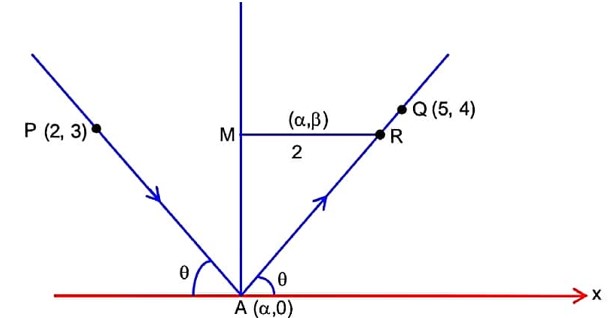
A ray of light passing through the point P(2, 3) reflects on the x-axis at point A and the reflected ray passes through the point Q(5, 4). Let R be the point that divides the line segment AQ internally into the ration 2 : 1. Let the co-ordinates of the foot of the perpendicular M from R on the bisector of the angle PAQ be (a, b). Then the value of 7a + 3b is equal to……….
A ray of light passing through the point P(2, 3) reflects on the x-axis at point A and the reflected ray passes through the point Q(5, 4). Let R be the point that divides the line segment AQ internally into the ration 2 : 1. Let the co-ordinates of the foot of the perpendicular M from R on the bisector of the angle PAQ be (a, b). Then the value of 7a + 3b is equal to……….
Let y = y(x) be the solution of the differential equation Then y(3) is equal to
Let y = y(x) be the solution of the differential equation Then y(3) is equal to
Let the solution curve y = y(x) of the differential equation pass through the point Then, is equal to:
Let the solution curve y = y(x) of the differential equation pass through the point Then, is equal to:
Let y = y(x) be the solution of the differential equation If
then k-1 is equal to.
Let y = y(x) be the solution of the differential equation If
then k-1 is equal to.
If the solution curve of the differential equation passes through the point (1, 0), then the abscissa of the point on the curve whose ordinate is tan(1), is
If the solution curve of the differential equation passes through the point (1, 0), then the abscissa of the point on the curve whose ordinate is tan(1), is
Let
It passes through (1, 0) = c = 2
Now put y = tan 1, then
ex = e – e + 2
Upvote This is an Objective Type Questions as classified in NCERT Exemplar
Sol:
Upvote The solution of the differential equation is:
(A)
(B)
(C)
(D)
The solution of the differential equation is:
(A)
(B)
(C)
(D)
This is an Objective Type Questions as classified in NCERT Exemplar
Sol:
Upvote