
Differential Equations
Get insights from 323 questions on Differential Equations, answered by students, alumni, and experts. You may also ask and answer any question you like about Differential Equations
- 323
Questions
- 0
Discussions
- 0
Active Users
- 1
Followers
Have a question about Differential Equations? Ask our experts
Keep it short & simple. Type complete word. Avoid abusive language.
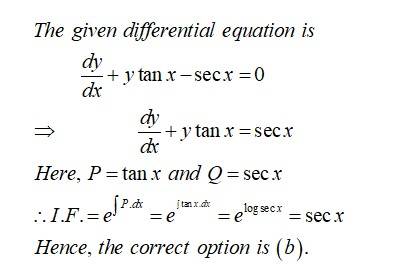
The integrating factor of the differential equation is:
(A) Cos
(B)
(C)
(D)
The integrating factor of the differential equation is:
(A) Cos
(B)
(C)
(D)
This is an Objective Type Questions as classified in NCERT Exemplar
Sol:
 Upvote

This is an Objective Type Questions as classified in NCERT Exemplar
Sol:
Upvote The degree of the differential equation is:
(A) 1
(B) 2
(C) 3
(D) 5
The degree of the differential equation is:
(A) 1
(B) 2
(C) 3
(D) 5
This is an Objective Type Questions as classified in NCERT Exemplar
Sol:
Upvote This is an Objective Type Questions as classified in NCERT Exemplar
Sol:
Upvote The differential equation represents:
(A) Family of hyperbolas
(B) Family of parabolas
(C) Family of ellipses
(D) Family of circles
The differential equation represents:
(A) Family of hyperbolas
(B) Family of parabolas
(C) Family of ellipses
(D) Family of circles
This is an Objective Type Questions as classified in NCERT Exemplar
Sol:
Upvote is the general solution of the differential equation:
(A)
(B)
(C)
(D)
is the general solution of the differential equation:
(A)
(B)
(C)
(D)
This is an Objective Type Questions as classified in NCERT Exemplar
Sol:
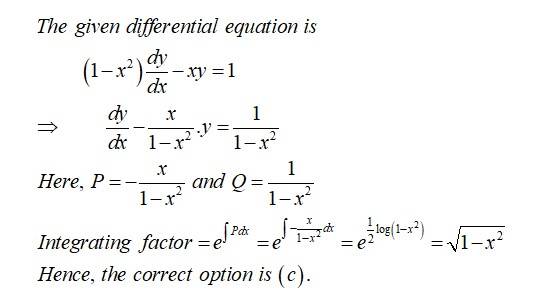
Upvote Integrating factor of the differential equation
(A)
(B)
(C)
(D)
Integrating factor of the differential equation
(A)
(B)
(C)
(D)
This is an Objective Type Questions as classified in NCERT Exemplar
Sol:
 Upvote
Which of the following is a second-order differential equation?
(A)
(B)
(C)
(D)
Which of the following is a second-order differential equation?
(A)
(B)
(C)
(D)
This is an Objective Type Questions as classified in NCERT Exemplar
Sol:
Upvote The number of solutions of when is:
(A) None
(B) One
(C) Two
(D) Infinite
The number of solutions of when is:
(A) None
(B) One
(C) Two
(D) Infinite
This is an Objective Type Questions as classified in NCERT Exemplar
Sol:
Upvote This is an Objective Type Questions as classified in NCERT Exemplar
Sol:
Upvote