Differential Equations

Get insights from 323 questions on Differential Equations, answered by students, alumni, and experts. You may also ask and answer any question you like about Differential Equations

  • 323

    Questions

  • 0

    Discussions

  • 0

    Active Users

  • 1

    Followers

Have a question about Differential Equations? Ask our experts

Ask Your Question

Keep it short & simple. Type complete word. Avoid abusive language.

New answer posted•a year ago
S
a year ago

This is a Short Answer Type Questions as classified in NCERT Exemplar

Sol:

Given  differential  equation  is  dydx+ay=emx∴    P=a  and  Q=emxIntegrating  factor  I.F=e∫Pdx=e∫a.dx=eax∴  Solution  of  the  equation  is       y×I.F.=∫Q.I.F.dx+c⇒y.eax=∫emx.eaxdx+c       ⇒y.eax=∫e(m+a)xdx+c⇒y.eax=e(m+a)x(m+a)+c      ⇒y=e(m+a)x(m+a).e−ax+c.e−ax∴           y=emx(m+a)+c.e−axHence,  the  required  value  is  y=emx(m+a)+c.e−ax.

Thumbs Up IconUpvote Thumbs Down Icon
New answer posted•a year ago
S
a year ago

This is a Short Answer Type Questions as classified in NCERT Exemplar

Sol:
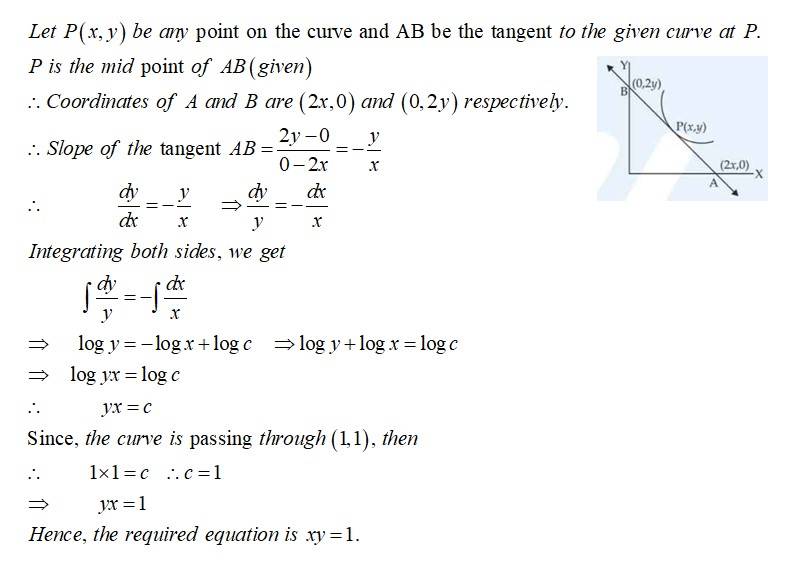
G i v e n     e q u a t i o n     i s     d y d x + 2 x y = y ⇒           d y d x = y − 2 x y           ⇒ d y d x = y ( 1 − 2 x )           ⇒ d y y = ( 1 − 2 x ) d x I n t e g r a t i n g     b o t h     s i d e s ,     w e     h a v e ∴     S o l u t i o n     o f     t h e     e q u a t i o n     i s               ∫ d y y = ∫ ( 1 − 2 x ) d x         ⇒ l o g y = x − 2 . x 2 2 + c ⇒ l o g y = x − x 2 + l o g c         ⇒ l o g y − l o g c = x − x 2 ⇒ l o g y c = x − x 2           ⇒ y c = e x − x 2 ∴ y = c . e x − x 2 H e n c e ,     t h e     r e q u i r e d     s o l u t i o n     i s     y = c . e x − x 2 .

Thumbs Up IconUpvote Thumbs Down Icon
New answer posted•a year ago
S
a year ago

This is a Short Answer Type Questions as classified in NCERT Exemplar

Sol:

G i v e n     d i f f e r e n t i a l     e q u a t i o n     i s     ( x 2 − 1 ) d y d x + 2 x y = 1 x 2 − 1 D i v i n d i n g     b y     ( x 2 − 1 ) , w e     g e t                 d y d x + x y x 2 − 1           ⇒ 1 ( x 2 − 1 ) 2 It  is  a  linear  differential  equation  of  first  order  and  first  degree. ∴         P = 2 x x 2 − 1     a n d     Q = 1 ( x 2 − 1 ) 2 I n t e g r a t i n g     f a c t o r     I . F = e ∫ P d x = e ∫ 2 x x 2 − 1 d x = e l o g ( x 2 − 1 ) = ( x 2 − 1 ) ∴     S o l u t i o n     o f     t h e     e q u a t i o n     i s               y × I . F . = ∫ Q . I . F . d x + c ⇒ y ( x 2 − 1 ) = ∫ 1 x 2 − 1 d x + c             ⇒ y ( x 2 − 1 ) = 1 2 l o g | x − 1 x + 1 | + c H e n c e ,     t h e     r e q u i r e d     v a l u e     i s     y ( x 2 − 1 ) = 1 2 l o g | x − 1 x + 1 | + c .

Thumbs Up IconUpvote Thumbs Down Icon
New answer posted•a year ago
S
a year ago

This is a Short Answer Type Questions as classified in NCERT Exemplar

Sol:

G i v e n     e q u a t i o n     i s     d y d x = e − 2 y ⇒             d y e − 2 y = d x           ⇒ e 2 y . d y = d x I n t e g r a t i n g     b o t h     s i d e s ,     w e     g e t           ∫ e 2 y . d y = ∫ d x           ⇒ 1 2 e 2 y = x + c P u t     y = 0     a n d     x = 5 ⇒ 1 2 e 2 y = 5 + c           ⇒ c = 1 2 − 5 = − 9 2 ∴ T h e     e q u a t i o n     b e c o m e s     1 2 e 2 y = x − 9 2 N o w     p u t t i n g     y = 3 ,     w e     g e t                                       1 2 e 6 = x − 9 2               ⇒ x = 1 2 e 6 + 9 2 H e n c e ,     t h e     r e q u i r e d     v a l u e     o f     x = 1 2 ( e 6 + 9 ) .

Thumbs Up IconUpvote Thumbs Down Icon
New question posted•a year ago
New answer posted•a year ago
S
a year ago

This is a Short Answer Type Questions as classified in NCERT Exemplar

Sol:

E q u a t i o n     o f     a l l     n o n     v e r t i c a l     l i n e s     a r e     y = m x + c D i f f e r e n t i a t i n g     w i t h     r e s p e c t     t o     x ,     w e     g e t     d y d x = m A g a i n     d i f f e r e n t i a t i n g     w . r . t .   x     w e     h a v e     d 2 y d x 2 = 0 H e n c e ,     t h e     r e q u i r e d     e q u a t i o n     i s     d 2 y d x 2 = 0 .

Thumbs Up IconUpvote Thumbs Down Icon
New answer posted•a year ago
S
a year ago

This is a Short Answer Type Questions as classified in NCERT Exemplar

Sol:

The  given  differential  equation  is             dydx=2y−x     ⇒dydx=2y2xSeparating  the  variables,  we  get    dy2y=dx2x     ⇒2−ydy=2−xdxIntegrating  both  sides,  we  get          ∫2−ydy=∫2−xdx                      −2−ylog2=−2−xlog2+c       ⇒−2−y=−2−x+clog2⇒               −2−y+2−x=clog2⇒               2−x−2−y=k             [where  clog2=k]

Thumbs Up IconUpvote Thumbs Down Icon
New answer posted•a year ago
S
a year ago

This is a Long Answer Type Questions as classified in NCERT Exemplar

Sol:

Given  that  xdydx=y(logy−logx+1)⇒                    xdydx=y[log(yx)+1]⇒                       dydx=yx[log(yx)+1]Since,  it  is  a    differential  equationSo,  put         y=vx        ⇒dydx=v+x.dvdx⇒       v+x.dvdx=vxx[log(vxx)+1]⇒          v+x.dvdx=v[logv+1]⇒                 x.dvdx=v[logv+1]−v     ⇒x.dvdx=v[logv+1−1]⇒                 x.dvdx=v.logv            ⇒dvvlogv=dxxIntegrating  both  sides,  we  have         ∫dvvlogv=∫dxxPut  logv=t  on  L.H.S.⇒      1vdv=dt∴         ∫dtt=∫dxx⇒    log|t|=log|x|+logc⇒    log|logv|=logxc           ⇒logv=xc⇒log(yx)=xcHence,  the  required  solution  is  log(yx)=xc.

Thumbs Up IconUpvote Thumbs Down Icon
New answer posted•a year ago
S
a year ago

This is a Long Answer Type Questions as classified in NCERT Exemplar

Sol:

Here,  slope  of  the    of  the  curve=dydxand  the  difference  between  the  abscissa  and  ordinate  =x−y.∴  As  per  the  condition,  dydx=(x−y)2Put  x−y=v        1−dydx=dvdx∴            dydx=1−dvdx∴  the  equation  becomes          1−dvdx=v2      ⇒dvdx=1−v2       ⇒dv1−v2=dxIntegrating  both  sides,  we  get              ∫dv1−v2=∫dx⇒12log|1+v1−v|=x+c          ⇒12log|1+x−y1−x+y|=x+c                  …(1)Since,  the  curve  is    through  (0,0),  then⇒12log|1+0−01−0+0|=0+c     ⇒c=0∴  On  putting  c=0  in  eq.(1)  we  get           12log|1+x−y1−x+y|=x       ⇒log|1+x−y1−x+y|=2x∴              1+x−y1−x+y=e2x⇒            (1+x−y)=e2x(1−x+y)Hence,  the  required  equation  is  (1+x−y)=e2x(1−x+y).

Thumbs Up IconUpvote Thumbs Down Icon