Integrals

Get insights from 366 questions on Integrals, answered by students, alumni, and experts. You may also ask and answer any question you like about Integrals

  • 366

    Questions

  • 0

    Discussions

  • 0

    Active Users

  • 0

    Followers

Have a question about Integrals? Ask our experts

Ask Your Question

Keep it short & simple. Type complete word. Avoid abusive language.

New question posted•a year ago
New answer posted•a year ago
S
a year ago

This is a Long Answer Type Questions as classified in NCERT Exemplar

Sol:

Let????I=?e?3xIIcos3xIdx????????????????=cos3x.?e?3x?dx??(D(cos3x).?e?3x?dx)dx????????????????=cos3x.e?3x?3??(3cos2x(?sinx).e?3x?3)dx????????????????=?13e?3xcos3x??cos2xsinx.e?3xdx????????????????=?13e?3xcos3x??(1?sin2x)sinx.e?3xdx????????????????=?13e?3xcos3x??sinx.e?3xdx+?sin3xI.e?3xIIdx????????????????=?13e?3xcos3x??sinx.e?3xdx+sin3x?e?3xdx??(D(sin3x).?e?3x?dx)dx????????????????=?13e?3xcos3x??sinx.e?3xdx+sin3x.e?3x?3??(3sin2x.cosx.e?3x?3)dx????????????????=?13e?3xcos3x??sinx.e?3xdx?13e?3xsin3x+?sin2xcosx.e?3xdx????????????????=?13e?3xcos3x??sinx.e?3xdx?13e?3xsin3x+?(1?cos2x)cosx.e?3xdx?????????????I=?13e?3xcos3x?[sinx.e?3x?3??cosx.e?3x?3dx]?13e?3xsin3x+?cosx.e?3xdx??cos3x.e?3xdx????????????????=?13e?3xcos3x+sinx.e?3x3??cosx.e?3x?3dx?13e?3xsin3x+?cosx.e?3xdx?I?????????2I=e?3x?3[cos3x+sin3x]?[sinx.e?3x3??cosx.e?3x?3dx]+?cosx.e?3xdx????????????????=e?3x?3[cos3x+sin3x]+13sinx.e?3x?13?cosx.e?3xdx+?cosx.e?3xdx????????2I=e?3x?3[cos3x+sin3x]+13sinx.e?3x+23?cosx.e?3xdxNow,?I1=23?cosxI.e?3xIIdx????????????????=23[cosx.?e?3xdx??(D(cosx).?e?3x?dx)dx]????????????????=23[cosx.e?3x?3???sinx.e?3x?3dx]????????????????=23[cosx.e?3x?3?13?sinx.e?3xdx]

=2?9cosx.e?3x?29?sinx.e?3xdx???????????I1=2?9cosx.e?3x?29[sinx.e?3x?3??cosx.e?3x?3dx]???????????I1=?29cosx.e?3x+227sinx.e?3x?227?cosx.e?3xdx???????????I1=?29cosx.e?3x+227sinx.e?3x?19.23?cosx.e?3xdx???????????I1=?29cosx.e?3x+227sinx.e?3x?19.I1I1+19I1=?29cosx.e?3x+227sinx.e?3x???????10I19=?29cosx.e?3x+227sinx.e?3x???????????I1=?110cosx.e?3x+115sinx.e?3xSo,?????2I=?13e?3x[sin3x+cos3x]+13sinx.e?3x?110cosx.e?3x+115sinx.e?3x?????????????I=?16e?3x[sin3x+cos3x]+16sinx.e?3x?120cosx.e?3x+130sinx.e?3x????????????????=?16e?3x[sin3x+cos3x]+15sinx.e?3x?120cosx.e?3x????????????????=e?3x24[sin3x?cos3x]+3e?3x40[sinx

...Read more

Thumbs Up IconUpvote Thumbs Down Icon
New answer posted•a year ago
S
a year ago

This is a Short Answer Type Questions as classified in NCERT Exemplar

Sol:

L e t         I = ∫ d x 1 + c o s x                                 = ∫ d x 2 c o s 2 x / 2                             [ ?     1 + c o s x = 2 c o s 2 x / 2 ]                                 = 1 2 ∫ s e c 2 x 2   d x = 1 2 . 2 t a n x 2 + C = t a n x 2 + C H e n c e ,     t h e     r e q u i r e d     s o l u t i o n     i s     t a n x 2 + C .

Thumbs Up IconUpvote Thumbs Down Icon
New answer posted•a year ago
S
a year ago

Consider, I=∫01tan−1(2x−11+x−x2)dx

⇒I=∫01tan−1(x−(1−x)1+x(1−x))dx⇒I=∫01[tan−1x−tan−1(1−x)]dx−−−−−(1)⇒I=∫01[tan−1(1−x)−tan−1(1−1+x)]dx⇒I=∫01[tan−1(1−x)−tan−1x]dx⇒I=∫01[tan−1(1−x)−tan−1(x)]dx−−−−−(2)

Adding (1) and (2), we get

⇒2I=∫01[tan−1x−tan−1(1−x)−tan−1(1−x)−tan−1x]dx⇒2I=0⇒I=0

Thus, the correct option is B.

Thumbs Up IconUpvote Thumbs Down Icon
New answer posted•a year ago
S
a year ago

Giver, f(a + bx) = f(x). _________ (1)

Let I =∫abx+(x)=∫ab(a+b−x)f(a+b−x)dx_____(2)

{?∫abf(x)dx=∫abf(a+b−x)dx.

=∫ab(a+b−x)f(x)dx. ___________ (3) {because Equation (1)}

+=∫ab[(a+b−x)f(x)+x f(x)] dx

⇒2I=∫ab(a+b−x+x)f(x)dx

⇒2I=∫ab(a+b)f(x)dx

⇒=a+b2∫abf(x)dx.

therefore, Option D is correct.

Thumbs Up IconUpvote Thumbs Down Icon
New answer posted•a year ago
S
a year ago

Let =∫cos2x dx(sinx+cosx)2

=∫cos2x−sin2x(sinx+cosx)2dx {?cos2x=cos2x−sin2x

=∫(cosx+sinx)(cosx−sinx)(sinx+cosx)2dx{?a2−b2=(x+b)(x−b)

=∫(cosx−sinx)sinx+cosx   .dx

=log|sinx+cosx|+c    {∫f′(x)f(x)dx=log|f(x)|+c

So, option B is correct.

Thumbs Up IconUpvote Thumbs Down Icon
New answer posted•a year ago

268. ∫dxex+e−x is Equal to

9 Views|Posted a year ago
Asked by Vishal Baghel
S
a year ago

Let =∫dxex+e−x

=∫dxex+1ex.=∫exdxex·ex+1

=∫exdxe2x+1

Putting ex = t

exdx = dt.

∴=∫dtt2+1.

= tan- 1 t + c

= tan- 1 (ex) + c

therefore, Option A is correct.

Thumbs Up IconUpvote Thumbs Down Icon
New answer posted•a year ago
S
a year ago

Let I=∫01e2−3xdx

We know that,

∫abf(x)dx=(b−a)limn→∞1n[f(a)+f(a+h)+...+f(a(n−1)h)]

Where, h=b−an

Here, a=0,b=1 and f(x)e2−3x

⇒h=1−0n=1n

∴∫01e2−3xdx=(1−0)limn→∞1n[f(0)+f(0+h)+...+f(0+(n−1)h)]

=limn→∞1n[e2+e2−3x+...+e2−3(n−1)h]=limn→∞1n[e2{1+e−3h+e−6h+e−9h+...+e−3(n−1)h}]=limn→∞1n[e2{1−(e−3h)n1−(e−3h)}]=limn→∞1n[e2{1−e−3nn1−e−3n}]=limn→∞1n[e2(1−e−3)1−e−3n]=e2(e−3−1)limn→∞1n[1e−3n−1]=limn→∞1n[e2(1−e−3)1−e−3n]=e2(e−3−1)limn→∞1n[1e−3n−1]

=e2(e−3−1)limn→∞(−13)[−3ne−3n−1]=e2(e−3−1)3limn→∞[−3ne−3n−1]=−e2(e−3−1)3(1)=−e−1+e23=13(e2−1e)

Thumbs Up IconUpvote Thumbs Down Icon
New answer posted•a year ago

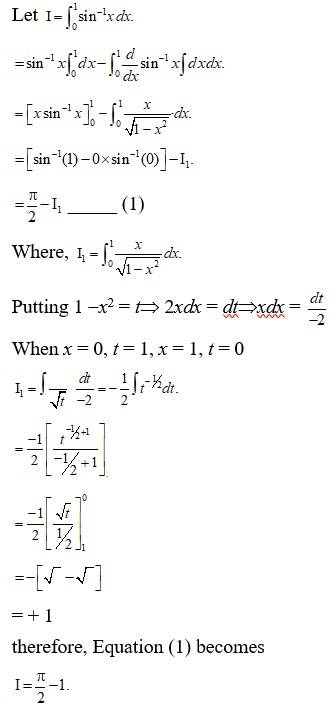
266. ∫01sin−1x dx.=π2−1

3 Views|Posted a year ago
Asked by Vishal Baghel
S
a year ago

Kindly go through the solution

Thumbs Up IconUpvote Thumbs Down Icon
New answer posted•a year ago

265. ∫0π4·2tan3x dx=1−log2

13 Views|Posted a year ago
Asked by Vishal Baghel
S
a year ago

Let I ∫0π4·2tan3x dx

=2∫0π4tan2xtanx dx

=2∫0π4(sec2x−1)tanx dx {?sec2x=tan2x+1}

=2∫0π4sec2xtanx dx−2∫0π4tan x dx

=2I1+2[log](cosx)0π4

=2I1+2[log(cosπ4)−log(cos0)]

=2I1+2(log1/√2
−log1)

=2I1+2(log·2−12−0)

I=2I1+2×(−12)log2=2I1−log2.____(1).

Where I1=∫0π4sec2xtanx dx

Let tan x = t =>sec2xdx = dt

When, x = 0, t = tan 0. = 0

x=π4,t=tanπ4=1

1=∫01t dt=[t22]01=12−0=12

So, Equation (1) becomes,

=2×12−log2

=1 - log 2.

...Read more

Thumbs Up IconUpvote Thumbs Down Icon