
Kinetic Theory
Get insights from 102 questions on Kinetic Theory, answered by students, alumni, and experts. You may also ask and answer any question you like about Kinetic Theory
- 102
Questions
- 0
Discussions
- 0
Active Users
- 0
Followers
Have a question about Kinetic Theory? Ask our experts
Keep it short & simple. Type complete word. Avoid abusive language.
We have 0.5 g of hydrogen gas in a cubic chamber of size 3cm kept at NTP. The gas in the chamber is compressed keeping the temperature constant till a final pressure of 100 atm. Is one justified in assuming the ideal gas law, in the final state? (Hydrogen molecules can be consider as spheres of radius 1 Ao ).
We have 0.5 g of hydrogen gas in a cubic chamber of size 3cm kept at NTP. The gas in the chamber is compressed keeping the temperature constant till a final pressure of 100 atm. Is one justified in assuming the ideal gas law, in the final state? (Hydrogen molecules can be consider as spheres of radius 1 Ao ).
This is a short answer type question as classified in NCERT Exemplar
Radius = 1Ao
Volume of hydrogen molecules = 4/3 r3
= 4/3 (3.14) (10-10)3 m3
Number of moles of H2 = mass/molecular mass=0.5/2=0.25
Molecules of H2 present = number of moles of H2 present
= 0.25
So volume of molecules present = mole
 Upvote

A gas mixture consists of molecules of types A, B and C with masses mA > mB > mC . Rank the three types of molecules in decreasing order of (a) average K.E., (b) rms speeds.
A gas mixture consists of molecules of types A, B and C with masses mA > mB > mC . Rank the three types of molecules in decreasing order of (a) average K.E., (b) rms speeds.
This is a short answer type question as classified in NCERT Exemplar
(a) The average KE will be the same

M= molar mass of the gas
m=mass of each molecular of the gas
R= gas constant
vrms
(b) k = Boltzmann constant
T= absolute temperature
mA>mB>mC
Vrms.A
Upvote The container shown in Fig. has two chambers, separated by a partition, of volumes V1 = 2.0 litre and V2= 3.0 litre. The chambers contain µ1 = 4.0and µ2 =5.2 moles of a gas at pressures p1= 1.00 atm and p2 = 2.00 atm. Calculate the pressure after the partition is removed and the mixture attains equilibrium.
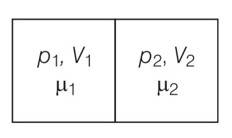
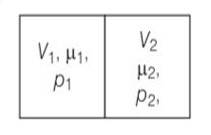
The container shown in Fig. has two chambers, separated by a partition, of volumes V1 = 2.0 litre and V2= 3.0 litre. The chambers contain µ1 = 4.0and µ2 =5.2 moles of a gas at pressures p1= 1.00 atm and p2 = 2.00 atm. Calculate the pressure after the partition is removed and the mixture attains equilibrium.


This is a short answer type question as classified in NCERT Exemplar
V1=2L ,V2=3L
µ1 = 4.0and µ2 =5.2
p1= 1.00 atm and p2 = 2.00 atm
p1V1= µ1RT1
p2V2= µ2RT2
when the partition is removed the gases get mixed without any loss of energy . the mixture now attains a common equilibrium pressure and total volume
Upvote Calculate the ratio of the mean free paths of the molecules of two gases having molecular diameters 1Å and 2 Å . The gases may be considered under identical conditions of temperature, pressure and volume.
Calculate the ratio of the mean free paths of the molecules of two gases having molecular diameters 1Å and 2 Å . The gases may be considered under identical conditions of temperature, pressure and volume.
This is a short answer type question as classified in NCERT Exemplar
Mean free path l=1/
So n= number of molecules /volume
d = diameter of the molecule
l
d1=1Ao, d2=2Ao
l
l1:l2=4:1
Upvote A gas mixture consists of 2.0 moles of oxygen and 4.0 moles of neon at temperature T. Neglecting all vibrational modes, calculate the total internal energy of the system. (Oxygen has two rotational modes.)
A gas mixture consists of 2.0 moles of oxygen and 4.0 moles of neon at temperature T. Neglecting all vibrational modes, calculate the total internal energy of the system. (Oxygen has two rotational modes.)
This is a short answer type question as classified in NCERT Exemplar
Oxygen gas having 5 degrees of freedom
Energy per mole of the gas =5/2RT
For 2 moles of the gas total internal energy =2 5/2RT=5RT
Neon is a monoatomic gas having 3 degrees of freedom
Energy per mole =3/2RT
We have 4 moles of Ne
Energy =
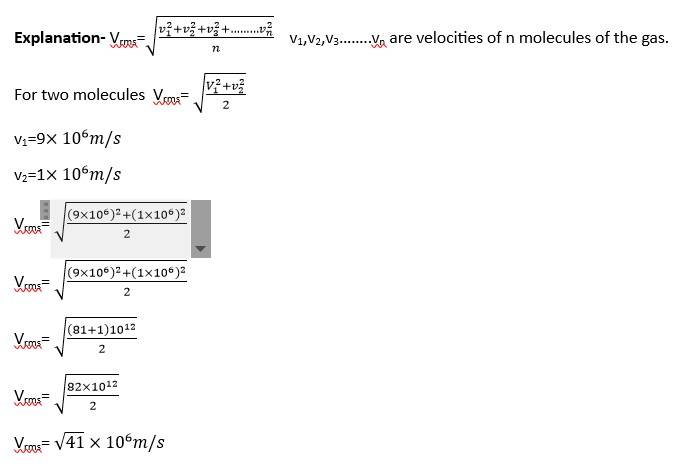
Upvote Two molecules of a gas have speeds of 9 x 10⁶ m s-1 and 1 x 10⁶ ms−1 , respectively. What is the root mean square speed of these molecules.
Two molecules of a gas have speeds of 9 x 10⁶ m s-1 and 1 x 10⁶ ms−1 , respectively. What is the root mean square speed of these molecules.
This is a short answer type question as classified in NCERT Exemplar
Upvote The molecules of a given mass of a gas have root mean square speeds of 100ms-1 at 27 C° and 1.00 atmospheric pressure. What will be the root mean square speeds of the molecules of the gas at 127°C and 2.0 atmospheric pressure?
The molecules of a given mass of a gas have root mean square speeds of 100ms-1 at 27 C° and 1.00 atmospheric pressure. What will be the root mean square speeds of the molecules of the gas at 127°C and 2.0 atmospheric pressure?
This is a short answer type question as classified in NCERT Exemplar
Vrms=
Vrms=
T1=27oC= 27+273=300K
T2=127oC= 127+273= 400K
Vrms2=
Upvote The volume of a given mass of a gas at 27°C, 1 atm is 100 cc. What will be its volume at 327°C?
The volume of a given mass of a gas at 27°C, 1 atm is 100 cc. What will be its volume at 327°C?
This is a short answer type question as classified in NCERT Exemplar
V
V/T = constant
T1=273+27=300K
T2= 273+327= 600K
V1= 100cc
V2=V1 (600/300)
V2=2V1
V2= 2 (100)=200cc
Upvote <p><strong>The volume of a given mass of a gas at 27°C, 1 atm is 100 cc. What will be its volume at 327°C?</strong></p>
Calculate the number of atoms in 39.4 g gold. Molar mass of gold is 197g mole-1.
Calculate the number of atoms in 39.4 g gold. Molar mass of gold is 197g mole-1.
This is a short answer type question as classified in NCERT Exemplar
molar mass = mass of avogadro’s number of atoms= 6.023 atoms.
197 g of gold contains =6.023
1g of gold contain= atoms
39.4 g of gold atoms = atoms
Upvote