
Kinetic Theory
Get insights from 102 questions on Kinetic Theory, answered by students, alumni, and experts. You may also ask and answer any question you like about Kinetic Theory
- 102
Questions
- 0
Discussions
- 0
Active Users
- 0
Followers
Have a question about Kinetic Theory? Ask our experts
Keep it short & simple. Type complete word. Avoid abusive language.
The average translational kinetic energy of N2 gas molecules at_________°C becomes equal to the K.E. of an electron accelerated from rest through a potential difference of 0.1 volt. (Given kB = 1.38 × 10⁻²³ J/K) (Fill the nearest integer).
The average translational kinetic energy of N2 gas molecules at_________°C becomes equal to the K.E. of an electron accelerated from rest through a potential difference of 0.1 volt. (Given kB = 1.38 × 10⁻²³ J/K) (Fill the nearest integer).
K.E. energy of electron = eV
Translational K.E. of N2 =
So eV =
T = 773 – 273 = 500°C
 Upvote

Consider a mixture of gas molecule of types A, B and C having masses mA < mB < mC. The ratio of their root mean square speeds at normal temperature and pressure is:
Consider a mixture of gas molecule of types A, B and C having masses mA < mB < mC. The ratio of their root mean square speeds at normal temperature and pressure is:
As we know that root mean square speed is given as
Upvote Which of the following graphs represent the behaviour of an ideal gas? Symbol have their usual meaning.
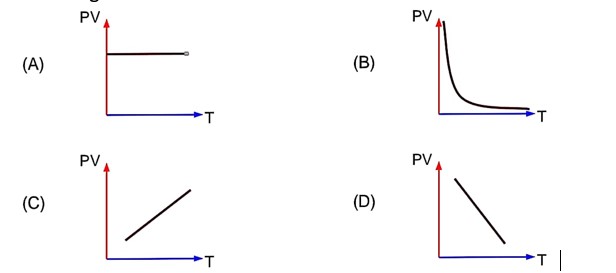
Which of the following graphs represent the behaviour of an ideal gas? Symbol have their usual meaning.
According to ideal gas law we know that
PV = nRT
Upvote The average translational kinetic energy of N2 gas molecules at_________°C becomes equal to the K.E. of an electron accelerated from rest through a potential difference of 0.1 volt. (Given kB = 1.38 × 10⁻²³ J/K) (Fill the nearest integer).
The average translational kinetic energy of N2 gas molecules at_________°C becomes equal to the K.E. of an electron accelerated from rest through a potential difference of 0.1 volt. (Given kB = 1.38 × 10⁻²³ J/K) (Fill the nearest integer).
K.E. energy of electron = eV
Translational K.E. of N2 =
So eV =
T = 773 – 273 = 500°C
Upvote If the rms speed of oxygen molecules at 0°C is 160 m/s, find the rms speed of hydrogen molecules at 0°C.
If the rms speed of oxygen molecules at 0°C is 160 m/s, find the rms speed of hydrogen molecules at 0°C.
Same gas is filled in two vessels of the same volume at the same temperature. If the ratio of the number of molecules is 1 : 4, then
(A) The r.m.s. velocity of gas molecules in two vessels will be the same.
(B) The ratio of pressure in these vessels will be 1 : 4.
(C) The ratio of pressure will be 1 : 1.
(D) The r.m.s. velocity of gas molecules in two vessels will be 1 : 4.
Choose the correct answer form the options given below:
The root mean square speed of smoke particles of mass 5 × 10-17kg in their Brownian motion in air at NTP is approximately. [Given k = 1.38 × 10⁻²³ JK-1]
The root mean square speed of smoke particles of mass 5 × 10-17kg in their Brownian motion in air at NTP is approximately. [Given k = 1.38 × 10⁻²³ JK-1]
m = 5 × 10-17kg ; k = 1.38 × 10⁻²³ Jk-1
Upvote