Limits and Derivatives

Get insights from 93 questions on Limits and Derivatives, answered by students, alumni, and experts. You may also ask and answer any question you like about Limits and Derivatives

  • 93

    Questions

  • 0

    Discussions

  • 0

    Active Users

  • 0

    Followers

Have a question about Limits and Derivatives? Ask our experts

Ask Your Question

Keep it short & simple. Type complete word. Avoid abusive language.

New answer posted•a year ago
S
a year ago

x + 1 − 2 l o g 2 ( 3 + 2 x ) + 2 l o g 4 ( 1 0 − 2 − x ) = 0

x + 1 + l o g 2 [ 1 0 . 2 x − 1 ( 3 + 2 x ) 2 ] − x = 0

( 2 x ) 2 − 1 4 . 2 x + 1 1 = 0

2x + y

x 1 + x 2 = l o g 2 ( 4 9 − 1 5 2 4 )

x 1 + x 2 = l o g 2 1 1

Thumbs Up IconUpvote Thumbs Down Icon
New answer posted•a year ago
S
a year ago

(i) f(x)=sin x cos x

So, f?(x)=limh?0f(x+h)?f(x)h

=limh?0sin(x+h)cos(x+h)?sinxcosxh

=limh?012h×[2sin(x+h)cos(x+h)?2sinxcosx]

=limh?012h[sin2(x+h)?sin2x]

=limh?012h[2cos2(x+h)+2x2sin2(x+h)?2x2]

=limh?01h[cos(2x+h)sinh]

=limh?0cos(2x+h)×limh?0sinhh

=cos(2x+0)

=cos2x

(ii) f(x)=secx

So, f?(x)=limh?0f(x+h)?f(x)h

=limh?01h[sec(x+h)?secx]

=limh?01h[1cos(x+h)?1cosx]

=limh?01h[cosx?cos(x+h)cos(x+h)cosx]

=limh?01h[?2sin(x+x+h2)sin(x?(x+h)2)cos(x+h)cosx]

=limh?01h[?2sin(2x+h2)sin(?h/2)cos(x+h)cosx]

=limh?0(?1sin(2x+h2)cos(x+h)cosx×limh?0(?1)sinh/2h/2

=sinxcosx?cosx×1

=tanx?secx.

(iii) Given f(x)=5 sec x+4 cosx.

So, f?(x)=limh?0f(x+h)?f(x)h

=limh?05sec(x+h)+4cos(x+h)?[5secx+4cosx]h.

=limh?05h[sec(x+h)?secx]+limh?04h[cos(x+h)?cosx]

=limh?05h[1cos(x+h)?1cosx]+limh?04h[?2sin(x+h+x2)sin(x+h?x2)]

=limh?05h[cosx?cos(x+h)cos(x+h)(cosx)]+limh?04h[?2sin(2x+h2)sinh2]

=limh?05h[?2sin(2x+h2)sin(?h/2)cos(x+h)cosx]?4limh?0sin(2x+h2)limh?0sinh/2h/2

=sin(2x+02)cos(x+0)cosx×1?4sin(2x2)

=5sinxcosx?1cosx?4sinx

=5tanx?secx?4sinx

(iv) Given f(x)=cosecx

f?(x)=limh?0f(x+h)?f(x)h

=limh?01h[cosec(x+h)?cosecx]

=limh?01h[1sin(x+h)?1sinx]

=limh?01h[sinx?sin(x+h)sin(x+h)sinx]

=limh?01h[2cos(x+x+h2)sin(x?(x+h)2)]sin(x+h)sinx]

=limh?01h[2cos(x+x+h2)sin(x?(x+h)2)sin(x+h)sinx]

=limh?01h[2cos(2x+h2)sin(?h/2)]sin(x+h)sinx]

=limh?0cos(2x+h2)sin(x+h)sinx×(?1)sin(2)h/2)

=cos(2x+02)sin(x+0)sinx×(?1)

=?cosxsinx×1sinx

=?cotx?cosecx

(v) Given,f(x)=3 cot x+5cosecx.

So, f?(x)=limh?0f(x+h)?f(x)h =2cos(x+0)cosx×1+7sin(2x+02)×(?1)

=limh?03cot(x+h)+5cosec(x+h)?[3cotx+5cosx)

h?03h[cot(x+h)?cotx]+limh?0

=?5h[cosec(x+h)?cosecx]

=limh?03h[cos(x+h)sin(x+h)?cosxsinx]+limh?05h[1sin(x+h)?1sinx]

=limh?03h[cos(x+h)sinx?cosxsin(x+h)sin(x+h)sinx]+limh?05h[sinx?sin(x+h)sin(x+h)sinx]

=limh?03h[sin(x?(x+h))sin(x+h)sinx+limh?05h[2cos(x+x+h2)sin(x?(x+h)2)sin(x+h)sinx

=limh?03sin(x+h)sinx×limh?0(?1)sinhh+limh?05h[2cos(2x+h2)sin(?h/2)sin(x+h)sinx

=3sinx?sinx×(?1)+5limh

...Read more

Thumbs Up IconUpvote Thumbs Down Icon
New answer posted•a year ago
S
a year ago

29.

Given, f (x) = (x-a1) (x-a2)… (x-an)

So,  limx→a1f (x)=limx→a1 (x−a1)limx→a1 (x−a2)? limx→a1 (x−an)

= (a1-a1) (a1-a2) … (a1-an)

= 0 (a1-a2) … (a1-an)

 = 0

And limx→af (x)=limx→a (x−a1)limx→a (x−a2)…limx→a (x−an)

= (a-a1) (a-a2) … (a-an)

Thumbs Up IconUpvote Thumbs Down Icon
New answer posted•a year ago
S
a year ago

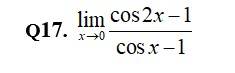
17. Kindly go through the solution

==limx→02sin2x2sin2x2

=limx→0 (sinxx)2×x2limx→0 (sinx2x2)2x22

= (1)2×x2×4 (1)2×x2

= 4

Thumbs Up IconUpvote Thumbs Down Icon
New answer posted•a year ago
S
a year ago

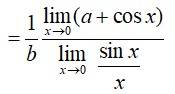
18.  limx? 0ax+xcosxbsinx=limx? 0x (a+cosx)bsinx

=1b* (a+cos0)1

=a+1b

Thumbs Up IconUpvote Thumbs Down Icon
New answer posted•a year ago
S
a year ago

73. Given, f (x) = xsinnx

So, f?(x) = (sinxxdxdx)−(xddxsinxx)(sinxx)2

= sinxx−x·n(sinx)x−1ddxsinx(sinx)2x

=(sinx)n−x·x(sinx)n−1·cosx(sinx)2n

=(sinx)n−1[sinx−nx·cosx](sinx)2n

=sinx−n·x·cosx(sinx)2n−(n−1)

=sinx−nxcosx(sinx)n+1

Thumbs Up IconUpvote Thumbs Down Icon
New answer posted•a year ago
S
a year ago

72. Given, f (x) = (x + sec x) (x tan x)

So, f?(x) = (x + see x) ddx(x−tanx)+(x−tanx)ddx(x+secx).

=(x+secx)(dxdx−ddxtanx)+(x−tanx)(dxdx+ddxsecx)

Let g(x) = tan x.

So, g?(x) =


=limh→01h[tan(x+h)−tanx]

=limh→01h[sin(x+h)cos(x+h)−sinxcosx]

=limh→01h[sin(x+h)cosx−sinxcos(x+h)cos(x+h)cosx]

=limh→01h[sin(x+h−x)cos(x+h)cosx]

=limh→01cos(x+h)cosx×limh→0sinhh


=1cos2x=sec2x . _____ (2)

And P(x) = see x.

=limh→0sec(x+h)−secxh

=limh→01h[1cos(x+h)−1cosx]

=limh→01h[cosx−cos(x+h)cos(x+h)cosx]

=limh→01h[−2sin(x+x+h2)sin(x−(x+h)2)cos(x+h)cosx]


=sinxcos2x = tan x sec x. ____ (3)

   Putting (2) and (3) in (1) we get,

   f?(x) = (x + sec x) (1 - sec2x) + (x- tan x) (1 + tan x

...Read more

Thumbs Up IconUpvote Thumbs Down Icon
New answer posted•a year ago
S
a year ago

71. Given, f (x) = x1+tanx

=x1+sinxcosx

=cosx·xcosx+sinx

So,f′(x)=(cosx+sinx)ddx(x⋅cosx)−(x⋅cosx)ddx(cosx+sinx)(cosx+sinx)2


=(cosx+sinx)(−xsinx+cosx)−(−x·sinxcosx+xcos2x)(cosx+sinx)2

=−xcosxsinx+cos2x−xsin2x+sinxcosx+xsinxcosx−xcos2x(cosx+sinx)2

=cos2x+sinxcosx−x(sin2x+cos2x)(cosx+csinx)2

Dividing numerator and denominator by cos2x we get,
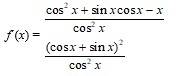
=cos2xcos2x+sinxcosx·cosxcosx−x1cos2x(cosxcosx+sinxcosx)2

=1+tanx−xsec2x(1+tanx)2

Thumbs Up IconUpvote Thumbs Down Icon
New answer posted•a year ago
S
a year ago

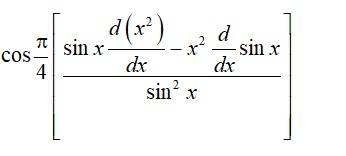
 70. Given, f (x) = x2cos (π4)sinx

=x2sinx×cosπ4

So, f? (x) =


=cosπ4 [2·xsinx−x2cosxsin2x]

=xcosπ4 [2sinx−xcosxsin2x].

Thumbs Up IconUpvote Thumbs Down Icon
New answer posted•a year ago
S
a year ago

69. Given, f (x) = 4x+5sinx3x+7cosx

So,

f′(x)=(3x+7cosx)ddx(4x+5sinx)−(4x+5sinx)ddx(3x+7cosx)(3x+7cosx)2

=(3x+7cosx)(4x+5cosx)−(4x+5sinx)(3−7sinx)(3x+7cosx)2

=x+x  x+x+x−x+x  x− x+ 35 sin2x_                                                      ( 3x+7 cosx)2

=15xcosx+28cosx+28xsinx−15sinx+35(cos2x+sin2x)(3x+7cosx)2

=35+15xcosx+28cosx+28xsinx−15sinx(3x+7cosx)2

Thumbs Up IconUpvote Thumbs Down Icon