Limits and Derivatives

Get insights from 93 questions on Limits and Derivatives, answered by students, alumni, and experts. You may also ask and answer any question you like about Limits and Derivatives

  • 93

    Questions

  • 0

    Discussions

  • 0

    Active Users

  • 0

    Followers

Have a question about Limits and Derivatives? Ask our experts

Ask Your Question

Keep it short & simple. Type complete word. Avoid abusive language.

New answer posted•a year ago
S
a year ago

58. Given f (x) = cosec x. cot x.

By Leibnitz product rule,

So, g(x) = limh→0g(x+h)−g(x)h

=limh→0cot(x+h)−cotxh

=limh→01h[cos(x+h)sin(x+h)−cosxsinx]

=limh→01h[sinxcos(x+h)−cosxsin(x+h)sinxsin(x+h)]

=limh→01h[sin(x−(x+h))sinxsin(x+h)] [?csin (A−B)=sinAcosB−cosAsinB]

=limh→01h  [sin (−h)sin x. sin (x+h)]

=limh→01sinxsin(x+h)×(−1)limh→0sinhh

=1sinxsin(x+0)×(−1)

= -cosec2x.______(2)

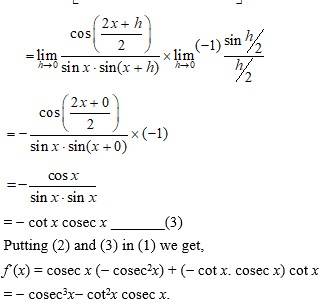
And hx) = limh→0h(x+h)−h(x)h

=limh→0cosec(x+h)−cosecxh

=limh→01h[1sin(x+h)−1sinx]

=limh→01h[sinx−sin(x+h)sinx·sin(x+h)]

=limh→01h[2cos(x+x+h2)sin(x−(x+h)2)sinxsin(x+h).]

Thumbs Up IconUpvote Thumbs Down Icon
New answer posted•a year ago
S
a year ago

57. Given, f (x) = sin (x + a)

So, f (x) = limh→0f (x+h)−f (x)h

=limh→0sin (x+h+a)−sin (x+a)h

=limh→01h·2  cos (x+h+a+x+a2)sin (x+h+a− (x+a)2)

=limh→0cos (2x+2a+h2)limh→0sin (h2)h2

=cos (2x+2a+0)2×1

= cos (x + a)

Thumbs Up IconUpvote Thumbs Down Icon
New answer posted•a year ago
S
a year ago

56. Given, f (x) = (ax + b)n (cx + d)m

So, f’(x) = (ax+b)nddx(cx+d)n+(cx+d)mddx(ax+b)n

=(ax+b)x·mc(cx+d)m−1+(cx+d)mna(ax+b)x−1

=(ax+b)n−1(cx+d)m−1[(ax+b)·mc+(cx+d)na]

=(ax+b)n−1(cx+d)m−1[mc(ax+b)+na(cx+d)]

Thumbs Up IconUpvote Thumbs Down Icon
New answer posted•a year ago
S
a year ago

55. Given, f (x) = (ax + b)n

Chain rule,  ddxu (x)n=nu (x)n−1dudxu (x) where

u (x) is a function of x.

So, f (x) = ddx (ax+b)n

=n (ax+b)n−1ddx (ax+b)

=na (ax+b)n−1

Thumbs Up IconUpvote Thumbs Down Icon
New answer posted•a year ago
S
a year ago
54. 

So f? (x) = ddx (4−2)

=ddx (4)−ddx (2)

=4ddx (x12)−0=4×12x12−1=2x−12=2


Thumbs Up IconUpvote Thumbs Down Icon
New answer posted•a year ago
S
a year ago

53. Given, f (x) = =ax4−bx+cosx

So, f(x) = limh→0f(x+h)−f(x)h

=limh→01h[a(x+n)4−b(x+h)2+cos(x+h)−(ax4−bx2+cosx)]

=limh→0  ah  [1(x+h)4−1x4]−limh→0bh[1(x+h)2−1x2]+limh→01h[cos(x+h)−cosx]

=limh→0ah[x4−(x+h)4(x+h)4·x4]−limh→0bh[x2−(x+h)2(x+h)2·x2]+

limh→01h[−2sin(x+h+x2)sin(x+h−x2)]

=limh→0ah[x4−x4−4x3h−6x2h2−4xh3−h3x4·(x+h)4]−limh→0bh[x2−x2−h2−2xhx2(x+h)2]

+limh→0ah[−2sin(2x+h2)sinh2]

=limh→0ah[h(−4x3−6x2h−4xh2−h2)x4(x+h)4]−limh→0  bh   [h(−h−2x)x2(x+h)2]

−limh→0sin(2x+h2)limh→0sinh2h2

=limh→0a(−4x3−6x2h−4xh2−h2)x4(x+h)4−limh→0b(−h−2x)x2(x+h)2

sin(2x+02)×1

=a(−4x3)x4·x4−b(−2x)x2·x2−sinx.

=−4ax5+2bx3−sinx

Thumbs Up IconUpvote Thumbs Down Icon
New answer posted•a year ago
S
a year ago

52. Given, f (x) = px2+qx+rax+b

f′(x)=(ax+b)ddx(px2+qx+r)−(px2+qx+r)ddx(ax+b)(ax+b)2

=(ax+b)(2xp+q)−(px2+qx+r)(a)(ax+b)2

=2apx2+2bpx+aqx+bq−apx2−aqx−ar(ax+b)2

=apx2+2bpx+bq−ar(ax+b)2

Thumbs Up IconUpvote Thumbs Down Icon
New answer posted•a year ago
S
a year ago

51. Given, f (x) = (ax+b)px2+qx+r

So, f(x) = (px2+qx+r)ddx(ax+b)−(ax+b)ddx(px2+qx+r)(px2+qx+r)2

 =(px2+qx+r)a−(ax+b)(2xp+q)(px2+qx+r)2

=apx2+aqx+ar−2apx2−aqx−2bpx−b(px2+qx+9)2q.

=− apx2−2bpx+ar−bq(px2+qx+r)2

Thumbs Up IconUpvote Thumbs Down Icon
New answer posted•a year ago
S
a year ago

48. Given, f (x) = 1ax2+bx+c

So, f? (x) =  (ax2+bx+c)ddx (1)−1·ddx (ax2+bx+c) (ax2+bx+c)2

= (ax2+bx+c) (0)− (2ax+b) (ax2+bx+c)2

=− (2ax+b) (ax2+bx+c)2

Thumbs Up IconUpvote Thumbs Down Icon
New answer posted•a year ago
S
a year ago

49. Given, f (x) = 1+1x1−1x=x+1xx−1x=x+1x−1

So, f (x) =  (x−1)ddx (x+1)− (x+1)ddx (x−1) (x−1)2

=  (x−1)− (x+1) (x−1)2

=x−1−x−1 (x−1)2=−2 (x−1)2

Thumbs Up IconUpvote Thumbs Down Icon