
Limits and Derivatives
Get insights from 93 questions on Limits and Derivatives, answered by students, alumni, and experts. You may also ask and answer any question you like about Limits and Derivatives
- 93
Questions
- 0
Discussions
- 0
Active Users
- 0
Followers
Have a question about Limits and Derivatives? Ask our experts
Keep it short & simple. Type complete word. Avoid abusive language.
Let [t] denote the greatest integer ≤ t. If for some λ ∈ R – {0,1}, lim(x→0) |1-x+|x / (λ−x+[x]) = L, then L is equal to:
<!-- [if !supportLineBreakNewLine]-->
<!--[endif]-->
Let [t] denote the greatest integer ≤ t. If for some λ ∈ R – {0,1}, lim(x→0) |1-x+|x / (λ−x+[x]) = L, then L is equal to:
<!-- [if !supportLineBreakNewLine]-->
<!--[endif]-->
LHL : lim_ (x→0? ) |1-x-x|/|λ-x-1| = 1/|λ-1|
RHL: lim_ (x→0? ) |1-x+x|/|λ-x+0| = 1/|λ|
For existence of limit
LHL = RHL
⇒ 1/|λ-1| = 1/|λ| ⇒ λ = 1/2
∴ L = 1/|λ| = 2
 Upvote

lim(x→0) (tan(π/4 + x))¹/? is equal to
<!-- [if !supportLineBreakNewLine]-->
<!--[endif]-->
lim(x→0) (tan(π/4 + x))¹/? is equal to
<!-- [if !supportLineBreakNewLine]-->
<!--[endif]-->
lim (x?0) (tan (? /4+x)¹/? = e^ (lim (x?0) (tan (? /4+x)-1)/x)
= e^ (lim (x?0) (2tanx/ (1-tanx)/x) = e².
Upvote If lim(x→1) (x+x²+x³+.+xⁿ-n)/(x-1) = 820, (n∈N) then the value of n is equal to.
If lim(x→1) (x+x²+x³+.+xⁿ-n)/(x-1) = 820, (n∈N) then the value of n is equal to.
lim (x→1) (x+x²+.+x? -n)/ (x-1) = 820
⇒ lim (x→1) (x-1)/ (x-1)+ (x²-1)/ (x-1)+.+ (x? -1)/ (x-1) = 820
⇒ 1+2+.+n = 820
⇒ n (n+1)=2×820
⇒ n (n+1)=40×41
Since n∈N, so n=40
Upvote Let m and M be respectively the minimum and maximum values of |cosx, 1+sin²x, sin2x; 1+cos²x, sin²x, sin2x; cos²x, sin²x, 1+sin2x|. Then the ordered pair (m,M) is equal to:
<!-- [if !supportLineBreakNewLine]-->
<!--[endif]-->
Let m and M be respectively the minimum and maximum values of |cosx, 1+sin²x, sin2x; 1+cos²x, sin²x, sin2x; cos²x, sin²x, 1+sin2x|. Then the ordered pair (m,M) is equal to:
<!-- [if !supportLineBreakNewLine]-->
<!--[endif]-->
Determinant = -2-sin2x. Max -1, min -3. (m, M)= (-3, -1).
Upvote The derivation of tan?¹((√(1+x²)-1)/x) with respect to tan?¹((2x√(1-x²))/(1-2x²)) at x=1/2 is:
<!-- [if !supportLineBreakNewLine]-->
<!--[endif]-->
The derivation of tan?¹((√(1+x²)-1)/x) with respect to tan?¹((2x√(1-x²))/(1-2x²)) at x=1/2 is:
<!-- [if !supportLineBreakNewLine]-->
<!--[endif]-->
Let x = tanθ
y? = tan? ¹ (secθ-1)/tanθ) = tan? ¹ (tan (θ/2) = θ/2 = (1/2)tan? ¹x
x = sinφ, y? = tan? ¹ (2sinφcosφ)/cos2φ)
= tan? ¹ (tan2φ) = 2φ = 2sin? ¹x
dy? /dy? = (dy? /dx)/ (dy? /dx) = (1/2) (1/ (1+x²) / (2/√ (1-x²)
= (√ (1-x²) / (4 (1+x²) = (√ (1-1/4) / (4 (1+1/4) = √3 / 10
Upvote lim (x→0) (e^ (√ (1+x²+x? )-1)/x - 1) / ( (√ (1+x²+x? )-1)/x )
put (√ (1+x²+x? )-1)/x = t
clearly x→0 ⇒ t→0
∴ given limit = lim (t→0) (e? -1)/t = 1
Upvote Let lim (x→0) [ (3x²+2)/ (7x²+2)]^ (1/x²) = e^ [lim (x→0) (1/x²) * (3x²+2)/ (7x²+2) - 1)] =
e^ [lim (x→0) (1/x²) * (-4x²)/ (7x²+2)] = e^ (-4/2) = e? ²
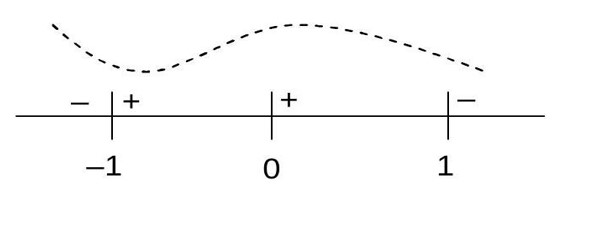
Upvote Let be a polynomial of degree 5 such that are its critical points. If , then which one of the following is not true?
Let be a polynomial of degree 5 such that are its critical points. If , then which one of the following is not true?
Minima at
Maxima at
Upvote If exists and is equal to b, then the value of a – 2b is…….
If exists and is equal to b, then the value of a – 2b is…….
use of L’ Hospital rule implies
a – 2b = 4 – (1) = 5
Upvote Let f : R ® R be defined as f(x) = <!-- [if gte mso 9]><xml>
Let f : R ® R be defined as f(x) = <!-- [if gte mso 9]><xml>
f : R -> R.
As f is continuous at x = 0
Upvote